
(Version française disponible ici.)
During the pandemic, remote work became much more common for employees, including many public servants, whose jobs could be done from home. As public-health pressures eased, governments began to reconsider what role remote and hybrid work should play over the longer term. Governments have made different choices and have not converged on a single return-to-office (RTO) model for public servants.
The federal government and some provinces are increasing in-office requirements, in some cases moving toward full-time or near-full-time attendance. Others are maintaining hybrid arrangements, while some have not set out a clear government-wide minimum in-office requirement. The result is a patchwork of return-to-office policies for public services across Canada.
We have mapped those choices, and the variations are clear. The reasons behind them less so. Public announcements do not always explain why governments have chosen one approach over another or whether they have considered the wider effects.
This matters because return-to-office policies interact with a much broader set of policy objectives than workplace management alone.
Work location is no longer simply an operational decision. For many workers, it has become part of the employment bargain. RTO policies can influence governments’ ability to recruit and retain workers.
These policies also interact with the wider labour market and can impact fiscal, transportation and equity objectives. Decisions about where public servants work must balance multiple priorities rather than optimizing a single outcome.
Remote work changed the employment bargain
Although relatively uncommon before the pandemic, remote and hybrid work arrangements have since become regular features of many office-based jobs. Statistics Canada estimates about 7.2 per cent of Canadian workers worked most of their hours from home in early 2020, before the pandemic. By April 2020, that share had reached 41.1 per cent. The way Statistics Canada measures work location has since changed and hence is not directly comparable, but recent data shows working from home remains common. By May 2026, 11.4 per cent of employed Canadians worked exclusively from home and another 9.8 per cent had a hybrid arrangement.
Remote and hybrid work are especially relevant to the public sector. In February 2024, 47.4 per cent of workers in public administration worked from home at least some of the time, either exclusively or through a hybrid arrangement.
Prepare to give workers more say in back-to-office plans: survey
It’s delivery time | The Functionary
What problem are return-to-office mandates meant to solve?
What return-to-office mandates mean for women in the workforce
For many workers whose jobs can be performed remotely, work location has become part of the employment bargain. The value of a job is determined not only by pay but also by working conditions such as flexibility, work schedules and commuting time and costs. Economists refer to these non-monetary characteristics as job amenities. In a hiring experiment in the U.S., researchers found that applicants were willing, on average, to accept eight-per-cent lower pay for the option to work from home.
Work location can also affect whether employees stay in a job. A randomized experiment in Nature found that employees working from home two days a week reported higher job satisfaction and were one-third less likely to quit without reductions in performance or promotion rates.
The evidence does not point to a single best arrangement. Different jobs require different levels of in-person collaboration, supervision and service delivery. What it does show, though, is that work location has become something workers and employers value differently. Changing it changes an important condition of employment.
Return-to-office policies do more than restore the pre-pandemic norm. Governments are deciding which mix of remote and in-person work best fits different jobs and public-service objectives. They are also making choices that reach beyond internal workplace management. These decisions can affect recruitment and retention, commuting and public transit, office space and public finances, emissions, accessibility, caregiving and gender equality. They can also shape how public services are managed and delivered. Statistics Canada’s research has already linked the growth of remote work to reduced commuting, lower public-transit use and likely reductions in transportation emissions.
Return-to-office policies vary across Canadian jurisdictions
At the federal level, minimum in-office requirements have progressively increased since the pandemic:
- 2023: hybrid model, with two to three days in the office;
- 2024: standardized at three days for most employees and four days for executives;
- 2026: tightened to four days for most employees and five days for executives.
The provinces have not followed a common path. From late 2024 onward, several provinces changed their RTO policies in different ways.
Figure 1 shows when and how RTO policies have evolved in jurisdictions that made changes over the last two years.
Other provinces did not change their minimum in-office requirements during the period examined. Three provinces with hybrid models have kept them unchanged: British Columbia and New Brunswick, where policies have some flexibility, and Manitoba, where three days a week in-office is the minimum. In Prince Edward Island and Newfoundland and Labrador, we did not identify a government-wide minimum in-office requirement in the publicly available information reviewed. In Saskatchewan, in-office work has been the rule since 2022, with remote work an exception.
Figure 1: RTO policy changes, October 2024 to July 2026
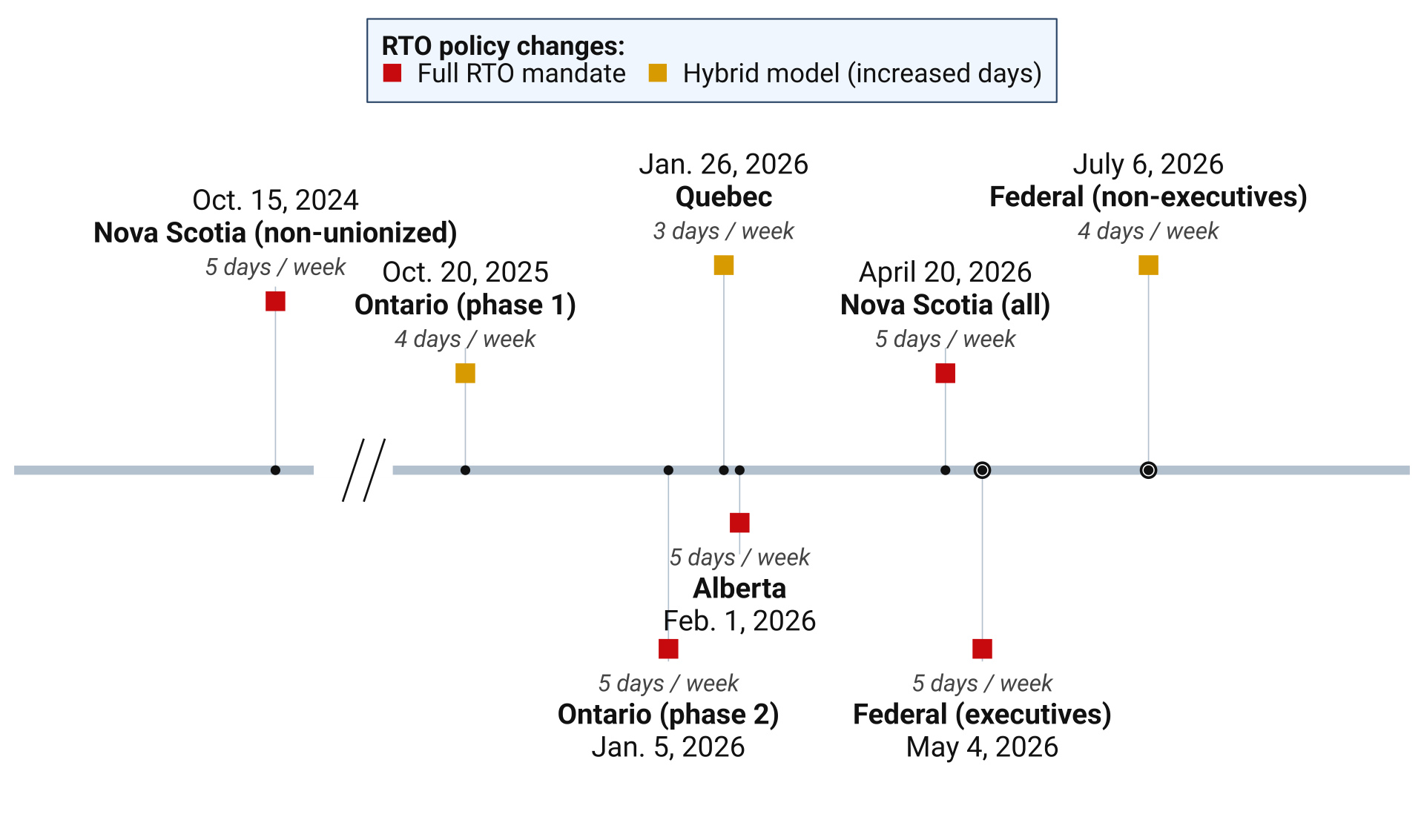
Source: Authors’ compilation is based on official federal and provincial government directives, policy documents and public-service announcements collected in June 2026 and reflects available information.
Note: The period between November 2024 and September 2025 is compressed to improve readability.
Across the jurisdictions examined, three broad patterns have emerged.
The first includes jurisdictions where full-time or near-full-time office attendance is required or is the general rule. This includes the federal government, Ontario, Alberta, Nova Scotia and Saskatchewan.
The second includes governments maintaining standardized hybrid arrangements. This includes British Columbia, Manitoba, New Brunswick and Quebec.
The third group has less standardized return-to-office arrangements, leaving greater discretion to departments or managers (see figure 2).
Figure 2: Provincial RTO policy status as of June 2026
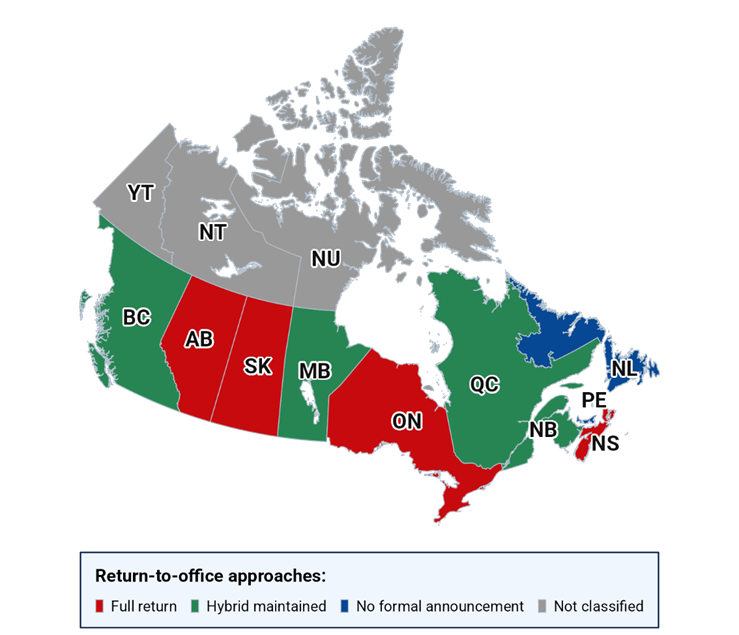
Source: Authors’ classification based on official provincial government directives, policy documents and public-service announcements collected in June 2026 and reflects available information.
Note 1: Provinces are grouped according to the RTO approach identified in publicly available government information. The territories are not included in the analysis.
Note 2: “No formal announcement” means provinces did not issue a government-wide return-to-office directive during the period examined. Existing remote-, hybrid- or in-person-work arrangements may still have remained in place.
One could argue that governments have been responding to many of the same broad labour-market developments, yet they have adopted different return-to-office policies.
Beyond workplace management
The variation across the country is easy to observe. Explaining it is more difficult.
Figure 2 points to an interesting pattern across provinces: governments on the political right spectrum, such as Ontario, Nova Scotia, Alberta and Saskatchewan, have generally adopted return-to-office policies requiring more in-person attendance.
But political ideology alone is unlikely to explain the pattern.
Other considerations may also shape these decisions, including: the size and composition of the public service, organizational culture, collaboration, mentoring, office space, collective bargaining and labour-market conditions. Governments must also consider service-delivery requirements, geography and broader economic priorities.
RTO policies can influence governments’ ability to recruit and retain workers. They can also affect productivity, commuting patterns and public-transit use, office-space needs and related public costs and local economic activity in downtown areas, particularly in cities with large concentrations of office-based employment.
Return-to-office policies also have implications for public finances, emissions, accessibility, caregiving responsibilities and gender equality.
A wider policy lens
Our overview does not suggest that any one return-to-office model is inherently better than another. It does show that their effects may be broader and uneven across workers. Women, people with disabilities, workers with caregiving responsibilities and employees with long commutes may experience the costs and benefits differently.
Future research should focus on how different arrangements affect workers, particularly equity-deserving groups, as well as public-service outcomes rather than on identifying a single model for everyone everywhere.
Governments should consider these wider and potentially uneven effects when designing, adjusting and evaluating return-to-office policies. While public servants’ work may appear to be an internal management decision, its wider and potentially uneven effects make it a broader public-policy question.