This article is part of our series “Cities at a Crossroads.” Explore the series to learn about the challenges facing Canadian municipalities and the solutions they are implementing to address them.
(Version française disponible ici)
When the social safety net fails, municipalities are left with the visible consequences. Montreal can support its organizations and boroughs, co-ordinate emergency response and intervene when encampments appear. However, it cannot replace the housing, health and income policies which should have prevented the situation in the first place. Homelessness becomes a municipal issue when it appears in public spaces, though it starts long before then.
“We can no longer turn a blind eye,” said Montreal Mayor Soraya Martinez Ferrada. She is right. But let’s not confuse the place where the crisis appears with the place where it is created.
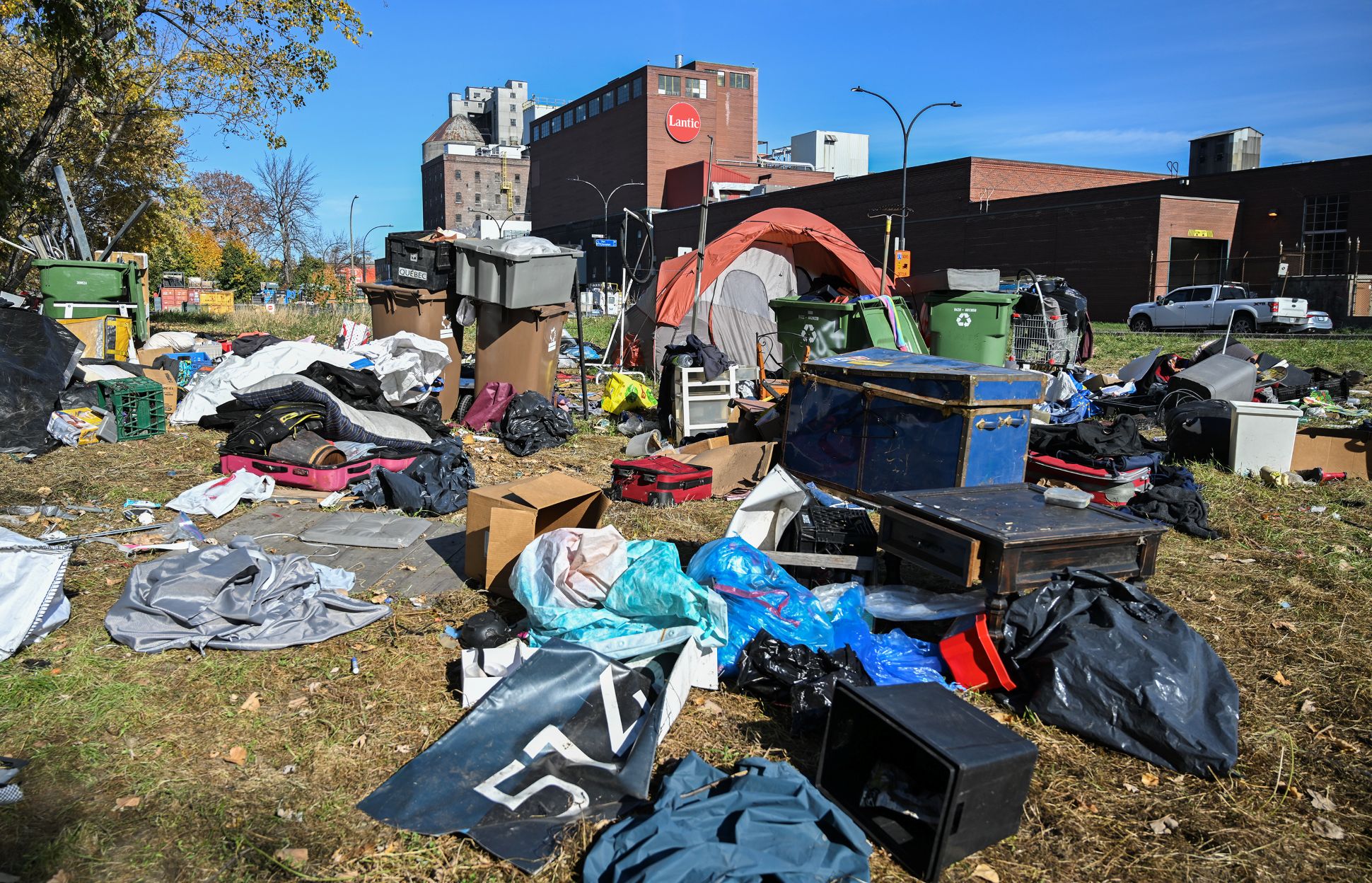
A tent in a park is not primarily a park issue. It often tells a history of upheavals: unaffordable rent, discharge from a hospital or a prison without another place to stay, youth protection without long-term support, or care interrupted at a critical moment. Then the issue enters a new realm. It is no longer about housing, poverty or continuity of care. It becomes an issue of encampment, cohabitation, hygiene or safety. A failure of public systems is then managed by municipalities.
This is not a neutral shift. It turns a prevention crisis into a local management problem. The question is no longer why a person has become homeless, but how to manage their presence in public spaces.
However, it would be reductive to assign causes to Quebec City and Ottawa and consequences to municipalities. Montreal is not just a passive backdrop to the crisis. Together with community organizations and boroughs, it absorbs the most visible part. The city must act but within a fragmented public framework: responsibilities are shared but the levers of power are not.
When municipalities bear the crisis
The figures illustrate the scale of the phenomenon. The initial results of the provincial count conducted April 15, 2025, estimated that 12,077 people were living with homelessness in 15 participating regions – 1,873 more than in 2022. Yet this is only a partial portrait. It captures a particular moment and leaves out some hidden homelessness. Despite limitations, the count confirms a trend.
In this context, Montreal presented its 2026-2027 funding for homelessness. The annual budget will reach $29.8 million in 2026 – an increase of $20 million from 2025. These funds will finance a crisis unit, increased support for boroughs and funding for frontline community organizations.
This funding is necessary: the organizations need stability and the homeless can wait no more. However, the funds also reveal the structural limitation: the municipality acts when the fallout is already there. These responses are useful, urgent, sometimes indispensable, but they remain after-the-fact responses.
The municipalization of social failure
This is what we’ve come to call the municipalization of social failure. Not because the municipalities are doing too much, but because they are asked to handle a crisis driven by causes that are partly beyond their control.
Montreal can intervene in an encampment, but it has no power over social assistance levels. In 2026, an adult with no barriers to employment receives $845 per month. Nor can the city produce needed housing on its own. As of April 1, 2026, the Office municipal d’habitation de Montréal reported 12,424 households on the subsidized housing waitlist. These figures illustrate the gap between local emerging needs and where the main levers of action lie.
The rental market has widened this gap. According to Statistics Canada, the average asking rent for a two-bedroom apartment in Montreal increased from $1,130 in 2019 to $1,930 in the first quarter of 2025 – a 70.8 per cent increase. CIRANO also revealed in 2026 that rent prices are one of the significant structural predictors of homelessness. Housing is therefore not merely a possible way out of homelessness; it is a preventive measure.
Reducing the flow into homelessness
“Turning off the tap of homelessness,” as Jérémie Lamarche, a community organizer at RAPSIM says, does not only involve better management of overflow. It means taking upstream actions when people’s lives go off track, before they become a visible crisis.
Quebec agrees with part of this analysis. The Interministerial Action Plan for Homeless 2021-2026 aimed to better define the government’s roles and responsibilities. There are roundtables and frameworks. What is missing is a sufficiently clear chain of accountability to prevent each system from disengaging with people at critical moments, leaving the streets as a last-resort shelter.
Accountability should begin with a simple principle: no high-risk discharge from an institution should lead directly to the street. Each file should answer three basic questions: Where will the person sleep tonight? Who will follow up with them tomorrow? Who will intervene if the plan fails?
Studies on preventing discharge into homelessness demonstrate that transition planning, coupled with access to housing and social support, can yield concrete results. In the evaluation of the Ontario program named Preventing Discharge to No Fixed Address, 80 per cent of participants remained housed 12 months after discharge.
Measuring prevention, not just management
It is also crucial to change what we measure. Dismantled camps, available beds, deployed teams and handled calls speak to effort. They do not indicate if someone avoided being on the street, exited homelessness for good, or secured housing. These are the outcomes that need to be made public.
Cities are closer to Canada’s problems than they are to the money
The federal program Reaching Home already encourages some communities to develop co-ordinated access, data sharing and outcome measurements. This approach is useful. Yet a database does not build housing, nor does it raise income or replace a clinical follow-up. It can increase system visibility, but it does not make it more accountable on its own.
Beyond social cohabitation
Social cohabitation is a real issue. Tensions exist in some neighbourhoods. Ignoring them would mean denying the living conditions of people experiencing homelessness, as well as those of nearby residents. But the concept can also be used to sidestep the issue. It transforms a crisis of rights, income and housing into a squabble among neighbours.
The focus then shifts from eliminating the cause of homelessness to mitigating its visible impacts. After each encampment is dismantled, accountability should go beyond simply restoring order. It should document who was displaced, who was rehoused, who relocated, what service providers were involved, and who remains responsible should people fall back into homelessness.
Look upstream before homelessness becomes visible
A coherent policy should integrate three objectives: protecting homeless people, preserving the quality of life in the neighbourhood and preventing upstream breakdowns. Trading prevention for crisis management leads to a perpetual emergency.
Montreal cannot be solely responsible for managing the social safety net of Quebec and Canada.
The statement “we can no longer turn a blind eye” makes sense but it is too late to look at the homeless only when they become visible on the street. The crisis did not begin there. The street is only where we lose the privilege of looking away.