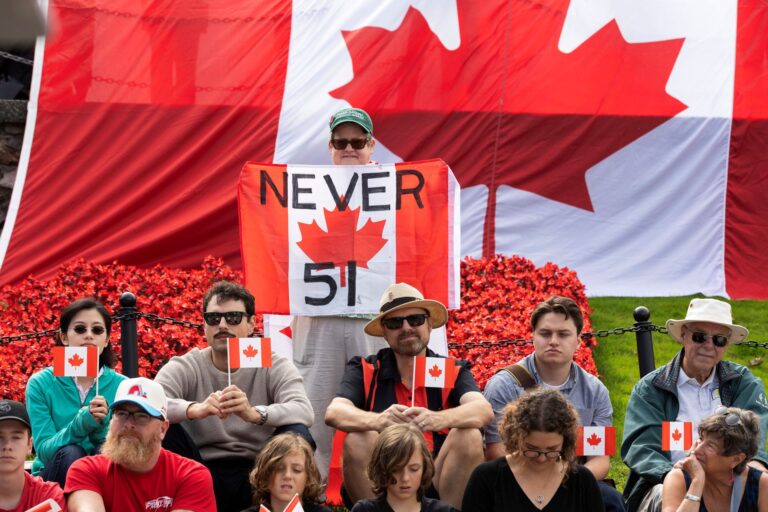
The truism has been “Canadians and Americans are best friends, like it or not.”
Surely we are in the “not” portion of this cycle. Although historians will certainly contend that relations have been worse, notably with the reciprocal burning of Kingston and Washington during the War of 1812, it is hard to recall a time when our populations have been so on edge with one another. It is particularly difficult to find an occasion when Canadians at all levels have been so blunt in their criticism of US officials, policies and existences. We have certainly endured personalized animosity at senior levels in the past: Dief vs JFK; Pearson vs LBJ; Nixon vs PET. In some respects, the relative tranquility from 1984 to 2000 was almost an aberration.
Thus the election of the second George Bush prompted a return to “normal” bilateral tension in senior level leadership. In previous issues of Policy Options I have chronicled the downward spiral of our relationship. In essence it appears as if Prime Minister Chrétien and the Liberal government have never gotten past the fact that “President Gore” does not reside in 1600 Pennsylvania Avenue. They project the air of believing that we have a “rogue” administration that is illegitimate, if not actively illegal. Installed by the equivalent of a judicial coup, key Bush administration officials are viewed as amoral ideologues convinced that foreign policy is “the US way or the highway.” We will not listen to wise Canadian counsel on topics such as missile defense, Kyoto, the International Criminal Court, the Antipersonnel Landmine protocol. Or, if we listen, we will not mind. We are (eyeball roll) un-Canadian.
The only regime change that Chrétien would support is one in Washington.
From this bedrock of fundamental hostility, fertilized by traditional Liberal skepticism for much of US origin (and certainly for US policy of conservative origin), comes a virtually endless barrage of disrespect. Thus the “moron” comment demonstrated the contempt within the prime minister’s office for President Bush. The “bastards” appellation proved that such a comment was acceptable within the Liberal caucus, or otherwise Carolyn Parrish would not continue to sit as a Liberal MP. Then the spasm of spite by a clutch of Liberal backbenchers calling the president “petulant,” “arrogant,” “jingoistic,” and even “hypocritical.” And from there the Liberals escalated further with natural resources minister Dhaliwal declaring that the president had let the world down and was “a failed statesman.”
Unsurprisingly, the Canadian population has complemented its political leadership with assaults on American symbols. Their national anthem has been booed at hockey games. The US flag has been burned by demonstrators. The US embassy has absorbed eggs and red paint. And most puerile and inhospitable of all was the booing of a US peewee hockey team. Yes, cowardly; or maybe “Joe Canadian” will add to his next rant that he proudly insults 12-year-olds.
Against this backdrop, US Ambassador Paul Cellucci expressed “disappointment” over the lack of Canadian support for the US position in Iraq during a speech in Toronto. And Canadians are surprised? We would have to have been an even more moronic set of bastards than Canadians have postulated not to take notice. There is a point at which the absence of response to critics suggests implicit agreement with their criticism.
Indeed, the entire response exercise was carefully choreographed. According to Ambassador Cellucci, we had been content with what we anticipated to be a Canadian split decision on Iraq. That is, Canada would make a force commitment to Afghanistan/antiterrorism. Canada would not participate militarily in Iraq, but would not be critical of the United States and say something favourable about our effort. But then Prime Minister Chrétien termed the war unjustified and Herb Dhaliwal, a senior cabinet minister, blasted the president. That didn’t seem very supportive.
According to media reports, National Security Advisor Condoleezza Rice and Cellucci coordinated a response. Several days prior to the ambassador’s speech, State Department spokesman Richard Boucher expressed “disappointment” in the Canadian decision not to support Coalition efforts in Iraq. That language was worked out between Washington and Ottawa, but appears to have gone largely unremarked in Canada.
As to Celluci’s speech itself, one suspects much of the comment— pro and con— has been made by those who neither heard it nor read it. A quick review might be instructive. More than three-quarters of the speech is a litany of what is going well with our relationship in terms of economic co-operation, border control, upgraded military coordination, combined efforts to counter terrorism in North America and Afghanistan. It is an honest account of the bread-andbutter elements of the world’s most complex and effective interdependency. Nevertheless, to be sure, our disappointment in Canada’s Iraq position is clear. To anyone missing the initial point, it was repeated four times over. Disappointed and upset.
In response there was a firestorm of comment to the effect that Ambassador Cellucci had been undiplomatic, indeed harsh, in his position. Particularly affected was leftist Mel Hurtig’s huffy claim that the speech had been “grossly undiplomatic.” Message to Hurtig: Diplomat is not spelled d-o-o-r-m-a-t. At least two cabinet ministers, reportedly David Collenette and Donald Boudria, wanted Ambassador Cellucci expelled for his statement. Happily, saner heads prevailed to prevent what would have been a virtual breaking of relations. Permit me to assure you that “disappointment” was as diplomatic as deserved. It sometimes appears that Canadians believe that they have a monopoly on the right to criticize, and the United States was invented to “take it,” because for us to respond would somehow be bullying Canada.
Many years ago, using a golf analogy, a Canadian diplomat told me that Canada would never surrender its right to scream “wait a minute” when we were at the height of our swing. Good enough, but if you try to grab the ball off the tee, don’t be surprised if you get whacked by a nine iron. On a golfing note, Mike Weir’s dramatic victory at the Masters, and his elegant remarks at the Green Jacket ceremony, may have been the best thing for Canada-US relations in quite some time.
Of course. Canada could have temporized; it could have suggested that the United States should have had more patience, listened longer to Ottawa’s proposed compromises in the UN Security Council, presented more convincing evidence of weapons of mass destruciton, backed stronger inspection regimes, and so on. It could have declined military participation, noting its overcommitment elsewhere. It could have been as adroit as Mexico, a country equally if not more economically dependent on the United States. Mexican diplomats avoided being pinned down in the UN Security Council and, as the US/UK trial balloon resolution never came to a vote, they were never forced to accept or reject the US position. For all I know, President Fox’s parliamentarians may have been even more hostile to Coalition action against Iraq than the Liberals in Canada, but you didn’t hear them being quoted on CNN. So much for the stereotype of those undisciplined, volatile Latins.
But Chrétien could also have led Canada into participation in the Coalition— as did British Prime Minister Blair. By now, all have seen the polls that suggest Canadians would have accepted a clear government decision to support the US-led Coalition. The polls said, in effect, “Lead and we will follow.” Since the original information came from Liberal pollster Marzolini, rather than from some conservative media-funded pollster, one can assume that it was regarded as credible and known to the Liberal leadership before making its decision.
But Chrétien and the Liberals just didn’t/couldn’t bring themselves to support a controversial US decision. In the end, that is a Canadian problem; not a US problem. If the only things that Canada can agree upon with the United States are “easy” decisions, or ones blatantly to Canadian detriment if you don’t make them, such as tighter border controls, Canada is going to have a poorer bilateral relationship with the United States than in the past.
On Iraq, Canada faced some choices. Essentially, Ottawa was privy to the same intelligence information that we had on hand and which Secretary Powell presented to the UN Security Council. We made the same presentations to Canadian officials that we made to others around the world. We determined that Iraq possessed weapons of mass destruction and that Saddam Hussein’s possession of these weapons posed a threat that was not acceptable and had to be eliminated. Why Tony Blair, with hardly any special personal or political sympathy for George Bush, was convinced and Jean Chrétien was not is for Canadians to mull over. In any event, Chrétien was not convinced that he could support our position.
Nevertheless, it is useful to reemphasize that the problem was not Canada’s decision, little as we agreed with it, but the manner in which it was communicated: undisciplined and characterized by ad hominen comments about the president of the United States and, indeed, about the American people. And ultimately disrespectful of our right to act in a manner not sanctioned by Canada and the United Nations. In a speech to the Institute for Research on Public Policy in Montreal, Ambassador Cellucci made many of the same points in almost identical language that he had used in Toronto regarding the positive, working elements of the bilateral relationship. Again, he noted that we had been disappointed with Canada’s Iraq position, but let it stand at that.
One anticipates that the United States is willing to move on. Canadians who are fibrillating over the prospects of economic retaliation for their Iraq position may be right, but not in the form of massive retaliation or deliberate border slowdowns. Retaliation is neither inevitable nor will it be across-the-board. Each of the outstanding economic files that are in dispute has its own logic. Thus softwood lumber will be solved— or not— based on proposals from each side, political pressures, and competing legal judgments. This approach has been true for decades through the rolling laundry list of problems perennial and particular: Pacific salmon; PEI potatoes; durum wheat; hanging file folders; split-run magazines. We have many problems, but it is because we have massive trade rather than because we are seeking opportunities to enrich law firms.
So rather than deliberate, pick-afight type problems, more likely is the continuing ascendancy of gimleteyed, green-eye-shade types who will make a deal that looks good, but not if it doesn’t. Canada and the United States remain open for business with each other. There is a lot of good business, mutually profitable business, to be done.
As part of the series of exchanges, a senior Canadian journalist took Ambassador Cellucci to task for characterizing the United States and Canada as “family.” He wrote bluntly that, “We are not part of your family. We are not even really friends…”
Perhaps he didn’t notice that Ambassador Cellucci was deliberately quoting Jean Chrétien: “We are not only great friends and great allies, we are family.” But very well; technically neither the ambassador nor the prime minister was correct in terming us “family.” Abstract structures such as a “republic” or a “federation” are political, not biological or social creations. On the other hand, Canada has clearly benefited from a rather benign US attitude toward Canada; perhaps foolishly we have acted as if our relationship was more akin to “family” than to business competitors focused on maximizing their individual interest.
Perhaps the relationship might be described as more equivalent to coworkers in adjoining cubicles. Sooner or later most co-workers grate on each other a bit: one is messy; another laughs too loud; a third talks endlessly about children. Normally, none of these or any of the personal foibles that characterize human relationships is terribly offensive, but under special circumstances, they can result in a hissy fit that leaves the “offender” wondering, “What brought that one on?” But because there is a job to be done, they patch it up and go back to whatever qualifies as “normal.” Still, a vacation— a getting away from each other, even a bit of deliberate avoidance— can help.
Happily the president is now too busy to visit Ottawa. A trip that was designed to be kiss-your-sister bland had morphed into a high-risk; no-gain exercise. Kicking the visit down the calendar was just smart. Moreover, it had the added benefit of avoiding a government awaiting interment. Now Chrétien doesn’t have to pretend to like Bush. Bush will be spared the bother of being heckled by Svend Robinson.
With that clarification of Canadian attitudes, however, the United States would be moronic not to pursue its interests even more efficiently and directly in bilateral encounters with Canada.
For example, tourism is a delicate flower; the US economy isn’t in that great shape, and travel/vacation are discretionary dollars in any event. Various scares ranging from terrorism to SARS may well keep Americans closer to home this summer. And anyone who has noted the hostility out of Canada, and missed the efforts to apologize, since good news never catches up with bad news, will probably give Canada a pass— at least for the near term.
More likely are specialized problems reflecting as much post9/11 rethinking as retribution. Regardless of how “smart” borders ultimately become, with the end of the Auto Pact, the incentive to have US factories in Canada declines when “just-in-time” inventories make any border delays expensive. Relocating subassembly component producers closer to final assembly points may look better every year. But don’t take it personally; it is only fiscal prudence. And on the bureaucratic/diplomatic front, it is clear from Ambassador Cellucci’s remarks that at least one Chrétien cabinet member is unlikely to be meeting with his US counterpart. Nor should that bother many Liberals who are clearly hoping that 2004 will bring regime change in Washington; for our part we know that regime change will occur in Ottawa.
We may also have reached the end of the trail for military exchange officers. Not today or tomorrow, but not business as usual, either. Canadian officers are excellent; they reflect extensive training and professionalism. They have been totally integrated into US units during such exchanges.
What was once reliable now appears less so. If Canada will commit forces only under UN authorization, both of our militaries may need to rethink the utility of putting foreign military personnel in key operating positions.
Thus the commander of the multilateral naval force in the Persian Gulf managed to find himself making what Ambassador Cellucci termed “incomprehensible” statements about what he would do with escaping Iraqis. But a similar, still-to-be-resolved question, will apply to the Canadian contingent headed for Afghanistan, where renegade Iraqis in our “deck of cards” could emerge.
Indeed, Canada now appears to be adopting what might be termed the “Chrétien Doctrine” in foreign affairs. That is, there will be no support for “regime change” other than through free elections, and no support for military action other than direct self-defense unless sanctioned by the United Nations. If that is the next step along the “soft power” path, even more elements of our bilateral and multilateral foreign affairs co-operation will need rethinking.
But to assume such may be borrowing trouble. The “Chrétien Doctrine” may reflect more meandering mumbles than meaningful manoeuver. For the moment, we will be seeking Canadian co-operation on a full range of bilateral and multilateral initiatives. We have been disappointed, but we will provide Canada with an opportunity to disappoint us again.