When Manitoba Premier Wab Kinew called recently for the Indian Act to be repealed, he restarted a debate about the federal government’s policies with respect to First Nations.
Kinew received pushback from some chiefs and academics who see the proposal as a distraction from more urgent matters, especially concerns about Bill C-39, the Building Canada Strong Act, which aims to speed up the federal approval process for major projects. But others see it as an important window of opportunity to consider long overdue reforms.
Here’s one that should be adopted.
The federal government should end its preference for elections in First Nations governments. Indigenous communities have gone to extraordinary efforts to preserve traditional legal and political orders, and are working to revive them across Canada. But Ottawa continues to obstruct their formal recognition, denying the authority of bodies such as the Wet’suwet’en hereditary chiefs or the Haudenosaunee Confederacy Council.
How some First Nations break the cycle of poverty
Rights and traditions will define Indigenous governance of the future
Honouring Indigenous self-determination by applying parallel paths
Perhaps surprisingly, reversing a preference for elections would actually be good for democracy. Traditional Indigenous governments can be much more democratic than the elected First Nations band councils.
We, the authors, are not Indigenous and our argument isn’t directed at Indigenous governments. They should make their own decisions. Our concern is that the federal government is inappropriately tipping the scales against democratic but non-electoral systems in First Nations communities.
The landscape of First Nations governance
To understand how the federal government’s preference for electoral governments has been embedded in policy, we need to review history and untangle some of the confusing terminology that has developed in this area.
Before the 1860s, British and then Canadian policy was to recognize whatever leaders Indigenous Peoples chose for themselves.
That began to change in 1869, when legislation empowered the federal government to call elections in any First Nations community, displacing existing leadership. A similar power remains in Section 74 of the Indian Act.
Starting in the 1870s, Ottawa used this legislation, along with other powers that allowed it to depose chiefs for vaguely defined reasons including “intemperance and immorality,” as well as the broader, discretionary powers of Indian agents, to establish elections in most First Nations communities.
The process was coercive, sometimes spectacularly so, as when the Royal Canadian Mounted Police “locked the council-house door and forced elections,” removing the historic chiefs from any position of authority at the Six Nations of the Grand River in Ontario in 1924.
The imposition of elections varied in different regions.
In 1899, elections became mandatory (Page 6) for First Nations east of Ontario. A few were initially exempted, but most complied.
In Western Canada, the Indian Affairs Department initially judged most First Nations insufficiently “civilized” for elections.
There, Indian agents often used personal discretion – sometimes hand-picking a life chief or developing an ad hoc electoral system (for instance by taking a straw poll of adult men) or sometimes simply declining to recognize any chief at all. Elections were introduced selectively and in many cases not until after the Second World War.
In 1951, amendments to the Indian Act created a more formal process of acknowledging chiefs and councils selected by the “custom of the band” – which could mean either traditional Indigenous practices where those were intact or the Indian agent’s ad hocsystems.
In 1988, the federal government created a process whereby First Nations could “revert” to a “custom” election system. Subsequent policies – the First Nations Elections Actof 2014 and the emergence of self-government agreements – mean that Indigenous leadership today rests on a dizzying range of policy foundations (see table 1 below).
But the key point is that according to Ottawa’s own estimates from 2008 (Page 6), only 10-15 of these communities had non-electoral leadership – at least one of which involved the codification, circa 1951, of an Indian agent’s discretionary practice of appointing hereditary life chiefs.
The federal government doesn’t collect data on custom regimes. But it is clear that there are few examples of First Nations that are formally governed by a traditional leadership system reflecting Indigenous rather than Indian agent customs. Indeed, one of the few remaining cases, the Algonquins of Barriere Lake, had Indian Act elections imposed in 2010.
Table 1
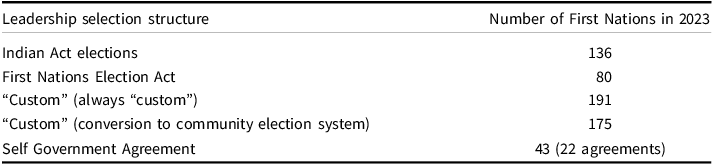
Source: Sherwin and Hutton Ferris, 2026
A democratic case for unelected governments
These impositions infringe on Indigenous Peoples’ capacity for self-determination. That might be partially justified if it produced more democratic outcomes – for example, if it ensured ordinary First Nations citizens have a greater voice in their communities. But it’s far from clear that this is the case.
Traditional leadership systems are not tainted by colonialism in the way elective band councils are because of Ottawa’s long-standing imposition of elections.
Democracy requires communication and interaction with leaders to approximate the ideal of self-rule by the group as a whole. Anecdotal evidence suggests many Indigenous Peoples are happier to co-operate with traditional leaders than with band councillors because the traditional leaders lack the taint of colonialism.
Elections are also not the only way Indigenous Peoples can sanction their leaders or hold them to account. Traditional governance practices require leaders to secure and maintain active support from those they hope to lead.
For example, the potlatch tradition practised by the Wet’suwet’en and many other West Coast First Nations requires aspiring leaders to raise money and other material support from their community. Without this, they cannot host the feast necessary to assume a chiefly title.
Historically, Indigenous persons could also vote with their feet, helped by far-flung networks, such as the Anishinaabe doodem clans. These networks ensured that people could leave their communities and move somewhere else because, for example, if someone from the bear clan came to a new village, the local bear clan members had a duty to help them settle.
Leaders who performed badly, therefore, could expect to watch their community shrink and their authority fade.
Today, the Haudenosaunee Confederacy, the alternative government to the Six Nations Grand River Band Council, continues to employ a remarkably inclusive and deliberative form of decision-making.
Policy questions are discussed slowly and carefully in informal discussions at the local level and by a nested series of councils at the local and national levels, as well as in the Confederacy Council, which brings together representatives of the six nations of the Haudenosaunee. In this way, the confederacy creates chains of responsiveness from each citizen to its highest leaders.
Elections are not the only way to make politics inclusive, responsive and democratic. A Six Nations Haudenosaunee might prefer to discuss a concern in a customary council rather than with federally approved elected leaders. Outsiders often see this as choosing a culturally appropriate form of leadership over a more democratic one. In fact, it would also be choosing democracy.
The path forward
The “conversion to community election system” and self-government agreements allow Indigenous communities to modify their leadership processes. But both require approval from Ottawa. None to date has resulted in a non-electoral Indigenous government, although there are instances of traditional institutions being established alongside elected leaders.
The federal government needs to go much further. It should revise its conversion to community election system policy to permit non-electoral selection. In addition, self-government negotiators should be open-minded about democracy’s institutionalization.
To be sure, there is a need for oversight. Traditional Indigenous democracies can be captured by powerful interests, just as electoral systems can. But any oversight should be controlled by Indigenous Peoples and grounded in Indigenous law. So long as they remain subject to federal oversight, Parliament should encourage the courts to take a broad view of Indigenous democracy.
These steps can be taken immediately. They can also be incorporated as Ottawa works with First Nations toward a more comprehensive shift toward self-government and nation-to-nation relationships.
Ottawa has intervened in Indigenous governments for more than 150 years using democracy as its primary rationale. Whether the Indian Act is ultimately repealed, replaced or reformed, it’s time for the federal government to get out of the way of First Nations rebuilding Indigenous democracy on their own terms.
This would be good for Indigenous Peoples, good for Canada and good for democracy.