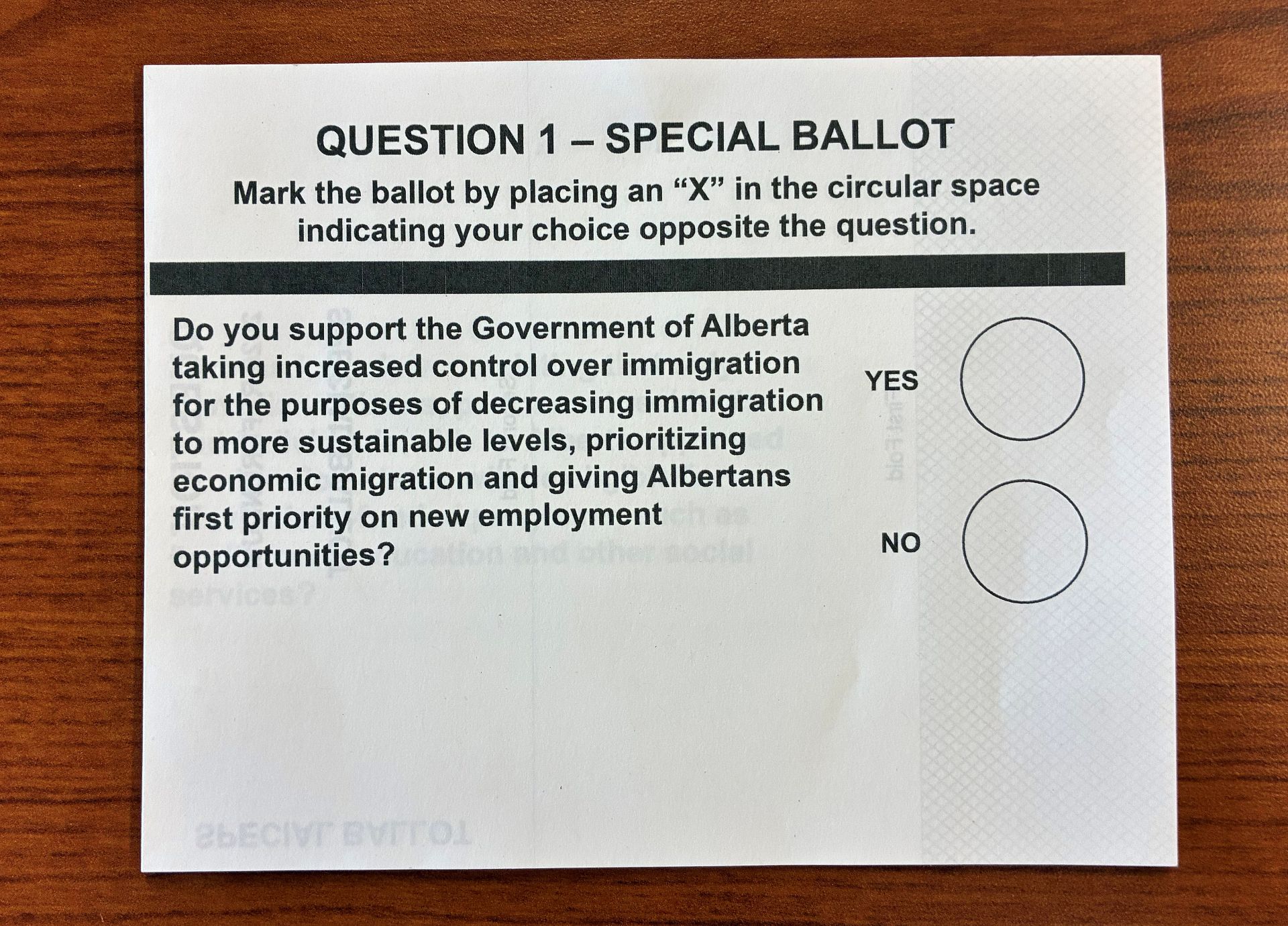
Alberta voters narrowly said “yes” in the province’s October referendum to five proposals about immigration – ranging from assuming more provincial control over the system to restricting newcomers’ access to public services and imposing new voter ID requirements – that form the foundation of the government’s proposed agenda for reform.
But interpreting those results as a sweeping mandate to revamp immigration policy would be a serious mistake.
The questions were ambiguous, the electorate was deeply divided along urban-rural lines, support for the government’s position declined by at least ten percentage points over the campaign and voters’ understanding of the questions and the motivations for their votes were anything but uniform.
Given this, the Danielle Smith government would be wise to restart the policymaking process it circumvented with the referendum, doing a deeper dive into options and consulting those most affected by the proposed changes.
One referendum, five questions, three conversations
Referendums are blunt policy instruments. They can register public frustration but cannot tell governments precisely what upsets people or how to resolve their grievances. At best, referendums can provide a general direction for reform. At worst, they gin up division and dissension, making it more difficult to decide where to go next because referendums do not substitute for detailed policy analysis and consultation with those most affected.
If the Smith government thinks it has a mandate for change based on the referendum results, it needs to recognize first that three very different conversations took place during the campaign. Then, it needs to reckon with that during the next phase of policy development.
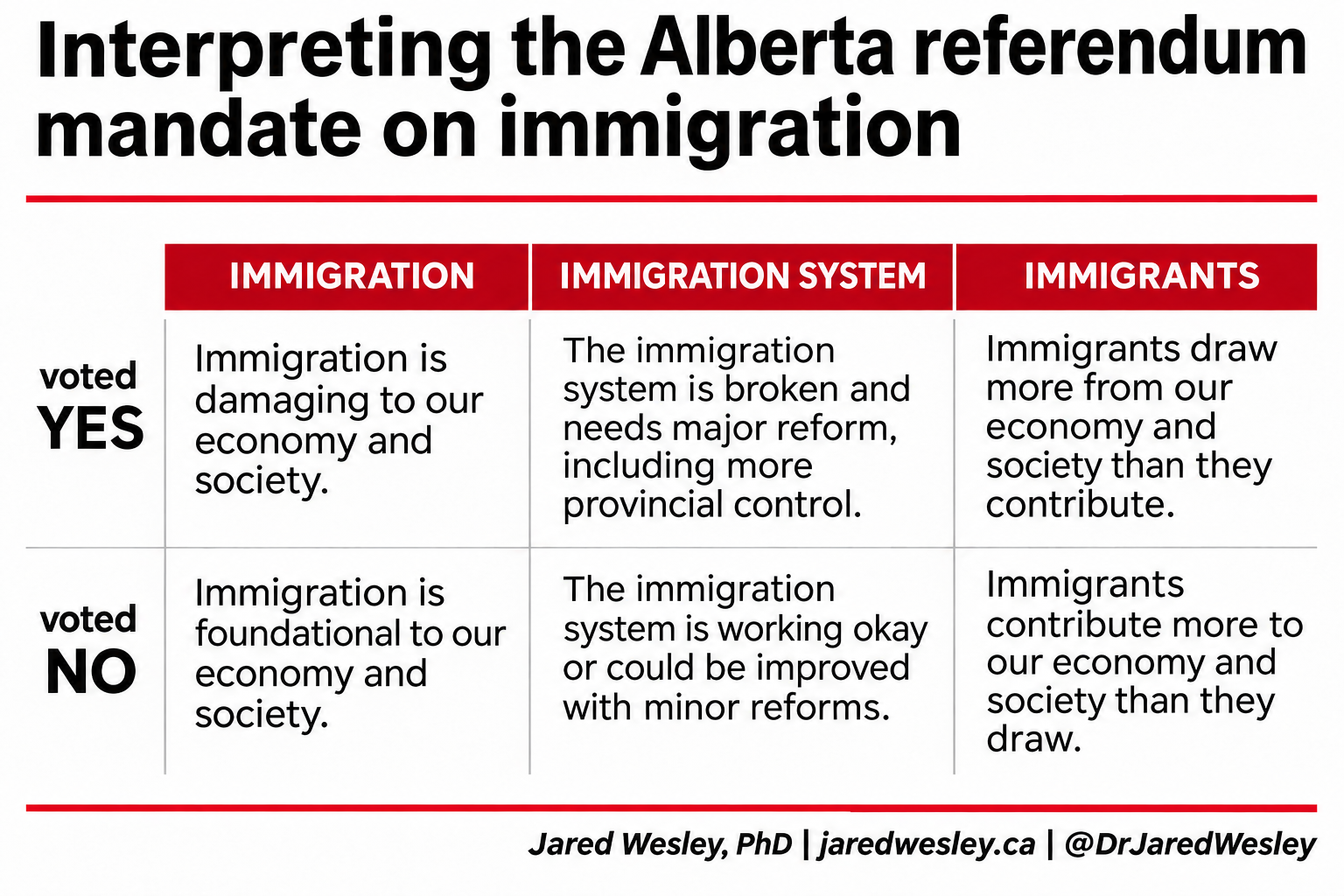
The first conversation was about immigration as a concept. Some Albertans approached the referendum as a question of values: Are we a welcoming society that recognizes immigration as central to our economic and cultural prosperity? Or do we reject that notion?
The second concerned the management of the immigration system. Here, dissatisfaction spanned the left-right spectrum and there was a broader mandate for change than for adjustments to social program accessibility.
Urbanites and progressives have concerns about lengthy processing times, barriers to permanent residency and citizenship, as well as the exploitation of immigrants. Rural folks and conservatives worry about immigration levels outpacing housing supply and the capacity of social programs and infrastructure.
These are serious policy questions with difficult answers. If the divided referendum results are any indication, Albertans want their provincial and federal governments to work out the responses together rather than hand control to one or the other.
The third conversation was more troubling. A small but vocal constituency treated the referendum as an opportunity to scapegoat immigrants for the many policy failings confronting their communities. These voters were not interested in improving the immigration system so much as punishing newcomers.
On the other side, advocates and allies found themselves defending the rights and humanity of immigrants in the face of increased incidents of hate.
There is no way of knowing the relative weight of these three factors in the minds of individual voters: immigration as a concept, immigration as a system or immigrants as people. The narrowness of the outcome, however, suggests the provincial government should proceed with caution in interpreting the results as a foundation for future policy moves.
Back to the policy drawing board
The referendum results indicate a slim majority of Albertans believe the provincial government should focus on reforming the immigration system. Given that immigration is generally a federal government responsibility, that means working with Ottawa to secure more provincial input on system design and aligning immigration levels with economic needs and labour market capacity.
Other potentially popular areas of opportunity include accelerating credential recognition; clearing backlogs and streamlining pathways to permanent residency and citizenship; and protecting prospective newcomers from exploitation before and after they arrive.
These reforms would address concerns shared across the country and the political spectrum.
The provincial government also needs to rebuild trust with immigrant communities. That starts with unequivocally condemning discrimination; refraining from framing the elimination of hate as diametrically opposed to protecting freedom of speech; engaging organizations that fear political retaliation; and ensuring newcomers have meaningful opportunities to shape future policies affecting their lives.
All of this means rejecting the temptation to inject anti-immigrant rhetoric into the ongoing campaign for next year’s provincial election. Alberta’s challenges are too multifaceted to be reduced to a simplistic contest between supposedly virtuous insiders and threatening outsiders.
Electoral imperatives will likely prevent the Smith government from moving too far, too quickly on this front because opposition to its proposals is strong in swing districts in Calgary.
The premier told a post-referendum press conference she would “proceed with caution,” while at the same time interpreting the referendum results as signalling “that people understand if you’re coming here temporarily and haven’t made a commitment to be an Alberta lifetime taxpayer, then you might have different rules associated with that when it comes to education, when it comes to healthcare, when it comes to childcare.”
She continued: “We want to also do it in a way that’s compassionate. And so we know that there are many, many people that came here under the old rules and we want to have some conversation about whether that should apply to those who are currently here or just arriving new.”
If the government chooses to proceed with changes to its immigration policy, there are important steps it can take to minimize the damage to the province’s economy, communities and democracy.
Before implementing any restrictions on immigrants’ access to public services, the government should clearly identify which immigrant groups it is targeting and whether the proposed changes would affect people who already live in the province or folks who have yet to arrive.
With that in mind, the government should publish detailed assessments of the fiscal, economic, legal and social consequences of restricting access to public services, as well as consult widely with those most impacted by the proposed policies including newcomers, immigrant settlement groups, and both public and private sector employers.
Albertans deserve to know who would be affected, what would actually be saved and what downstream costs would be incurred.
Voting rights demand special caution
Albertans also endorsed in the referendum requiring proof of citizenship to vote in provincial elections. However, validation is already embedded in the current verification processes and there is no evidence that changes are necessary to protect the integrity of elections.
If the government proceeds with establishing tighter identification requirements, it must ensure these do not prevent eligible citizens from exercising their democratic rights. Among other things, that means restoring the ability of eligible voters to vouch for the identity of others – a decades-old verification process that has worked well across Canada but that was eliminated in Alberta last year by Bill 54.
It also means providing free, accessible citizenship verification beyond paid versions such as driver’s licences and identification cards. Albertans should not have to pay to vote and exercising this right should not involve more red tape.
That means accepting a wide range of documents and accommodating people who lack passports or birth certificates, including seniors, Indigenous Peoples, people who have changed their name, those experiencing homelessness and people who have lost their documents through no fault of their own, such as those fleeing natural disasters or domestic violence.
The government should empower Elections Alberta to develop a straightforward process for resolving inevitable identification problems at the polls and give it the independence, resources and time needed to implement and publicize these changes.
The measure of success of this new process should not be how many ineligible people are prevented from voting. There is already virtually no evidence of widespread voter fraud in Alberta or other parts of Canada and the U.S., so this is a solution in search of a problem.
Rather, we should measure the government’s success by whether it makes things worse — how many eligible citizens will encounter new barriers to voting and whether this amounts to a form of voter suppression or governments choosing their voters. Election integrity cuts both ways and the quickest route to undermining it involves removing eligible voters’ ability to cast ballots.
Lastly, the government would be wise to refer any legislation on this issue to the courts prior to passage. It will likely be challenged in any event, so an early judgment would help improve it prior to implementation.
Referendums deliver results but seldom produce clear mandates, particularly when the margins of victory are as narrow as they were here.
Therefore, governments must return to the basics of policymaking to determine a path forward, including solid research, intergovernmental collaboration and a robust set of public consultations.