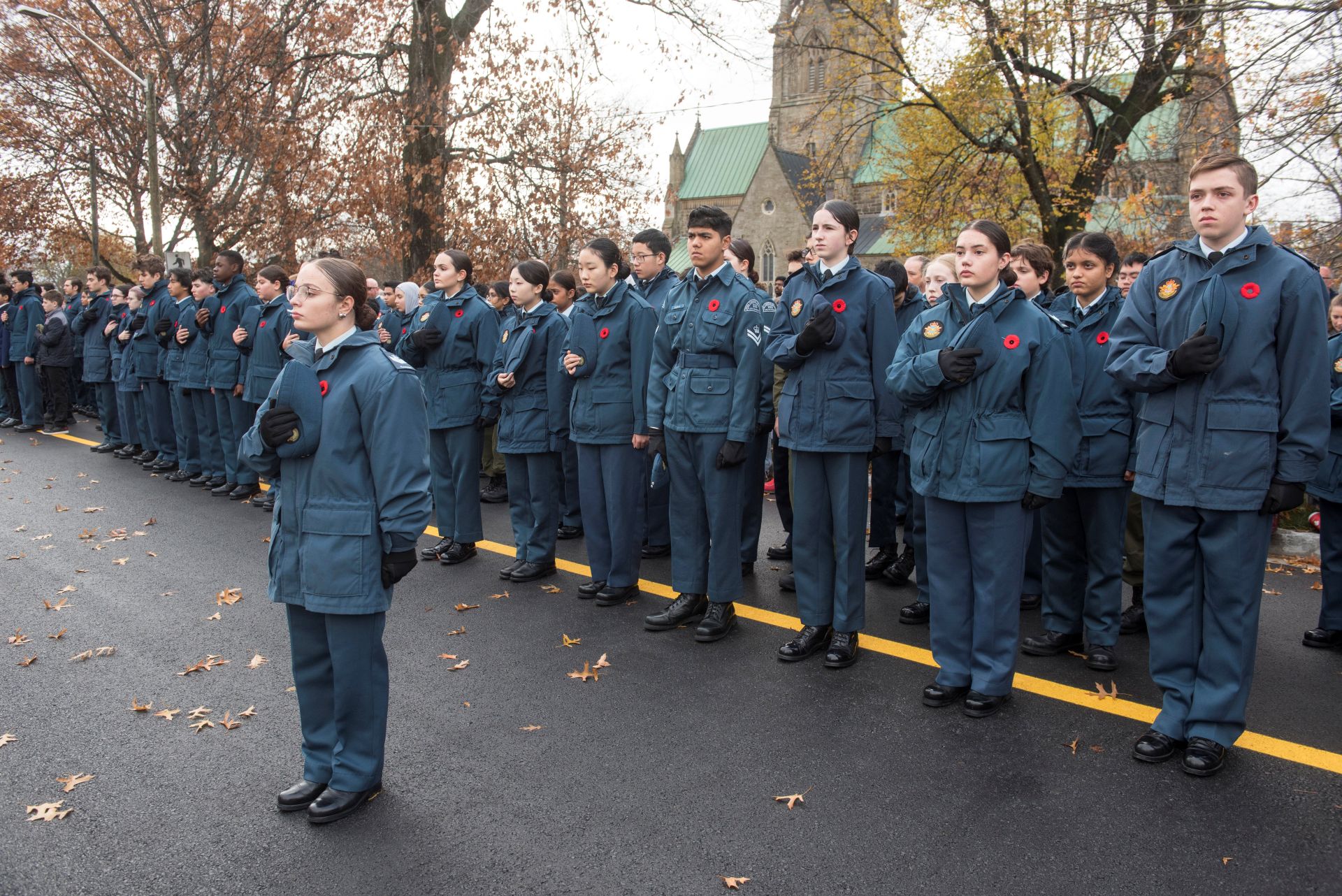
Pete Hegseth managed to do something last week that Canadian governments have struggled to do for years: get a lot of people talking about the Canadian Cadet Program.
Unfortunately, the U.S. Secretary of Defense did it by reposting a photograph from the Vernon Cadet Training Centre showing a cadet receiving an award from an officer. He added a Canadian flag and the words “this is real” – an obvious invitation to mock the women’s appearance.
Prime Minister Mark Carney said the post was “beneath their office,” while Defence Minister David McGuinty said it was “below the dignity” of the office Hegseth holds. Both are right.
But what made the episode uncomfortable for me was watching Canadian political and military leaders wrap themselves so enthusiastically in a program that successive governments have consciously allowed to become considerably less ambitious over the past decade.
Defending Canada’s cadets when someone in Washington mocks them is the easy part. But if Canadian political and military leaders are as proud of the Cadet Program as they said they were this week, their priorities should show it.
Most of the time, that doesn’t happen, although the federal government’s 2026 spring economic update offers an encouraging opportunity to reconsider what Canada wants this program to be and what resources are required to deliver it.
The update proposes $250 million over five years and $45 million annually thereafter to expand skilled-trades training through the CAF, including more hands-on programming and enhanced summer experiences for cadets and Junior Canadian Rangers.
It also proposes clearer pathways from those programs into apprenticeships and the Primary Reserve, including a new pilot that would provide fully funded trades training and paid, part-time experience in exchange for a period of Reserve service, with colleges, universities and Helmets to Hardhats helping participants move toward recognized apprenticeships and certification.
A new chance to invest in cadets
All three of my children have participated in the same Army Cadet corps in Ottawa. My oldest eventually held one of its senior leadership appointments, my son is now a senior cadet there and my youngest reached sergeant before deciding the program was no longer for her.
The experience was good for all three. It taught outdoor and safety skills, discipline, confidence, teamwork and most importantly leadership by giving them progressively greater responsibility as they demonstrated the judgment necessary to handle it.
Current policy at the Department of National Defence (DND) makes merit, successful training and a commanding officer’s assessment central to cadet promotion, with formal selection boards required for senior leadership appointments. That earned progression is one of the program’s great strengths.
Much of what my children gained came from excellent commanding officers, Cadet Instructor Cadre officers, civilian instructors, volunteers and senior cadets.
Summer training has contracted sharply
However, the opportunities surrounding those strong local programs have narrowed. Summer training offers the clearest measurable example.
In 2016, the National Defence and Canadian Armed Forces Ombudsman reported more than 20,000 young people attended 21 cadet training centres for two to six weeks.
However, a 2025 presentation from the commander of the Cadets and Junior Canadian Rangers Group reported that in 2024 only 6,840 cadets attended, along with 1,110 staff cadets and 360 more in digital-learning opportunities, which allowed cadets to participate remotely through a combination of instructor-led and self-directed training, rather than attending in person.
The scale of the change raises a legitimate question about why Canada once chose to make this challenging residential training available to tens of thousands of young people but now provides it to far fewer.
COVID explains the initial interruption, but the resource problem predated the pandemic. DND’s 2020 evaluation concluded that the “scope and funding profile” of the Cadet and Junior Canadian Ranger programs were not aligned and described the scope of the Cadet Program as “vast and unsustainable with the current funding profile.”
It also acknowledged that funding had increased beginning in 2018, but noted those increases only partially compensated for pay adjustments and new meal costs, while inflation and rising delivery costs continued to make existing activities difficult to sustain. A budget can grow while a program shrinks.
The institutional response was the program re-scope, designed to make it more “agile, accessible and affordable” while expressly requiring that training and activities be delivered within allocated resources.
That may be responsible management in a department facing serious pressures involving readiness, personnel, infrastructure and procurement, but it also reflects choices about what would be protected when resources were tight.
Cadets were never going to outrank operational requirements, but choices reveal priorities and the program was not protected at the previous level.
The military connection is worth preserving
The contraction also goes beyond summer training and can be seen in its military character, which is worth defending. Cadets is a youth development program, but uniforms, fieldcraft, marksmanship, drill, aircraft, ships and exposure to the Canadian Armed Forces (CAF) are part of its appeal.
DND still identifies “understanding the CAF” as an intended outcome and says exposure to its sea, land and air elements is essential to developing the unique identity of the cadet organizations.
Yet DND’s 2020 evaluation recorded concern among program managers that staffing shortages and greater reliance on civilian instructors meant the program was “losing the CAF aspects,” particularly because civilian instructors were less-equipped to deliver activities such as CAF familiarization.
In 2022, DND then removed three periods of mandatory CAF-familiarization training from both the second- and third-year programs to make room for other curriculum items – another indication the military dimension has been among the things reduced when the program has been squeezed.
My oldest daughter’s experience provides another example. In 2022, she attended the fullbore marksman program, which historically allowed talented army cadets to progress through advanced fullbore marksmanship toward the Royal Canadian Army Cadets National Rifle Team and an international competition at Bisley in the United Kingdom.
That pathway was never fully restored after COVID. DND’s current summer catalogue offers air rifle marksmanship courses but no fullbore progression or national rifle team.
Universities can help solve the Canadian military’s mobilization problem
There is a telling irony in National Defence’s 2024 celebration of Olympian Shannon Westlake, when it proudly noted that her shooting career began in Army Cadets and included two trips to Bisley because it was celebrating an outcome produced by a pathway that the next generation of cadets could no longer follow.
That matters as Canada tries to rebuild the Armed Forces and recruitment becomes a strategic priority. The value of the cadets program is much broader than producing future CAF members, because there are already tens of thousands of smart, motivated young cadets voluntarily showing an interest in military activities, accepting discipline and taking on greater leadership responsibilities.
When a young person discovers an enthusiasm for field exercises, aviation, marksmanship, navigation or military leadership, fostering that interest benefits the country whether that cadet ultimately chooses to enlist or not.
The Cadet Program remains capable of doing that extraordinarily well, as my children’s experiences and the work of dedicated local leaders demonstrate.