In a video last June, Prime Minister Mark Carney focused on affordability, security of supply and climate change as three prongs of an energy crisis he sees Canadians facing.
We are once again witnessing the effects of the latter as large parts of the country are hit with wildfires or floods. And U.S. President Donald Trump’s war on Iran —and subsequent price increases for petroleum products — has made the affordability challenge already facing many Canadians even worse.
But security of supply is primarily an issue in Atlantic Canada. Despite our country being the world’s fourth-largest producer of crude oil, the Saint John refinery, the only one in the region, relies on imported supplies.
The Saint John refinery
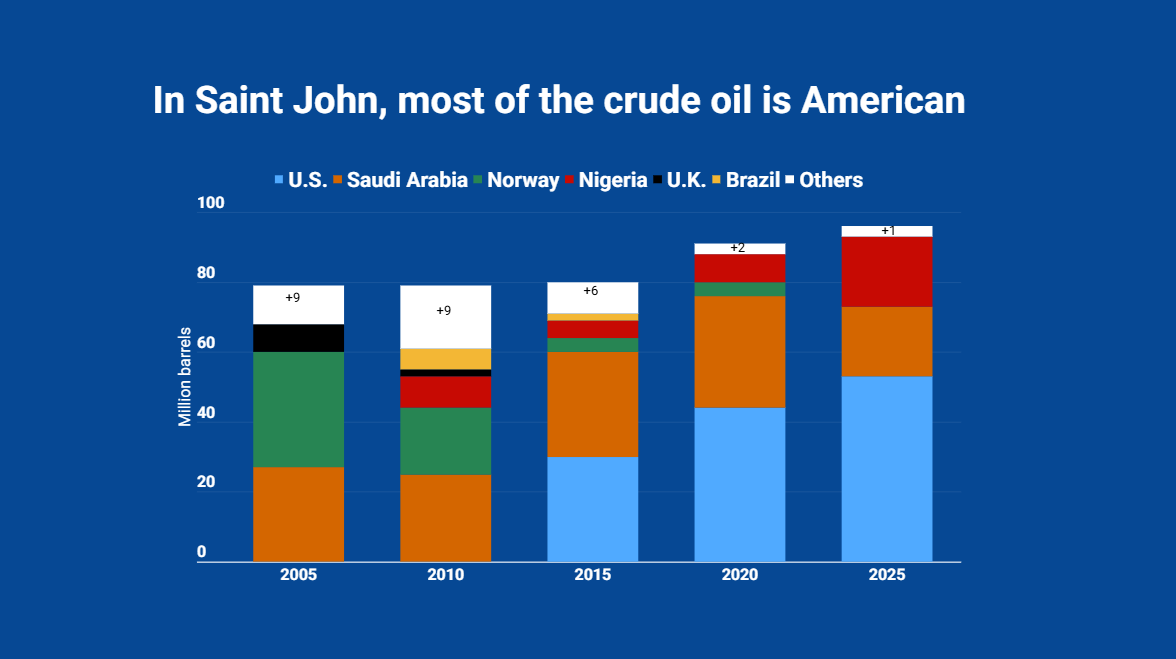
Most of the crude oil used by the Saint John refinery is imported from a few major exporting countries. Which countries and the volume they supply has changed over time.
In 2005, the refinery’s largest source of crude oil was Norway, followed by Saudi Arabia. By 2015, Saudi Arabia was the largest, the United States was second, and Norway had become one of the smaller providers. Since 2015, the U.S. has become the dominant source, and Saudi Arabia has been replaced by Nigeria in terms of importance.
Not only has the U.S. become the refinery’s most important source of crude (fig. 1), but the number of suppliers decreased to five by 2025 from 14 in 2010.
Relying on a limited number of sources, one of which (the U.S.) supplies more than half of the crude oil processed by the refinery, threatens the availability and affordability of petroleum products in Atlantic Canada.
For this to change, the refinery would need to reduce its reliance on the U.S. Could crude oil, either from Western Canada or Atlantic Canada, be an alternative?
Western Canada
For at least the past 20 years, there have been numerous attempts at bringing western Canadian crude to Atlantic Canada to help improve the region’s energy security.
Small quantities of crude oil have been delivered by rail, either from Western Canada or the western United States. Rail deliveries to Atlantic Canada (and assumed to be for the Saint John refinery) reached a peak in 2015 but have declined markedly since then (fig. 2). This may have been precipitated by the 2013 Lac Megantic tragedy and 2014 Plaster Rock derailment.
Probably the best-known attempt was TransCanada’s Energy East proposal to bring one million barrels a day of crude oil from Alberta and Saskatchewan for refining in Saint John and export to countries in the Atlantic Basin. Energy East required the repurposing of an existing natural gas pipeline, construction of a new line from Alberta to Ontario and extension through Quebec and into New Brunswick. TransCanada withdrew the proposal in 2017.
There has been interest in moving western Canadian crude to Atlantic Canada since, but there appears to be little likelihood this will happen.
Atlantic Canada
Newfoundland and Labrador’s offshore Jeanne d’Arc Basin was responsible for about 87.6 million barrels, or 4.5 per cent, of Canada’s crude oil production in 2025. Between 2020 and 2024, most of that went to the United States (fig. 3). The remainder was exported to the European Union and the United Kingdom. By 2025, the EU was the major importer.
The Jeanne d’Arc Basin produces both light and heavy crude oil (fig 4). Some refineries, like the one in Saint John, best handle light crude, while most in the U.S. are designed for heavy crude. At present, the basin produces more heavy crude than light.
Production from Newfoundland and Labrador is expected to decline over the next decade. However, exploration further offshore in the Flemish Pass Basin has found additional reserves of light crude oil (fig. 5). Equinor, a Norwegian multinational energy company, has an agreement with the Newfoundland and Labrador government to develop the Bay du Nord project in the basin.
The Bay du Nord and other projects are expected to reverse the decline of offshore production on Canada’s East Coast in the early 2030s (fig 6).
There is no publicly available data on how much, if any, crude oil from Newfoundland and Labrador is supplied regularly to the Saint John refinery.
What we do know is that concerns over the reliability of Saudi Arabian suppliers during Trump’s war on Iran have prompted refinery owner Irving Oil to make two separate requests to the Canadian Transportation Agency to use foreign-flagged vessels to carry limited quantities of crude from Canadian sources to the Saint John plant.
Five routes for western Canadian oil to get to eastern Canada
Canada’s rising oil exports to U.S. refineries have become a risk
A similar workaround occurred in 2020, when supply was threatened by the COVID-19 pandemic. Alberta shipped crude oil via the Trans Mountain pipeline to Vancouver, down North America’s west coast, and through the Panama Canal for delivery to the refinery.
Improving energy security in Atlantic Canada
It is unlikely that Trump would cut off crude oil supplies to the Saint John plant, since 80 per cent of the refinery’s product is shipped to the United States. But his renewed conflict with Iran could disrupt Saudi exports. As well, interruptions in U.S. crude oil production or shipments could limit supplies to the refinery. Atlantic Canada’s energy security is at risk from any event that disrupts the supply of crude oil or increases the price of refined products.
A potential approach to improving the region’s energy security would be to replace some or all non-Canadian crude oil imports to the Saint John refinery with supplies from Newfoundland and Labrador using Canadian flagged and crewed vessels. Shipping by tanker would not require construction of a pipeline and could be wound down as our energy sector was restructured to become more secure and less emissions intensive.
Atlantic Canada’s politicians need to recognize this and should make the case to the prime minister that using more crude oil from East Coast projects to feed the Saint John refinery is exactly the kind of “project of national interest” that needs fast-tracking through regulatory approvals.