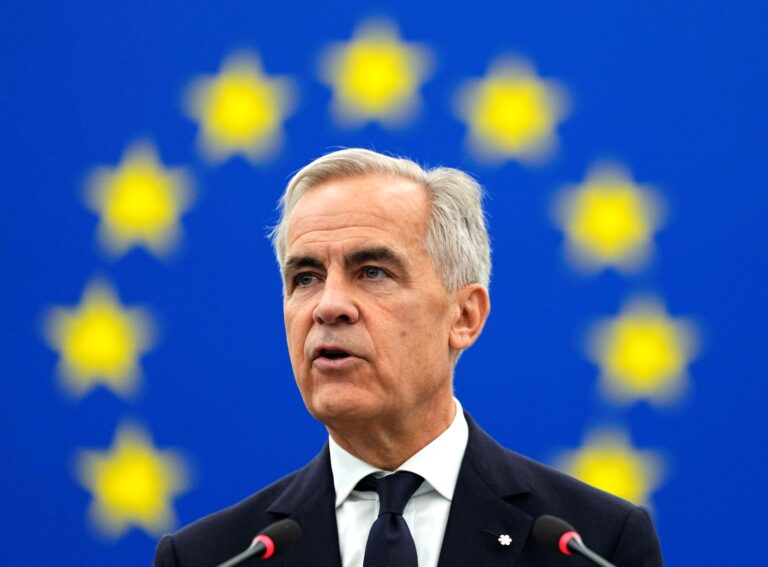
Prime Minister Mark Carney has staked his government on a sovereignty argument.
The 2025 federal budget committed $115 billion to nationbuilding infrastructure such as ports, pipelines and railways – some of which are dual-use civilian and military. This is part of what Carney calls Canada’s biggest economic transformation since the Second World War.
At Davos in January, he argued that sovereignty must be “anchored in the ability to withstand pressure.” The budget was an attempt to build an anchor in guns and steel – and that argument is compelling as far as it goes.
But it is calibrated on only one part of the global competition now taking shape. The next era of strategic rivalry will be decided less by who controls territory, resources and supply chains than by who controls the foundational technologies that will govern every sector of the economy and every dimension of national security. Artificial intelligence (AI) is the most visible current example.
The CUSMA review is Canada’s last chance to govern AI
Canada needs to develop its own AI computing power
Canada’s digital sovereignty debate overlooks software risks
Countries that lead in those technologies write the rules. They decide who can buy the most advanced chips, whose AI systems meet international safety standards and whose communication networks are trusted. Countries that lack those capacities are left to take what they are given, regardless of how many ports they build or submarines they commission.
That is the difference between a rule-maker and a rule-taker. It is also the distinction that the budget does not fully confront.
The Carney government needs to widen its sovereignty goals and take action now. Canada has world-class knowledge in specific domains – such as Arctic environmental science and AI safety governance – where global rules are not yet set and where the capacity to set them remains available to a country willing to invest.
A long-term problem
This is not a new diagnosis. In 1976-77, the Science Council of Canada argued: “Canada will need to assert technological sovereignty, that is, to develop and control the technological capability to support national sovereignty. Only in this way can we strengthen our technological base and, in turn, our long-term economic well-being and freedom of choice.”
Nearly 50 years of federal budgets and science/technology strategies later, the gap between that diagnosis and Canada’s actual investment in knowledge capacity remains wide. The 2025 budget does not close it.
Meanwhile, others are acting. Since 2019, the European Union has been building a policy framework around technological sovereignty. Ursula von der Leyen, president of the European Commission, defined the goal as “the capability that Europe must have to make its own choices, based on its own values, respecting its own rules.”
The connection to the rule-maker versus rule-taker distinction is direct. Without technological sovereignty, a country cannot shape the terms under which critical technologies are governed. It can only choose which dependencies to manage.
A country that does not control the enabling technologies governing its critical systems – the chips, software, platforms and standards – cannot make fully independent decisions about those systems, regardless of how many submarines it owns or ports it builds.
Canada must ensure its digital sovereignty in the face of U.S. threats
How Canada could achieve digital sovereignty
Who governs the digital sphere? How U.S. proxy lobbying erodes Canada’s digital sovereignty
Technological dependence is an economic problem. It is also a political one. When geopolitical pressure arrives, a country without its own technological capacity has fewer options and less room to resist.
Canada’s total research and development spending fell to1.81 per cent of GDP in 2022, well below the OECD average of 2.73 per cent. Within the G7, Canadian businesses rank second-lowest in R&D spending as a share of GDP – a position that has been constant across more than two decades.
The Council of Canadian Academies 2025 assessment of the state of science, technology and innovation found Canada continues to fall further behind international peers on key measures and calls for ambitious, decisive action to reverse that trajectory.
This is not a resource-sector problem or a small-market anomaly. It is the cumulative result of governments that have never treated knowledge investment as a strategic priority and of a business culture with little incentive to do so, either.
The 2025 federal budget does not break from this pattern.
First, the large federal granting councils – NSERC, SSHRC and CIHR – face an $83-million annual budget reduction.
In addition, when international researchers are recruited to come to Canada, they find a system with deep structural problems that remain unaddressed, such as thin commercialization infrastructure, few large firms willing to take R&D risk and a business culture that has historically treated innovation as optional.
The budget commits $926 million to “sovereign AI” computing infrastructure (supercomputers and data centres), but that hardware runs on chips governed by American export-control law. There is value in domestic computing capacity. But sovereign infrastructure built on someone else’s technological foundations and subject to someone else’s laws is a narrow form of sovereignty.
Semiconductors are the foundational input of the modern economy. Without advanced chips, there is no AI, no cloud computing, no modern defence system, no smart grid.
Canada appears in this picture only as a buyer. The United States currently shares access with allies, but it also decides – and has demonstrated that it will decide with increasing specificity –who gains access and who does not.
The Huawei affair made a related vulnerability visible. Canada was the last of the Five Eyes partners to ban Huawei and ZTE equipment from its 5G networks, spending four years caught between Beijing’s pressure and Washington’s warning that intelligence-sharing would be reconsidered for allies who chose the Chinese option.
Canada had no independent technological capacity on which to draw and could only calculate which form of pressure it was better-positioned to absorb.
Building the next frontier
Arctic environmental science and governance is one area where Ottawa should act. Canada has territorial stakes, scientific infrastructure and expertise, and the Arctic is becoming one of the defining geopolitical and environmental theatres of the century.
AI-safety research is another such area. Canadian researchers are among the founders of deep learning, the underlying questions remain open and whoever shapes the answers will be in a position to influence the regulatory frameworks that govern the technology globally.
Ottawa needs to choose fields where Canada has a credible chance to lead globally, invest at the scale that ambition demands and ensure that research capacity becomes industrial strength.
The Carney government has described the moment correctly – a rupture in the world order, a new era of leverage and pressure. The response should match the diagnosis.
Canada cannot build sovereignty only from ports, pipelines, ships and railways. It also needs the scientific institutions, industrial capacity, standards influence and technological depth that allow a country to shape the systems on which others depend.
Canada does not need to be a better rule-taker. It needs to decide, for the first time in a generation, which rules it wants to write.