Family policy is an odd concept. It is not clear what the objectives of this policy are. To support and help families presumably. But what kinds of families? And all families or just those who are failing to do what they are supposed to do? And what exactly are families supposed to do?
Economics is accustomed to describing the world as if it were made up of individuals, and of describing potential sources of market failure in terms of individuals. When one looks at family policy it is clear that those individuals are accustomed to forming voluntary coalitions— more or less permanent coalitions— to do what it is they do.
If we list some of the things that families do together it becomes clear why individuals continue to be interested in forming these arrangements, and why governments are immediately interested in whether families function well: they raise children; they purchase and hold and enjoy assets (such as housing); they spend a large amount of recreational time together; they purchase food and cook and eat together, in fact they consume many things together; they provide income insurance for each other against accidents, infirmity, age and unemployment (pooling risks)— even education; they look after each other.
Not all families do all of these things, but most families do most, especially when they are working well.
It seems clear that the family (and of course there is not just one type) is a primary institution of society— it is a way people choose to live to meet their needs. Further, many of the things that families do, such as raising children, providing physical and emotional care for family members and providing income insurance for family members, are things that as a society we are very interested in. As a result, governments have a strong interest in ensuring that families are able to do these things well.
So, perhaps, family policy is just a name for a set of diverse policies— income supplementation, tax policy, child care policy, social assistance policies, training and education policies, labour force policies, policies in relation to children, health care policy— that help families to function well.
On the broadest level, this must be true, but it doesn’t help provide us with clear objectives that family policy should pursue. Of course, there is a multiplicity of types of families and a range of different possible objectives. However, most people would agree that there is one set of problems that stands above all others: the problems related to the radical change over the last several decades in the roles of women in society and in families. In particular, there is the vastly increased participation of all women, and especially mothers of young children, in the labour force. This has changed the family dramatically from what it was, ultimately, I think, for the better, but the problems of the transition for families are often large.
We have all heard the figures, but they are worth repeating. In 1967 (Canada’s Centennial year, when many of us were young), only 17 percent of mothers with a preschool child (under school age) were in the labour force. By the turn of this new century, the percentage was four times as high— nearly 70 percent of mothers with preschool children were employed or looking actively for work. Most of those mothers were employed full time. That is, close to a million employed mothers, contributing about $27 billion of output to the economy per year and a corresponding amount of income to their young families. The proportion of mothers working has risen steadily in just about every year for nearly 40 years. It is a trend that is not likely to stop or be reversed any time soon.
As a result there have been big changes in the financial independence of women, and of the resilience of families to financial stress. There has been increased income for families. Women are much more likely to use their full range of talents and abilities. Young girls are much more likely to invest in their own human capital as a result of the role models they are provided by their mothers and other women.
However, along with the positive effects, there are negative ones— the stresses on families. The problem that I am particularly interested in is the effects on children. In the old days, we had a relatively well-established way of caring for children and raising children and educating young children. It put most of this burden on mothers and they handled it pretty well. Society has now changed in irretrievable ways, I think for the better. But we, as a society, have not determined a new set of mechanisms, of institutions, of social arrangements to provide care and education for our young children in the preschool years.
By 1988, the Canadian National Child Care Study, found that 75 percent of children between 18 months of age and before age 6 were in some kind of regular nonparental child care arrangements or kindergarten every week. Apart from half-day kindergarten in most jurisdictions at age 5, we, as a society, have spent very little of our attention or our resources to make sure children are well cared for in those regular arrangements.
So, in fact, these “regular” arrangements are actually quite irregular. Families use temporary arrangements— families get by. Mothers do off-shifting with fathers. Families get relatives to fill in. They pay relatively small amounts of money to have their children cared for by women who live in their neighbourhoods— women who, for one reason or another cannot currently be employed in the paid labour market. Unfortunately, in this life you generally get what you pay for, and paying a few thousand dollars a year for child care each year (even if that seems like a lot to the family doing the purchasing) only purchases care that is more custodial than it is developmental, performed by a person who is often not very keen on doing what she is doing, with little preparation for the job. The quality of nonparental care that many children get is, by any developmental criteria, probably mediocre to poor on average.
Many mothers (perhaps fathers too) feel guilty about the care of their children, and many make compromises in terms of advancement and types of job taken, many take part-time work, and so on. This goes a long way toward explaining the remaining wage gap between women and men.
This state of affairs is not acceptable. Nonparental child care is now second only to the family as an environment in which the early development of children unfolds. It is often the setting in which children first learn to interact with other children on a sustained basis, first interact with children of other cultures, establish bonds with adults other than their parents, and receive language stimulus outside the family context. A child’s early years appear to be his/her most important years.
There is, of course, mixed evidence about the short-run and long-run effects of child care, but increasingly there is a considerable consensus on a couple of points. First, good quality early childhood education has positive cognitive, language and social effects on most children (there is some doubt about very young infant children).
Second, the effects of this care depend a lot on what the alternatives are. When the care that would otherwise be provided is not very good, then good quality developmentally oriented child care will have strong positive effects. In particular, in disadvantaged families with income and educational deficits there is very strong and longitudinal evidence of positive and costeffective effects on many aspects of the development of children.
This evidence comes from a range of different studies: the Perry Preschool study, of course, the Abecedarian study, some good longitudinal data on the effects of Head Start programs on children. Unfortunately, there is not enough data on regular children as opposed to disadvantaged children. However, there is the very welldesigned National Institute of Child Health and Human Development (NICHD) study of over 1,000 regular children who are being followed longitudinally in the US. With the exception of the Longitudinal Study of Child Development conducted in Quebec, nothing even remotely comparable is being done in Canada, not even studies of kindergarten and its effects. Our carelessness about studying these issues reflects our general lack of interest in the care provided for young children.
All this points to a clear need for developmentally oriented early learning and care services for all preschool children as an essential complement to the child-rearing efforts of young families. It is true that there are already a number of elements of family policy in Canada that provide significant support to families trying to balance raising children and earning a living. First, there is taxation policy, which is individually based rather than based on the family unit. This tends to avoid or reduce punitively high marginal tax rates for mothers seeking employment. Second, there is the recently extended maternity and parental leave policy, now providing leave and benefits for almost a full year at the birth of a child, but with a cap on payments, so the parent at home can only get about $20,000 of benefits— perhaps considerably less than their prior income. Third, there is the Child Care Expense Deduction, which should be properly seen not as a child care measure but as providing more equitable taxation for employed mothers. To take a somewhat extreme case, but one that is easy to understand, if a working mother was in a 50 percent marginal tax bracket and there were no Child Care Expense Deduction, she would have to earn $14,000 in order to pay for a child care space for her preschooler costing $7,000 per year. With the Child Care Expense Deduction, she only has to earn (and pay) $7,000 for that child care space. Not to have a Child Care Expense Deduction would be a very significant barrier to women’s labour force activity and would be very costly to the Canadian economy. All of these are important ways in which we have, over time, tried to ease the conflict between work and family responsibilities, most of which have focused on mothers and work. Now we need to focus on children and the care they receive, which has big implications for families and work.
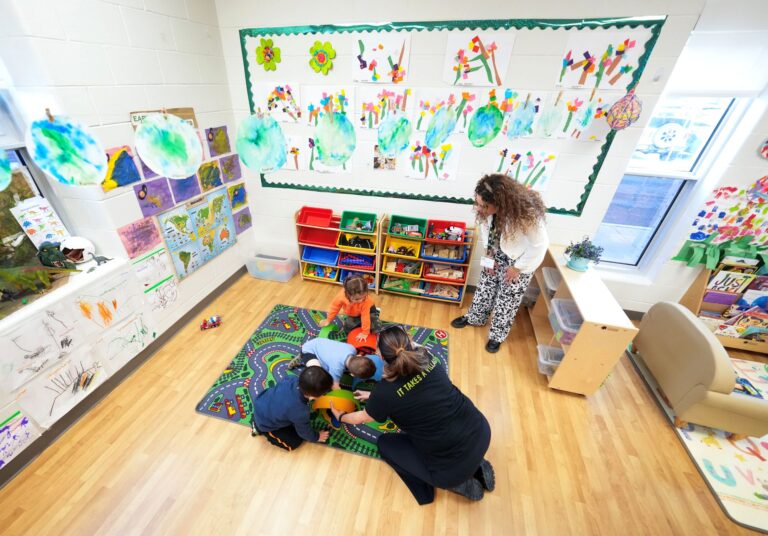
We need a policy that encourages all children to be well cared for in their early years. Some of that care will be provided by families and family members. Some needs to be provided by welltrained, highly motivated, loving and caring staff who have chosen early childhood care and education as a lifelong profession (or stable, long term, at least).
The evidence on the potential contribution of child care/early childhood education is quite strong. What set of policies will encourage families and permit families to choose early childhood education and care services of good developmental quality for their young children?
The conclusion that Michael Krashinsky and I have reached in our work pursuing a research agenda on child care is that universal programs with a substantial amount of public funding are likely to be most successful in supporting families and children. Furthermore, the investment of public dollars is likely to be worth the cost when measuring the human capital returns to children and the public benefits of mothers’ employment. These would be universal programs as opposed to income-based child care subsidies to poor families to encourage them to get off public assistance. These would be universal programs as opposed to programs that are only available to families with employed mothers. These programs would be universal in the same sense that kindergarten is universal. Of course, a substantial amount of public funding would be necessary to make this universality more than nominal, but it is also true that many families are willing to and can pay a significant contribution for good quality care.
I favour starting by focusing our attention on twoto five-year-olds, starting at the top end (fourand five-year-olds) and working our way down gradually with well-developed and supported programs. These would be universal, full-day, early learning and care programs, encompassing kindergarten where this exists and going beyond it to provide services that recognize and support the reality that most parents of young children are employed. Individual provinces (the design and delivery of services is a provincial/territorial responsibility) would no doubt differ in how kindergarten and broader services should be integrated. Quebec provides one model, Ontario has junior half-day kindergarten, and so on. From the point of view of the expansion of services, it would be ideal if these services were 100 percent publicly funded. However, it would also be reasonable to establish a core of full-school-day services that were free, with charges to parents for additional hours of care. It would be important to offer these kindergarten and child care services in as seamless as possible a way from the point of view of the child and the parent.
These proposals are hardly radical on an international level. Early childhood education services have become nearly universal for older preschool children in many countries over the last twenty years. Most European countries now regard early childhood education and care as an essential part of preparation of children for public school, an important component of the supports to families with employed parents, and as a venue for identifying children and families who will need special services. There is wide variation in policy toward ECEC for children less than three years of age, but full-day care with a developmental purpose is practically the norm in many OECD countries for children of three and over. The 2001 OECD report “Starting Strong: Early Childhood Education and Care” summarized the variation across child age levels in this way: “A pattern of coverage is seemingly emerging across the industrialized countries: a coverage rate ranging from 20-30 percent in year 1-2, and reaching over 80 percent coverage in full-time places, some time in the fourth year.” (p. 148)
How do we get there? There is enormous controversy over child care policy. There is virtually unanimous consent on the need for publicly paid child care of decent quality for the very poor who are also deserving (working or training). There is close to universal consent on the need for kindergarten services publicly paid for children in the final year before formal schooling (often for half days). There is very widespread support for maternity/parental leave (but the cost may cause some problems). There is considerable disagreement about whether mothers should work, whether children should be looked after by others, what kinds of care have positive effects. The controversy is the strongest about one-year-olds and perhaps two-year-olds. I hope and think that the controversy will diminish as good quality care flourishes, and as additional research provides more complete answers.
I believe that a good quality, universal set of services— building down from age four and five; probably based in the school system; developmentally oriented, not didactic, but play oriented; with a parental financial contribution, especially from those that use more services— will gain very substantial public support. I believe that parents will, despite some current worries in Alberta, overwhelmingly embrace these changes. For very young children (0 and 1 years of age), clearly different families will want different solutions, and the public support for child care and parent care and parenting supports will have to reflect this. Certainly, enhancing of the quality of existing out-of-home care for infant children is a high priority.
Dr. Gordon Cleveland recently wrote a monograph, co-authored with Prof. Michael Krashinsky, entitled Fact and Fantasy: Eight Myths About Early Childhood Education and Care, published by the Childcare Resource and Research Unit, University of Toronto.