(Version française disponible ici)
There are many things the Carney government needs to achieve its economic ambitions: global allies, foreign direct investment, intergovernmental collaboration and a skilled labour force.
But central to accomplishing anything is the public’s trust in government and the core of government itself, the public service. Both are closely related. The non-political public service is what executes the vision of the party in power and delivers core government responsibilities, such as the Employment Insurance system or monitoring food and drug safety.
But most Canadians have shaky confidence in the capacity of the bureaucracy, new data suggests.
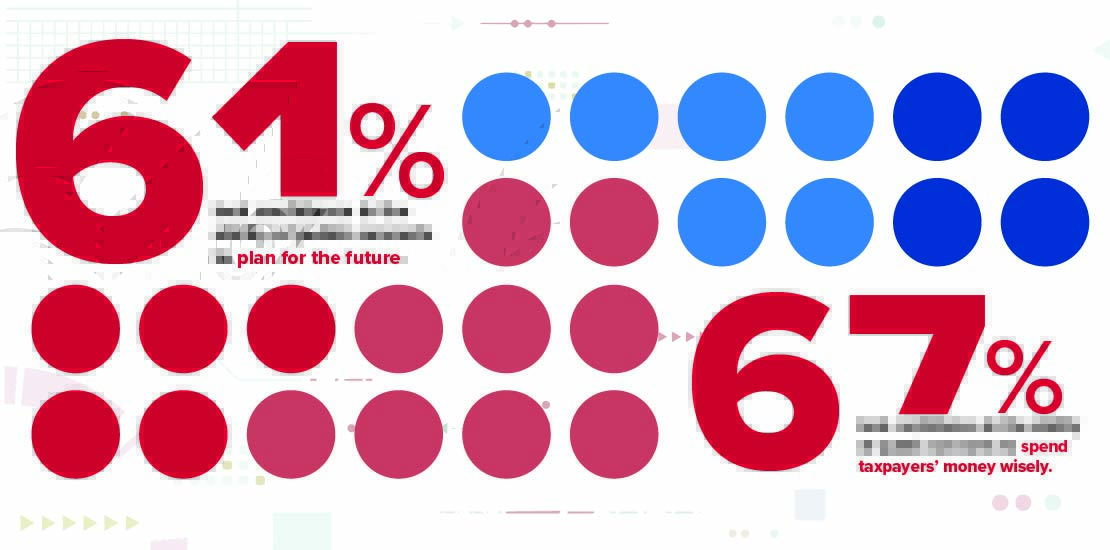
In a Confederation of Tomorrow survey, 61 per cent of respondents said they are not very confident or not confident at all in the ability of public servants to plan ahead by 10 to 20 years (figure 1). The study was done in February and March. The Institute for Research on Public Policy (the IRPP) is a partner.
That number rises to 75 per cent among Conservative voters.
In Saskatchewan and Quebec, a little over two-thirds of respondents said they don’t have confidence in their ability to plan for the future.
Overall, 67 per cent of respondents said they are not confident in the ability of public servants to spend taxpayers’ money wisely (figure 2).
Respondents were split on their confidence in public servants’ ability to deliver services to their community or to keep up with technological change.
Politicians, too, seem to have doubts about the federal government’s capacity. They are increasingly looking for ways to circumvent the massive machine that’s supposed to be there to get things done.
Over the past year, the Carney government has announced new agencies like the Major Projects Office and the Defence Investment Agency, positioning them as leaner and quicker entities than existing federal bodies.
Political staffers within ministers’ offices increasingly gather their policy ideas from people and entities outside government rather than the policy advisers inside the bureaucracy.
But these are workarounds. They don’t solve the fundamental problems. Someone has to knuckle down and fix the system we have.
To that end, the IRPP is launching a research project on state capacity. We have begun looking at what the federal public service needs to be able to deliver in one of the most challenging times in Canadian history. Over the course of this year, we will be publishing a series of memos and commentaries, and hosting public conversations, on how to tackle some of the most important constraints to state capacity. (You can sign up for regular updates here.)
Public servants often get a bum rap from politicians and the public. This project comes from a place of respect for a workforce that is capable of extraordinary accomplishments.
Canadians saw it during the COVID-19 pandemic, when public servants swung into action under extreme constraints to devise quick, innovative solutions. They performed acts of individual heroism despite outdated systems and inadequate intergovernmental processes. We documented it in a 2024 report from the Canadian Centre of Excellence on the Canadian Federation.
Public servants have a deep commitment to working for the public interest. They’re also deeply frustrated. We’ve encountered both sentiments in conversations with current and former senior public servants as part of our latest research. They are frustrated by seemingly intractable internal challenges that include the inability to hire and fire easily; a work culture that rewards risk mitigation over innovation; and the prioritization of developing ideas rather than executable plans.
A lot of these issues go back decades. There are shelves of reports on modernization. But politicians aren’t usually very keen to concentrate on public-service reform because it doesn’t win them any pats on the back from voters. The reverse, however, is also true.
When politicians don’t fix the underlying system, it can come back to haunt them. The public wants “the government” to deliver on its promises, and at election time it doesn’t discern between the politicians and the bureaucrats. They get lumped together.
Carney’s 15-per-cent challenge: Cutting and rewiring Canada’s public service
The executive cuts: Too many layers. Everyone knew it.
The public service needs to get better at firing its underperformers
Anxiety. Depression. Burnout: the galloping pace of mental-health claims
Worse still: there is a risk that a deeply dissatisfied electorate could gravitate toward populist movements and lose faith in government completely. At a time when sovereignty movements are making big noises in two Canadian provinces, trust in the whole government is a big deal.
Canadians aren’t asked very often to think about the public service, but it’s something everyone should care about. We want to build big projects, diversify trade, and become a significant middle power on the world stage. All smart, worthy goals. But the people inside government must have the skills, tools and processes to be able to get things done.
The 2026 Confederation of Tomorrow study consists of a survey of 5,696 adults, conducted between Feb. 14 and March 28, 2026. Ninety-two per cent of responses were collected between Feb. 19 and March 7; 91 per cent of responses were collected online. The remaining responses were collected by telephone, both landline and cellular, from respondents living in the North or on First Nations reserves, or from francophone respondents in New Brunswick.
The Confederation of Tomorrow surveys are conducted annually by an association of the country’s leading public policy and socio-economic research organizations: The Environics Institute for Survey Research, the Centre of Excellence on the Canadian Federation, The School of Public Policy at the University of Calgary, the Centre D’Analyse Politique – Constitution et Fédéralisme, the Brian Mulroney Institute of Government and the First Nations Financial Management Board.