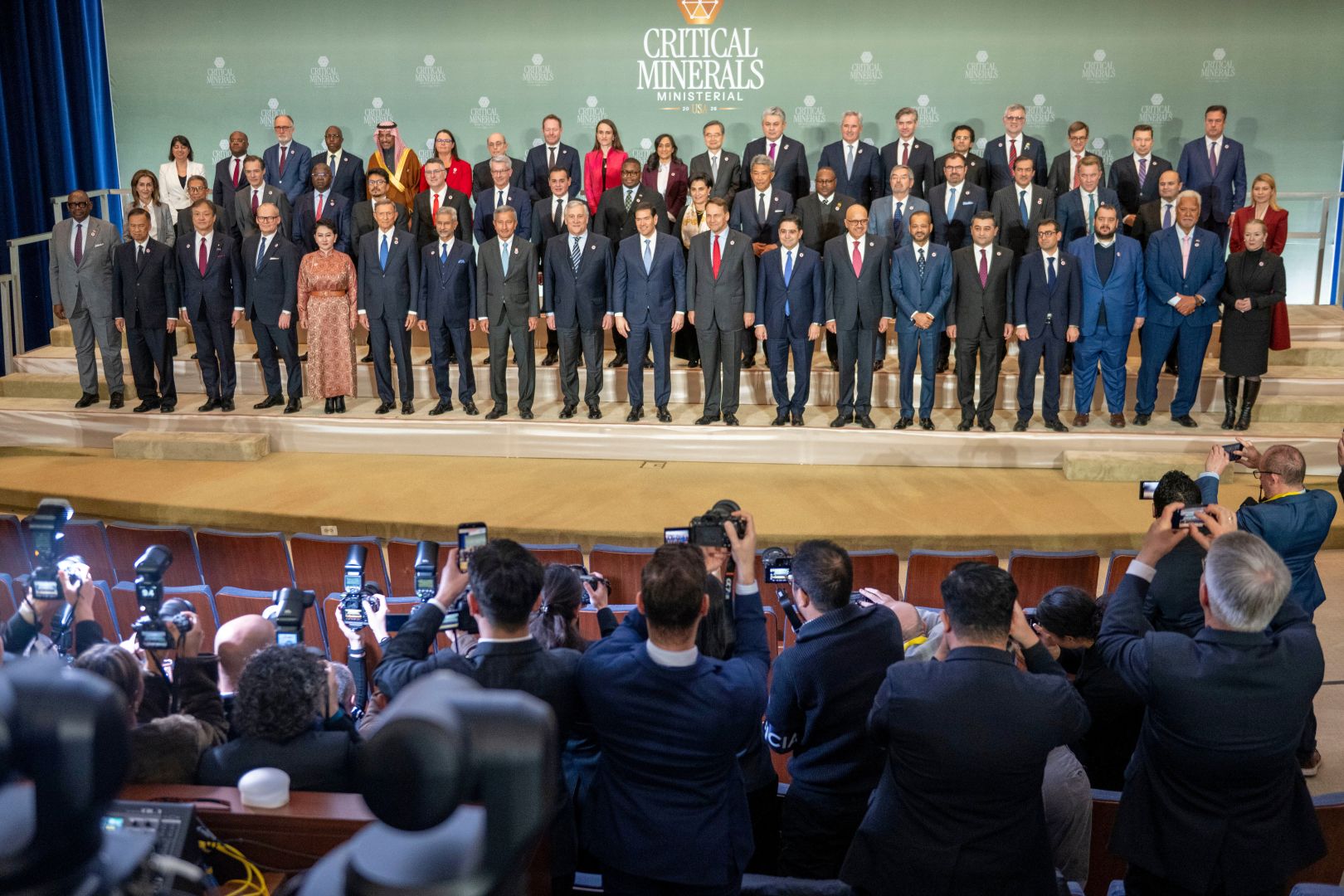
In February, the United States held critical minerals talks with 54 countries, including Canada, as well as the European Union. The stated goal was to counter China’s current grip on these minerals so crucial to green technologies by increasing international collaboration and stockpiling a separate supply.
Vice-president JD Vance called for a team approach and a “united front” against China. It’s a drastic departure from President Donald Trump’s unilateral policies that have been punishing long-term allies or threatening to take over their territory, as seen with Canada and Greenland.
Though welcome in principle, this new “critical minerals security” risks simply shifting reliance onto the U.S. from China. Nor does it necessarily lead to an effective transition to clean energy since Trump still maintains a pro-fossil-fuels stand.
China’s strategic chokepoint
Many producers around the world can supply critical minerals. Canada is one of them. But China dominates roughly 90 per cent of global rare earth processing capacity as it does graphite, lithium, cobalt and other materials. This makes China not just a supplier, but also the “factory floor” for key high-tech products — including batteries, magnets and electronics — that depend on these minerals.
China has also consolidated its position with export controls and strenuous licensing requirements on Chinese-sourced minerals and processing technologies. This has complicated western attempts to diversify supply chains or bring production to other countries like Canada.
Fragmented responses and alternative markets
Over the past fifteen years, western governments have experimented with a range of responses to dependence on China. There have been subsidies for domestic extraction and processing, bilateral deals to underwrite projects abroad and multilateral co-operation such as the Minerals Security Partnership. The former Biden administration was keen on extending U.S. leadership through several executive orders and partnerships. Agreements and memorandums of understanding were signed with Canada, South Korea and India, among others. Yet these efforts only partially dented the underlying imbalance in the critical minerals market.
Production costs, market prices and access to processing technologies have been perennial challenges. The U.S., EU and many non-Chinese producers face higher environmental, regulatory and labour costs and must also contend with China dumping heavily discounted products into their markets, thereby undercutting new production.
Subsidies have been poorly integrated and are often blamed for “start-and-stop” investment cycles in mining and refining. Moreover, western electric vehicle markets are volatile as consumer demand ebbs and flows in response to incentives and broader economic cycles. This has distorted market signals — sometimes undermining investment confidence in new supply chains. Local resistance to mining projects has further constrained production, especially in Europe where community acceptance remains fragile.
From fragmentation to a U.S.-led strategy
Agreements last October between the U.S. and Australia and the U.S. and Japan, as well as multilateral discussions emerging from critical minerals talks, parallel the previous administration’s strategy. But they also signal a shift towards more structured co-operation. These agreements envision co-ordinated investment, streamlined permitting, shared project selection and joint financing to create alternative supply corridors.
In theory, this unified approach could speed up diversification and reduce supply disruption, but it also has significant risks:
- Greater dependence on the U.S: Co-operation between countries through U.S.-led initiatives like Project VAULT (a strategic minerals reserve for companies) and FORGE (a multilateral investment mechanism) could simply shift reliance from one superpower to another. The same could be said of bilateral frameworks that emphasize U.S. financial support and policies. Smaller partners and middle powers like Canada, finding themselves tied more closely to American policy priorities, could face reduced leverage.
- Selective privileging: U.S. willingness to take equity stakes in strategic minerals companies — as signalled by a bill proposing a US$2.5 billion stockpile of critical minerals — favours U.S.-based enterprises. This can skew competition and favour U.S. companies over Canadian ones, for example.
- Negative market perceptions: Early evidence suggests that shifts in policy signals can depress the market valuation of firms previously buoyed by geopolitical supply concerns. Some Western mining companies experienced declines in share prices as U.S. policy actions reduced perceived supply risk premiums. This paradox of policy success undermining investment incentives is an underexplored risk.
- Marginalized European autonomy: Despite participation in discussions, the European Union remains less central to the U.S. bid to secure critical minerals and technology. Recent initiatives signal ambitions for continental strategic autonomy. The EU seems to maintain interest for now in partnering with the U.S. but at the risk of marginalizing the EU’s own supply chain structures.
- Reduced trade leverage with the U.S.: Hiving off critical minerals in a separate accord could eliminate a major point of influence for some countries, especially Canada and Mexico, in broader trade agreements.
- Market destabilization: Building a secure store of critical minerals could hurt minerals markets. While these efforts seek to provide user industries with a buffer against disruptions at mine sites, stockpiling is often perceived as a form of market manipulation when governments do not disclose or alter reported supply volumes. This creates uncertainty and market instability.
A strategic mismatch
Underlying these geopolitical strategies is a deeper contradiction: Washington wants to secure critical minerals without reducing fossil fuel production. This will not address the climate crisis, which Trump has repeatedly presented as a hoax.
So what would be a more coherent and equitable approach that could benefit Canada?
First, policymakers must recognize supply chains as more than geopolitical bargaining chips. Secure access should be paired with investment in recycling, substitution ad demand-side efficiency. These are areas where China’s dominance should be challenged and the competitiveness of western firms increased.
Second, challenging China’s dominance also requires thinking about the future in a technology-driven world. With current and fast shifts in mineral uses, western countries, including Canada, must assess new needs instead of focusing on a catch-up strategy.
Third, collaboration on critical minerals must evolve beyond bilateral frameworks so as to include non-U.S. countries in governance, financing and technical standards. This would help prevent new levels of dependency.
Fourth, climate and industrial policy goals must be reconciled. Supporting fossil fuel extraction while stockpiling minerals for clean energy is contradictory. It neither encourages a move away from oil, coal and natural gas nor builds durable supply chains.
Finally, the role of critical minerals must be clarified. Are these minerals to be used in the transition to green technologies or for military buildups? How do we prioritize them, especially when military and civilian uses overlap? And how can security of access be ensured given unprecedented tensions within NATO?
Ultimately, the geopolitics of critical minerals reveals a paradox that Canada must acknowledge. The very effort by countries to secure supply and reduce their vulnerability can itself entrench new forms of strategic reliance on the United States. Breaking China’s dominance requires more than subsidies, frameworks and summits. It demands an integrated industrial and climate strategy in which markets, countries and alliances share long-term objectives.