(Version française disponible ici.)
Long-term care (LTC) facilities are actually people’s homes. It’s where many Canadians live out their final days. But not all the residents in LTC receive the specialized care they need.
Often seniors’ behaviour that could be the result of past traumas is written off as a symptom of dementia. Care aides need training to identify the difference and provide trauma-informed care. Accrediting agencies and Canada’s new national long-term care standards include providing trauma-informed care. But that standard is voluntary. It must be made mandatory.
What does trauma look like in long-term care? A resident with dementia may become distressed or aggressive during personal care, particularly if they have a history of sexual abuse. Another may wander at night, repeatedly call for help or become increasingly difficult to reassure as communication becomes harder.
For someone who has lived through war, displacement or civil conflict, their behaviours in LTC may be connected to those earlier traumatic experiences.
How trauma can shape behaviour in long-term care
Sudden noises, unfamiliar touch, particular smells or other seemingly ordinary experiences can also provoke unusually strong reactions. A crashing meal cart, for example, might be distressing for someone who has experienced violence. The smell of smoke could trigger fear in someone who has survived a fire or another traumatic event.
There can be many explanations for these behaviours, including dementia, pain, anxiety, confusion or unmet needs. Trauma may be one factor among them.
That is why trauma-informed care does not require staff to diagnose trauma or assume a particular history. It asks them to recognize that past experiences may shape a resident’s response, avoid unnecessarily triggering distress and consider how care can be adapted.
Yet many long-term care workers receive little formal training in recognizing or responding to trauma-related behaviour.
Today more than 770,000 Canadians live with some form of dementia, and by 2030, there will be nearly a million. The vast majority of residents in LTC in Canada have dementia (69 per cent) or another form of cognitive impairment (87 per cent).
What is the relationship between dementia, trauma and PTSD?
Trauma increases the risk for dementia, and dementia can also increase the risk for delayed-onset PTSD. As my colleagues and I wrote in the Journal of the Medical Directors Association (JAMDA 2022), the overlap between symptoms can lead to misunderstanding resident needs and failure to provide effective treatment.
Long-term care staff are overwhelmingly caring and skilled providers, but they often lack trauma-informed training.
The good news is that providing trauma-informed care is actually included in Canada’s new (2023) national long-term care standards – a positive first step. Unfortunately, the standards are voluntary which means most provinces haven’t begun to implement them.
Accreditation Canada, which accredits roughly two-thirds of Canada’s long-term care homes, has adopted this standard for its reviews. The Commission on Accreditation of Rehabilitation Facilities (CARF), an international body that accredits more than 20 per cent of Canadian LTC facilities, already lists trauma-informed practice among its own accreditation criteria.
But without a mandatory requirement for trauma-informed care training in LTC, limited resources and stretched-thin staffing mean the default approach to problematic resident behaviour is too often medication.
In a 2022 study, we reported 53 per cent of care aides perceived that one or more residents they had cared for in the previous two weeks had a history of psychological trauma. While the study did not address this specifically, it may well be the case that some of the residents are experiencing symptoms of combined PTSD and responsive behaviours of dementia.
It’s clear LTC care providers need more support and training to address the complex needs of their residents. But training alone will not get us there.
The U.S. Substance Abuse and Mental Health Services Administration’s (SAMHSA) principles of trauma-informed care include: safety; trustworthiness and transparency; peer support; collaboration; empowerment, voice and choice; and attention to residents’ cultural and historical context. They describe a shift in how a care home operates, not a course staff complete once and set aside.
SAMHSA’s model spells out what putting those principles into action requires. In a nursing home, that means:
- Leadership commits real funding to trauma-informed care, not just an unfunded policy statement;
- Admission screening asks about past trauma the way it currently asks about medications and allergies;
- Physical spaces and routines are designed with trauma in mind, from private options for personal care to quieter alternatives to alarms during fire drills, to quiet, reflective spaces for staff;
- There is ongoing measurement of improvement to care and staff outcomes, not just whether training modules are completed.
Trauma-informed care must not be optional; it must be mandatory, it must be funded and it must be reviewed like any other required standard for accreditation.
Care that is not trauma-informed may result in resident suffering, both because they are re-traumatized, albeit unintentionally, and because staff, burned out and struggling with traumatic stress, may be unable to deliver optimal care. Plus, staff struggling with that level of stress may contribute to high staff turnover.
LTC residents deserve better.
Care aides are carrying trauma too
Care aides carry much of this burden themselves. Interviews with two dozen Alberta care aides found the same pattern: they could describe trauma-related behaviour in vivid detail, but had no training in how to name it, no framework for responding to it and no formal recognition that this work was even part of their job. As one aide put it, “We feel like we don’t matter.” A third described being hit, choked or chased by a resident reliving what researchers believe was a traumatic memory.
The cost to care aides’ mental health is measurable. In a 2024 survey of more than 2,200 care aides across 61 Alberta homes, nearly one in five screened positive for PTSD. A related analysis by the University of Alberta research program Translating Research in Elder Care (TREC) found that compassion fatigue – the toll of repeated, indirect exposure to residents’ distress – was strongly associated with a positive PTSD screen, more so than any other single feature of the workplace.
Trauma-informed care, in other words, is not only a resident-safety issue. It is a workforce-retention issue in a sector that is already short-staffed and cannot afford to keep losing the people who know this work best.
We need trauma-informed training for all care-home staff as well as employee assistance programs to help front-line staff manage workplace stress. LTC facilities in Canada are still seeing the negative impacts of COVID-19 – a trauma itself.
Canada’s aging population needs more personal support workers
A dementia-friendly plan in Toronto could lead the way for Canada
Seniors need trauma-informed services in long-term care homes
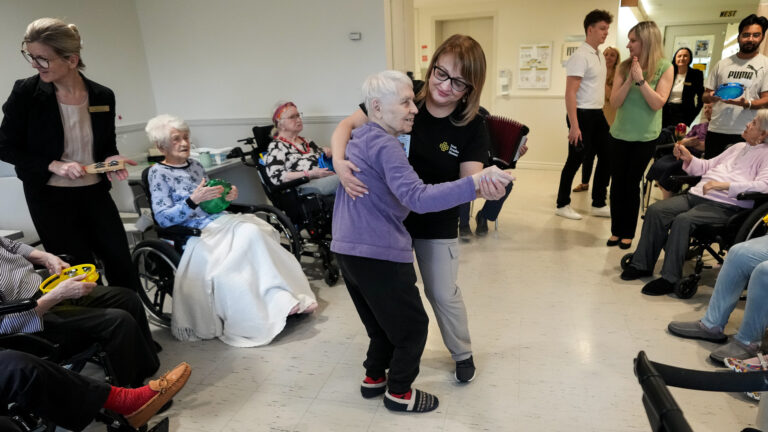
We also need routine screening for trauma in residents in LTC and resident programs that offer strategies to encourage sensory support and appropriate sensory stimulation in safe surroundings and with a proven track record – music, dance, yoga, pet therapy and the like – to help manage reactive responses. These are programs based in neurobiology and trauma-informed research, and, done appropriately, they support trust, safety, empowerment and are culturally sensitive.
Resident and staff trauma affect all those in the circle of care, from residents and families to frontline staff and managers. It’s time we made trauma-informed care routine and that government mandates and funds training across the country.
The federal government must play a lead role in this and skirt around the attitude that LTC is a provincial only matter. Mental health funding targeted specifically for staff mental health during and after COVID – firewalled, if you will – is an example of strong federal leadership in action. It can be done.
Our long-term care residents deserve to feel comprehensively cared for in their homes by well supported staff in their final years.