
Can you trust Mark Zuckerberg to design a socially responsible Facebook? How about Elon Musk with X or his artificial intelligence chatbot Grok?
The question of trust is at the heart of the Carney government’s recently tabled Bill C-34, the Safe Social Media Act, which would include a new independent regulatory body.
To date, most of the debate on the bill has focused on its proposal to ban teens under the age of 16 from social media. Critics have raised questions about whether such a ban is constitutional and whether it would risk privacy and freedom of expression by requiring that all social media users submit proof of age.
Critics also question how effective a ban would be. In Australia, a “substantial proportion” of teens are circumventing a similar ban, sometimes with the assistance of the social media companies targeted by the country’s new rules.
The complicity of social media companies in helping users beat the ban reflects a deeper, fatal flaw in the Canadian legislation. It trusts that tech companies in the United States will act in the public interest, despite having spent decades demonstrating that they are completely unworthy of such trust.
For the most part, Bill C-34 is a near carbon copy of key parts of a 2024 proposal for online harms legislation that died when Parliament was prorogued for last year’s federal election. The new bill tacks on the social media ban and extends its coverage to include chatbots and online services. What hasn’t changed is its motivating concept — the “duty to act responsibly.”
This duty is a form of corporate social responsibility which is a largely voluntary form of regulation that looks first to companies to police themselves and to take appropriate steps in the wider public interest.
Why trust is the wrong regulatory model
The United Nations sets out that all companies, regardless of nature or location, have a responsibility to respect human rights and more specifically to avoid causing harm to human rights through direct links to their operations, products or services.
In the case of Bill C-34, the Canadian Commission on Democratic Expression, which developed and championed the duty to act responsibly, requires platforms “to show that reasonable measures are being taken and, when necessary, adjustments made to avoid the occurrence of harms to individuals and groups.”
Legal scholar Vivek Krishnamurthy has called the concept a “made-in-Canada alternative to both American-style social platform immunity and European-style prescriptive regulation.”
Krishnamurthy’s situating this principle between no rules and state-set ones highlights the large role Bill C-34 places on companies to police themselves. The government would come in only after the fact to bless or criticize their self-regulation efforts.
Regulating companies entails evaluating their behaviour to determine whether they are capable and willingto comply with laws. Australian scholar John Braithwaite has put forth the idea of “responsive regulation” to describe how enforcement should begin with education and shaming before escalating to sanctions and criminal prosecution for continued bad behaviour.
Relatedly, companies can be mapped along a spectrum that runs from those most willing to comply (champions and compliant), to those with uneven compliance (confused and careless) and most seriously to ones that are regularly non-compliant (criminals and chancers, that is, risk-takers).
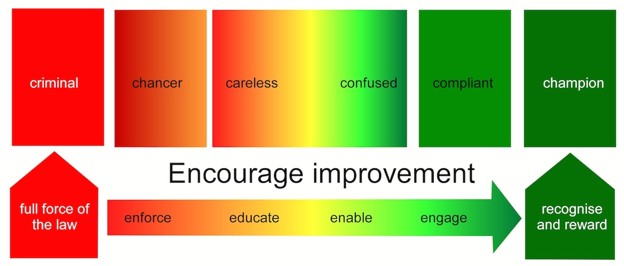
Source: South Australian Environmental Protection Agency. From 2012-2015 strategic plan, p. 2.
It’s clear that the actions of the large American social media companies place them toward the left of this continuum. The duty to act responsibly is more suited to companies that are at best confused about their responsibilities.
The large U.S. social media companies — X, Meta and Google/YouTube — have proven they are not good corporate citizens. These companies have repeatedly been found to amplify hate speech, incite racist violence, help spread misinformation and, in Facebook’s case, contribute to a genocide in Myanmar.
The duty to act responsibly can be effective only when the products being regulated don’t cause harm. One could reasonably expect daycares, for example, to take seriously this duty toward children in their care. But that’s problematic with tobacco companies, for example, because their existence is based on the sale of a dangerous product.
Political scientist Blayne Haggart, one of the authors of this commentary, argues that social media companies are akin to tobacco companies. Their goal to attract advertising and collect maximum data relies on using algorithms to encourage users to continually interact and make content go viral.
This gives companies an incentive to undermine, litigate, slow roll or play chicken with any regulatory attempts to restrict their activities.
Furthermore, the current U.S. administration gives tech companies more incentives to undermine any soft-arm attempts to persuade them to change their ways. The CEOs of social media giants have publicly pledged their fealty to President Donald Trump, who is himself openly hostile to regulation of American tech companies.
In response to Trump’s false accusations of bias against conservative speech, these companies slashed policies moderating their content and resources. Expecting companies beholden to a hostile, authoritarian government to comply meaningfully with legal responsibilities to police their platforms — even in the face of significant fines — is naïve.
Nothing that social media companies have done over the past 20 years suggests that they will be honest, willing partners with Canadian regulators. Yet that is the foundation upon which the Carney government is constructing its regulatory house of cards.
Address design and the business model
The key to regulating social media companies effectively is to recognize them for the bad actors they are and to respond according. Instead of relying upon them to “implement adequate measures,” as Bill C-34 proposes, rules need to address their design and business models, which are the drivers of their bad behaviour.
On the design side, an independent regulator could require a platform’s recommendation algorithms, which suggest content or groups to join, to instead prevent hate speech or slow the spread of discriminatory material or promotion of self-harm. For example, a 2022 report by Yale University’s School of Management points out that platforms could be directed to craft algorithms that put weight on the veracity of content.
Fixing attention- and data-driven business models is even more important. Social media companies are reliant upon advertising revenue, which means they work to attract as many users as possible — even when that means amplifying harmful or illegal content.
A regulator could restrict a platform’s ability to collect and monetize data. It also could require that companies move toward subscription fees or advertising that reflected only the content of a user’s searches or browsing rather than demographic traits captured from personal data. This change would reduce incentives that drive much of the bad behaviour exhibited by social media companies.
Choosing the right path
Years of harmful activity by social media companies has left Canadians desperate for governments to develop regulations in the public interest.
Recycling corporate social responsibility ideas has an innate appeal to digital-rights activists, many of whom remain suspicious of any government attempt at online regulation. In addition, leaving so many decisions about compliance to the companies themselves would certainly appeal to a government that has shown itself reluctant to regulate powerful U.S. companies.
But charting a middle path, as Bill C-34 proposes, isn’t the answer. More important is choosing the right approach to the job. Everything we know about these companies suggests that trust-based regulation simply won’t work. Government regulation and enforcement are the only things that can bring these companies into line.
Bill C-34 is made for a world that doesn’t exist. Its design is ineffective and offers little more than a pretext for its supporters to say, “At least we tried something,” even as the real problems they promise it will address continue to fester.