Maybe you’ve felt it by now. Anxiety, with a hint of emptiness, when you release something into the world you’ve co-created with a chatbot.
At the same time, maybe you’re no longer sure you’re capable of doing your work without AI, at least not as efficiently as you could. Dependency is what tech companies want from us. Daily active users is their metric, not ours. And they are pursuing it at all costs, including our children’s ability to learn.
Ottawa’s AI for All strategy makes a sweeping commitment to AI literacy. In its framing, literacy fuels trust, trust inspires adoption, and adoption is the only thing standing in the way of prosperity for all. Experts were quick to question this logic, noting it is not understandingthat stands in the way of public trust, but the lack of suitable safeguards as AI inundates our lives. We don’t trust AI because we’re overexposed to harms and excluded from alleged benefits. This discrepancy is especially stark in K-12 public schools.
Both the prime minister and minister of AI and digital innovation have warned of a brain drain, where top tech talent flees for the bloated salaries of major U.S. firms. Pillar 4 of the AI strategy calls for an increase in investment in talent attraction to lure and retain experts within our borders. But for a government intent on a thriving domestic talent pool, it is ignoring an urgent, upstream brain drain where generative AI ruptures young people’s capacity to think.
Emerging research warns that an over-reliance on chatbots harms critical thinking, essay writing and math acquisition. Often called cognitive offloading, the theory holds that generative AI systems foster dependence and compel users, especially young people, to sideline mental effort in favour of quicker, passable chatbot-generated work. A 2025 paper that claimed ChatGPT had a positive impact on learning was later retracted due to validity concerns.
Research on cognitive offloading validates what public educators are witnessing on the front lines. A 2026 Canadian Teachers’ Federation survey asked more than 6,200 teachers about their biggest concerns for education. Respondents frequently called out the impacts of AI systems on student learning and self-efficacy, teacher autonomy and human connection. One educator warned:
“Student use of AI [is] creating increasingly shallow learners who regurgitate information instead of critically thinking about new information they are given. I’m an English teacher, and they’ve already started to use it for shockingly simple things like ‘Describe your favorite memory,’ [I see] them type into ChatGPT ‘what is my favorite memory?’”
The most compelling reason to address what’s happening in K-12 schools comes from young people themselves. The 2025 Gen(Z)AI Youth Assembly in Toronto brought together 100 participants aged 17 to 23 to talk about their concerns with AI chatbots and develop policy solutions. One of their three biggest worries? Cognitive offloading and the consequences for “their ability to learn, work and engage in civic discourse.” Similarly, a Brookings Institution’s 2026 study found 65 per cent of surveyed students felt cognitive decline was the greatest risk of AI.
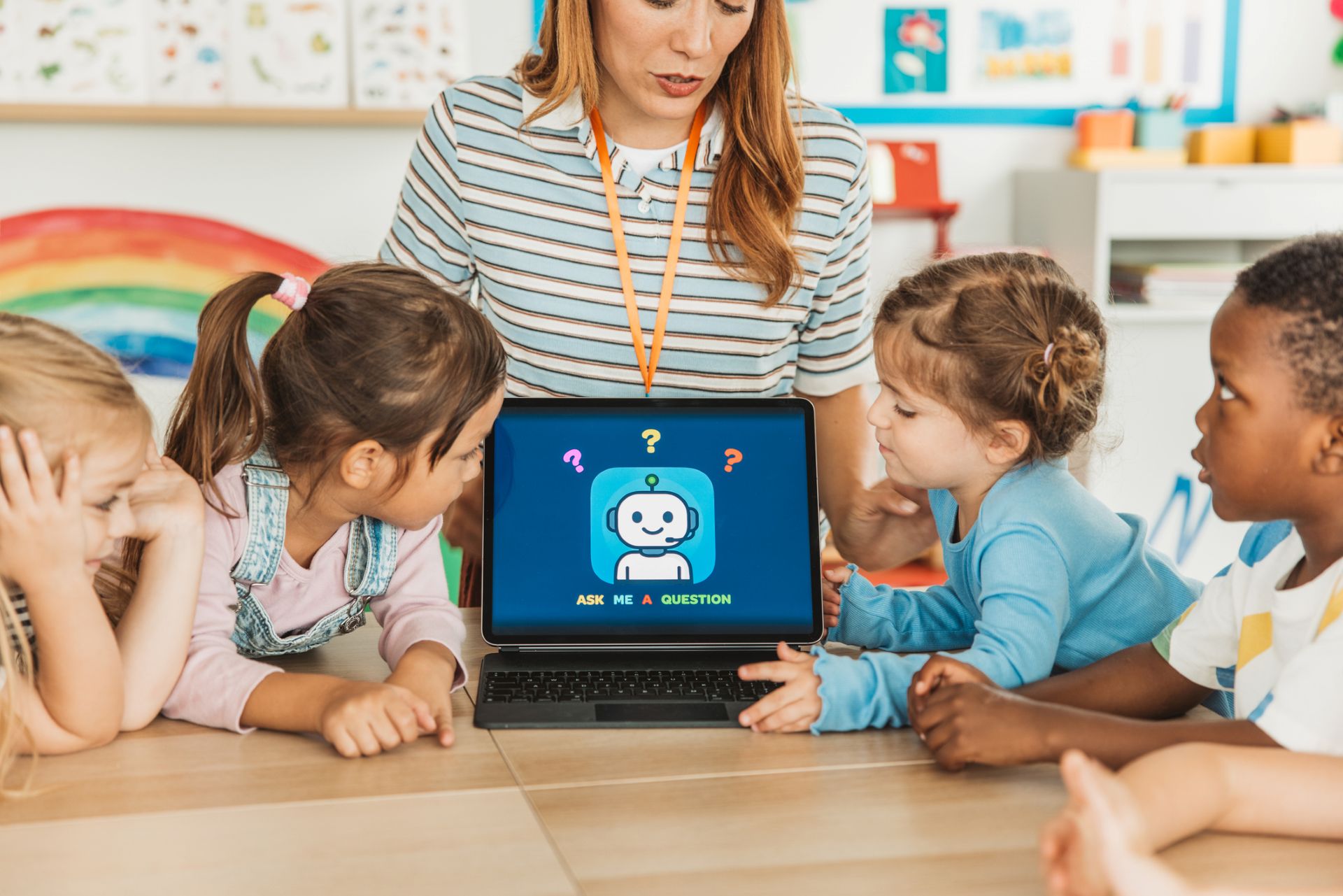
Despite warnings, our under-resourced public education systems are vulnerable to snake oil. We’ve all heard them by now — Gates, Altman, Zuckerberg — promising AI will revolutionize education. They idealize a future where every student has a personalized algorithmic tutor designed by their company. They are right that personalized learning benefits students but wrong about the delivery mechanism. Students do not learn best plonked in front of a screen or locked into interactions with an anthropomorphic machine. They learn through strong, trusting relationships with qualified teachers, teachers who understand the context and culture of a student’s life and tailor learning in response. And the benefits of human connection are strongest for the most marginalized students.
Big Tech’s profit-fueled fantasies must not undermine our own vision of education as a public good. What is lost when AI increasingly mediates the teacher-student relationship? When students are shoved toward unreliable, risky AI platforms instead of a trained educator? When time-starved teachers offload lesson planning to a chatbot that will never possess a nuanced understanding of how each individual child learns? Well-resourced provincial and territorial school systems, with smaller class sizes, specialized supports for students and protected prep time for teachers, would go a long way toward enabling the human-centred, personalized learning young people need to truly thrive.
Generative AI and deeper thinking: What’s in our heads still matters
The federal government also has an essential role to play. A recent G7 statement committed to “providing a safe digital space” for children and youth “for their development, for their education and for their well-being.” If the government is serious about this, there are notable gaps in the AI strategy. The national AI literacy initiative barely acknowledges K-12 education, with a vague commitment to arming only 3,000 of the 420,000-strong public educator workforce with “AI learning kits.” Educators and students should be at the helm of defining and designing K-12 AI literacy programs. Crucially, programs must prioritize a critical understanding of AI risks, not simply enthusiastic adoption, and be accessible to schools throughout the country.
If the Safe Social Media Act (Bill C-34) passes, a new Digital Safety Commission of Canada will administer the rules on what makes digital services safe for children. While the legislation explicitly regulates social media platforms and AI chatbots, it also allows the government to create new categories of regulated online services when they are found to pose significant risks to young people. AI systems used by children for learning that may not meet the definition of a chatbot, such as AI tutors with anthropomorphic features, must be declared a regulated online service.
In defining age-appropriate design standards for regulated services, the commission must hold technology companies accountable for features that pose developmental risks to young users. For example, the sycophantic, frictionless interactions often central to AI chatbot architecture have been shown to inspire dependence and inhibit the productive struggle necessary for learning. While regulating AI learning systems cannot prevent children from using chatbots to do their homework, it will ensure systems that make it into schools are grounded in safety and efficacy.
The digital safety commission, or the Office of the Privacy Commissioner of Canada (OPC), depending on how Bill C-34 progresses, should also have a mandate to develop national standards for EdTech procurement. This is something the OPC has called for. A common set of standards would ensure every district, especially the least-resourced, can hold vendors to the same high bar for safety, privacy and children’s right to learn.
More than 90 per cent of young people attend public K-12 schools in Canada. Our universal public education system is something to be proud of and to protect. Slowing down the rollout of AI in our schools to give research and policy time to catch up will avoid the real risks to student learning. Young people who feel cognitively stunted and drained of connection are unlikely to trust a government that suggests AI systems may someday, somehow benefit us all.