A few short decades ago, a prime minister recognized the perils of establishing new national programs without provincial and territorial buy-in. He put important limits on the use of the federal spending power – Ottawa’s ability to spend on anything it wants, even if it falls in provincial jurisdiction. The move was lauded across most of the country and set the ground rules for a more productive mode of fiscal federalism in Canada.
No, that prime minister wasn’t Stephen Harper. Although his brand of “open federalism” abided by many of the same rules of engagement and helped broaden and deepen Ottawa’s commitments.
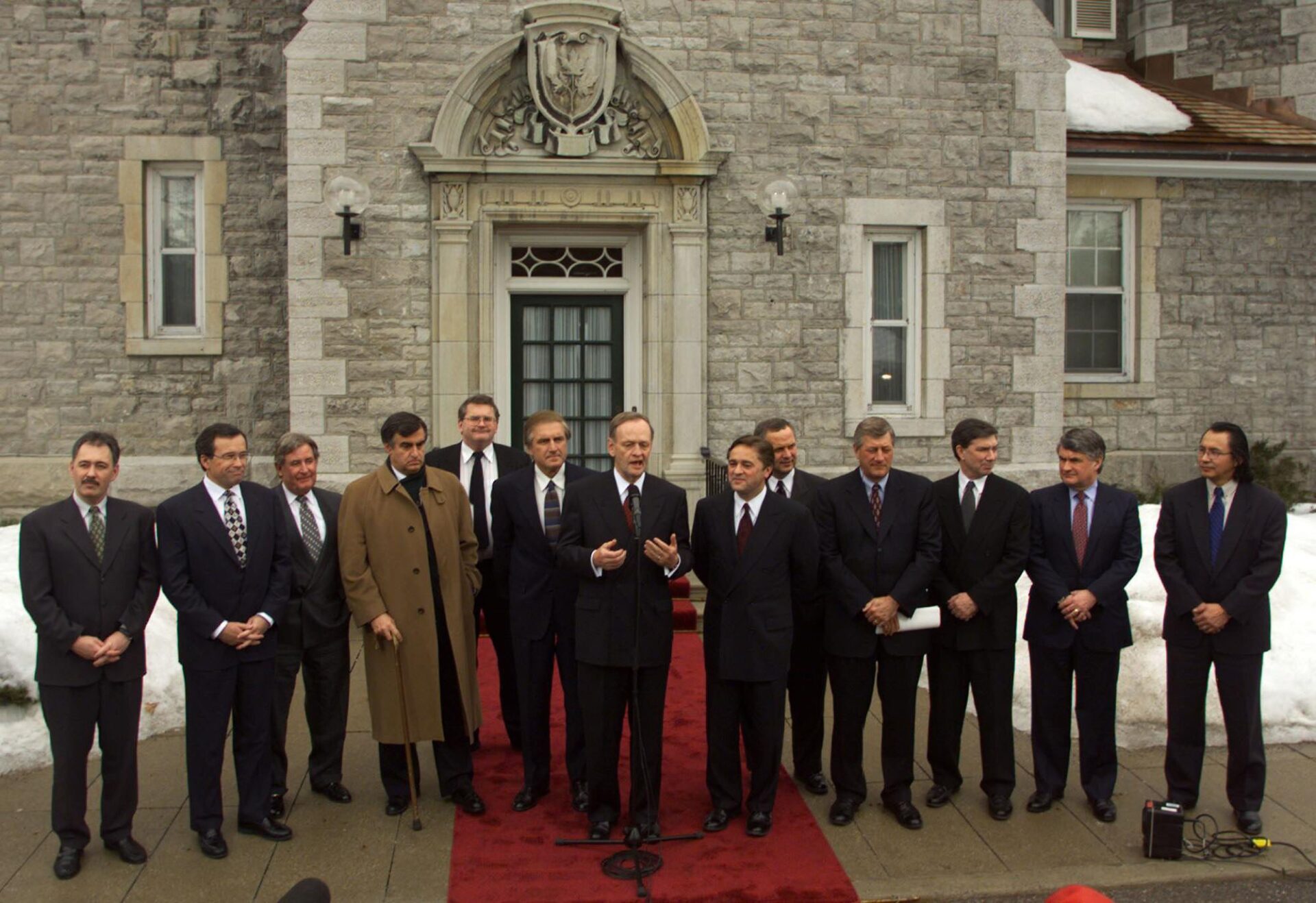
It was Jean Chrétien who understood the importance of restraint when dealing with areas of provincial and territorial jurisdiction. He and the premiers negotiated the Social Union Framework Agreement (SUFA), with 10 of 11 governments signing the landmark deal in 1999.
While Quebec withheld its signature (the document included a line recognizing the constitutionality of the federal spending power, which the province contests to this day), SUFA was an important step in limiting Ottawa’s ability to spend in areas of provincial jurisdiction.
Many of the same conditions confronting Chrétien then confront Prime Minister Mark Carney today: massive deficits, intergovernmental turmoil, national unity tensions and more important federal priorities than treading on provincial and territorial turf.
That’s why resurrecting and revamping the Social Union Framework Agreement is the right choice for this moment.
Rules governing the use of the federal spending power
SUFA was an accord between the federal, provincial and territorial governments (except Quebec) that established principles and processes for co-operation in social policy. It affirmed shared Canadian values such as equality, fairness, diversity, dignity and mutual responsibility, while committing governments to providing accessible, reasonably comparable social programs across the country.
The agreement promoted mobility rights by removing residency-based barriers to services and employment, and strengthened public accountability through performance reporting and citizen engagement.
Governments committed to notifying each other of any major changes to social programs and transfers, and to joint planning whenever possible.
Most importantly, SUFA set rules for the use of the federal spending power, requiring consultation and provincial and territorial support for new Canada-wide social initiatives while preserving jurisdictional flexibility in program design. No new national programs or services could be established without the agreement of at least half the provincial and territorial governments, and those with existing programs of a similar nature could opt out with compensation.
The agreement has never been repealed and doesn’t have an expiry date. It simply fell into disuse during the Trudeau years, which means it would be a good foundation for a renewed accord on managing Canada’s social union. There are eight areas in particular that require updating and strengthening.
Reimagining a new SUFA
For one, we should expand the definition of the social union beyond 1990s categories to include housing, child care, disability supports, long-term care, digital access, climate resilience and income security – areas now central to social citizenship but not fully captured in the original framework.
Second, we should remove the clause endorsing the federal spending power as constitutional. This is a relic from old intergovernmental disputes, a poison pill for the Quebec government and an affront to the spirit of co-operative federalism the Carney government is promoting.
Third, accountability provisions should be modernized to acknowledge that governments are accountable to the public they serve, regardless of how social programs are funded. Too often, federal reporting requirements are based on the false assumption that provincial and territorial governments are accountable to Ottawa for health and social spending. They are not. All governments are responsible to their respective legislatures. And there is only one set of taxpayers – all levels of government are accountable to them for how public dollars are spent.
Fourth, through the concept of open federalism, the Harper government put Canada’s system of fiscal federalism on a more sustainable and equitable footing. The core principles and formulas he established remain in place today, despite the upheaval of the Trudeau years, suggesting they could also be incorporated into a revamped SUFA as a means of entrenching good practice. These should include:
- an explicit commitment to each order of government respecting the autonomy of the other, and to delineating and clarifying roles so Canadians understand who is responsible for what
- a recognition of and commitment to reducing the vertical fiscal imbalance, which sees Ottawa collect more revenue than it can spend on its areas of jurisdiction, while provinces and territories bear more constitutional responsibility for the social union than current revenue levers can support
- a pledge to work constructively and bilaterally to support social programs and services, prioritizing variable geometry, flexibility and local needs ahead of one-size-fits-all approaches
- an affirmation of the importance of per-capita formulas for all health and social transfers as a means of treating all Canadians equally regardless of where they live.
Fifth, in a renewed SUFA, limits on the federal spending power should be clarified to include direct federal spending on provincially and territorially regulated industries and institutions, as well as municipalities. Any new federal initiatives that target these sectors should be fully negotiated with the provinces and territories involved, and funds flow through federal-provincial-territorial transfer agreements.
Sixth, the mobility provisions should be updated to move beyond commitments to providing all Canadians access to services. Mutual recognition of professional credentials, especially in health care, early learning and social services, should also be included. This will allow professionals greater choice and governments greater access to the labour they need to renew the social union from coast to coast to coast.
How Canada’s internal trade reform echoes 1864 — and what it will take to finish the job
Seventh, the chapter dealing with Indigenous rights could be updated to reflect Jordan’s Principle and best practices, including those developed by tripartite partnerships in Alberta concerning child care, education, policing and health.
Lastly, the new SUFA should include, given their increased prevalence, crisis-response rules for pandemics, disasters and sudden economic shocks.
Alberta well positioned to lead efforts
Given global threats and instability, a renewed Social Union Framework Agreement would bring the sort of order and predictability that governments across Canada are seeking here at home. It would also help calibrate expectations around the expansion of new programs and services at a time governments should be focusing on the sustainability and modernization of the core ones we have.
The national pharmacare and dental care programs rolled out under the Trudeau government might not have come to fruition had SUFA been respected. SUFA wouldn’t have prevented them. But it would have required the federal government to negotiate with the provinces and territories whose jurisdiction they wanted to influence, achieve majority support and offer compensation to those jurisdictions that chose to opt out. This hard work may have discouraged the federal government from pursuing new national initiatives, and there’s no guarantee that more than half of the provinces and territories would have signed on.
This brand of collaborative federalism does not need to be led out of Ottawa. Premiers have proven quite effective at setting national priorities and carrying out the hard work of consensus-building. National does not need to mean federal.
As a first step, premiers should table discussions around a renewed SUFA at the next meeting of the Council of the Federation. They should task ministers responsible for health, education and social services with forming a working group to review and revamp the agreement for presentation to the federal government within the year.
Given Alberta’s success with previous initiatives like the Canadian Energy Strategy, the Harper-era reforms to federal transfers and generating consensus around the need for reforms to the fiscal stabilization fund, it is well-positioned to spearhead these efforts.
It is one of many ways Alberta can prove its commitment to lead, not leave.
The authors are both members of Lead Not Leave, a policy initiative advocating for a stronger Alberta within a united Canada.