The broadcast opens with an aerial shot: a red-earth road threading through dense green forest, the camera slightly unstable, signaling distance and difficulty of access. A graphic flashes numbers that compress scale into immediacy: “1,000 suspected cases … several hundred dead … WHO declares emergency.”
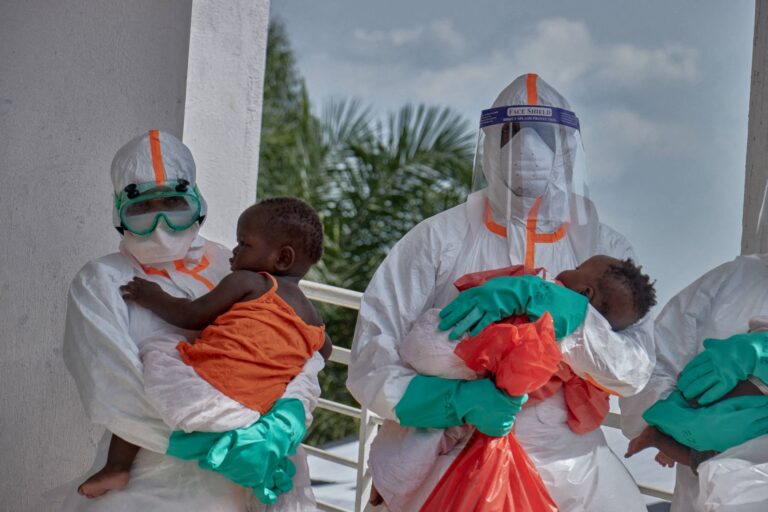
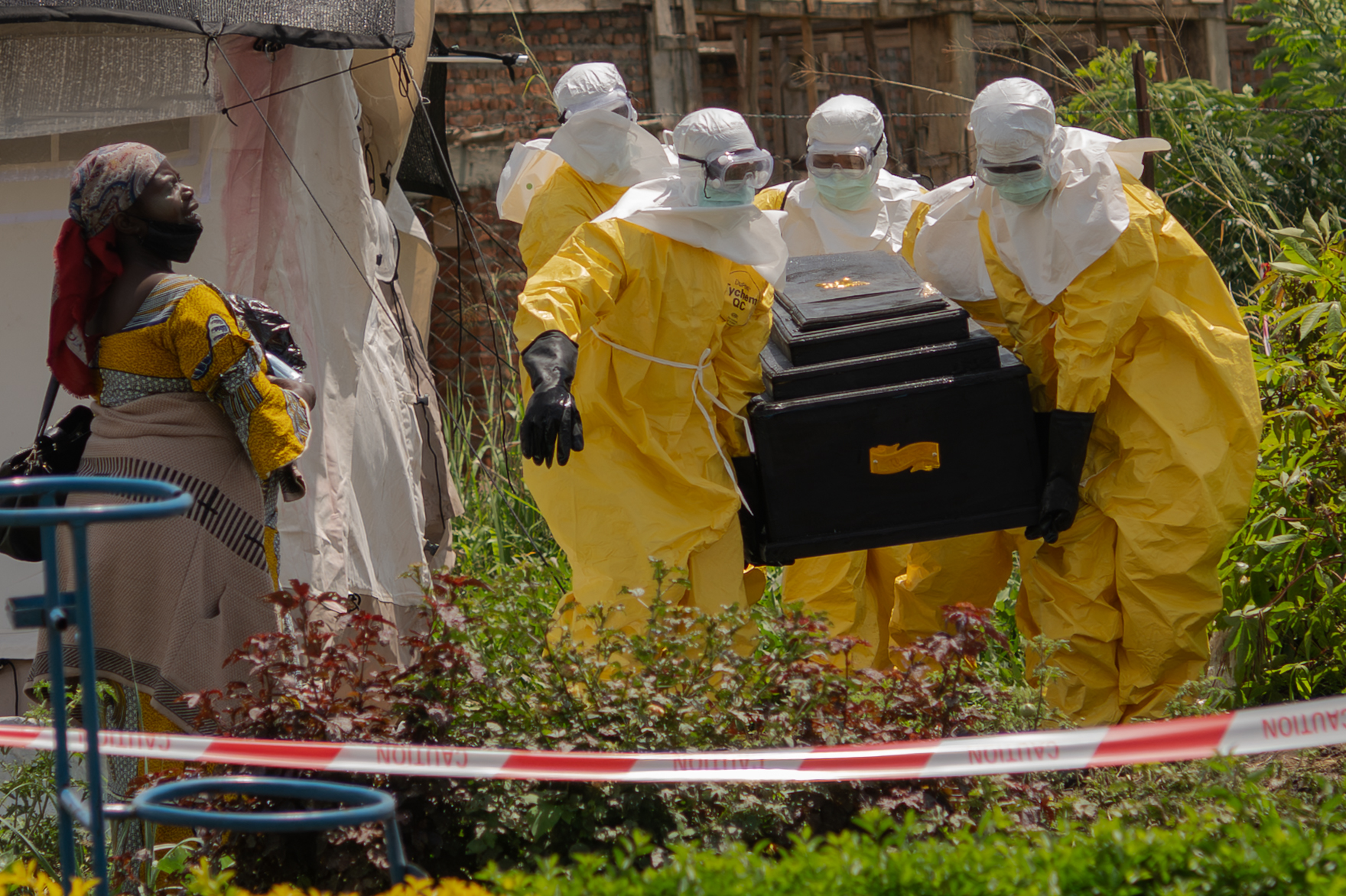
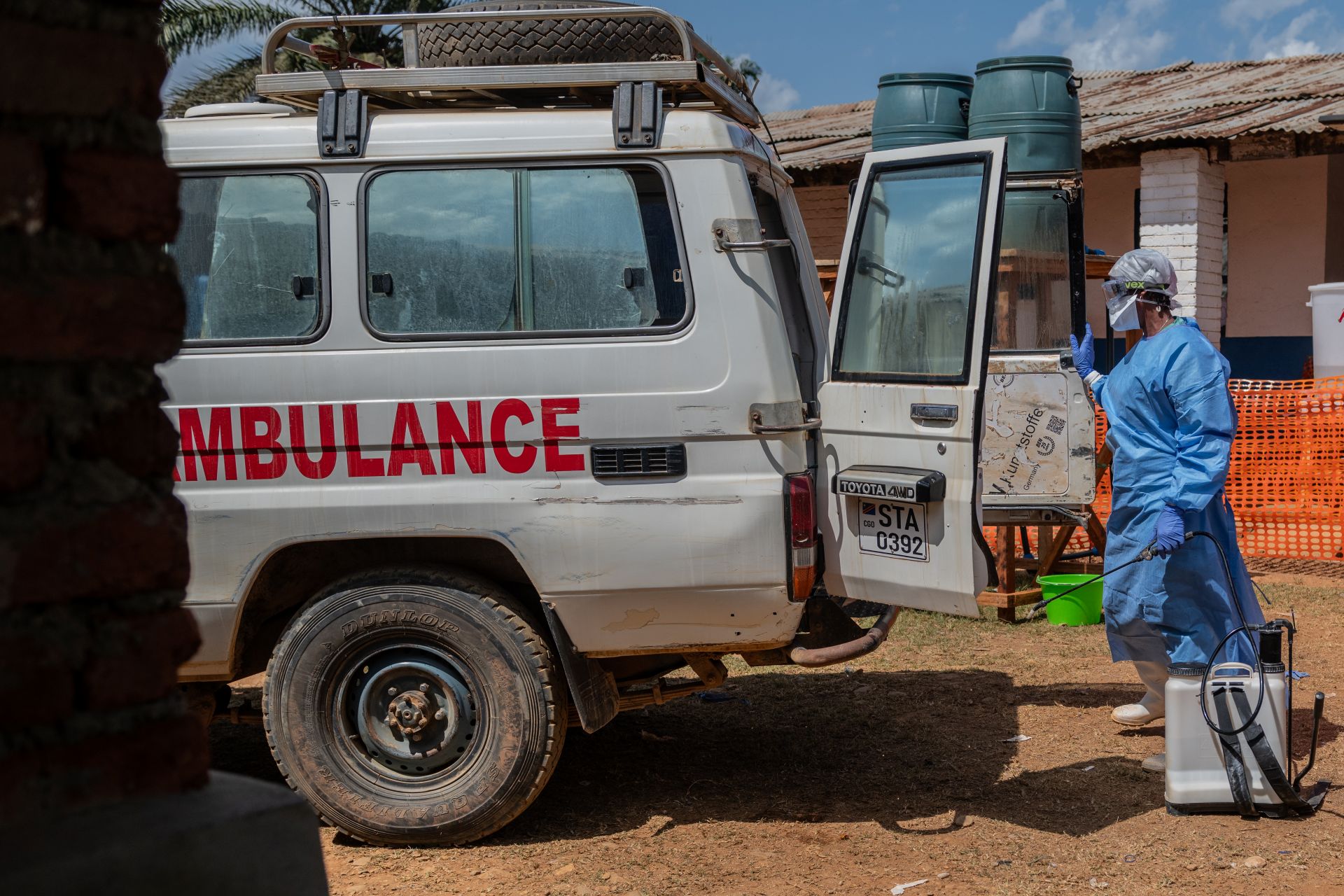
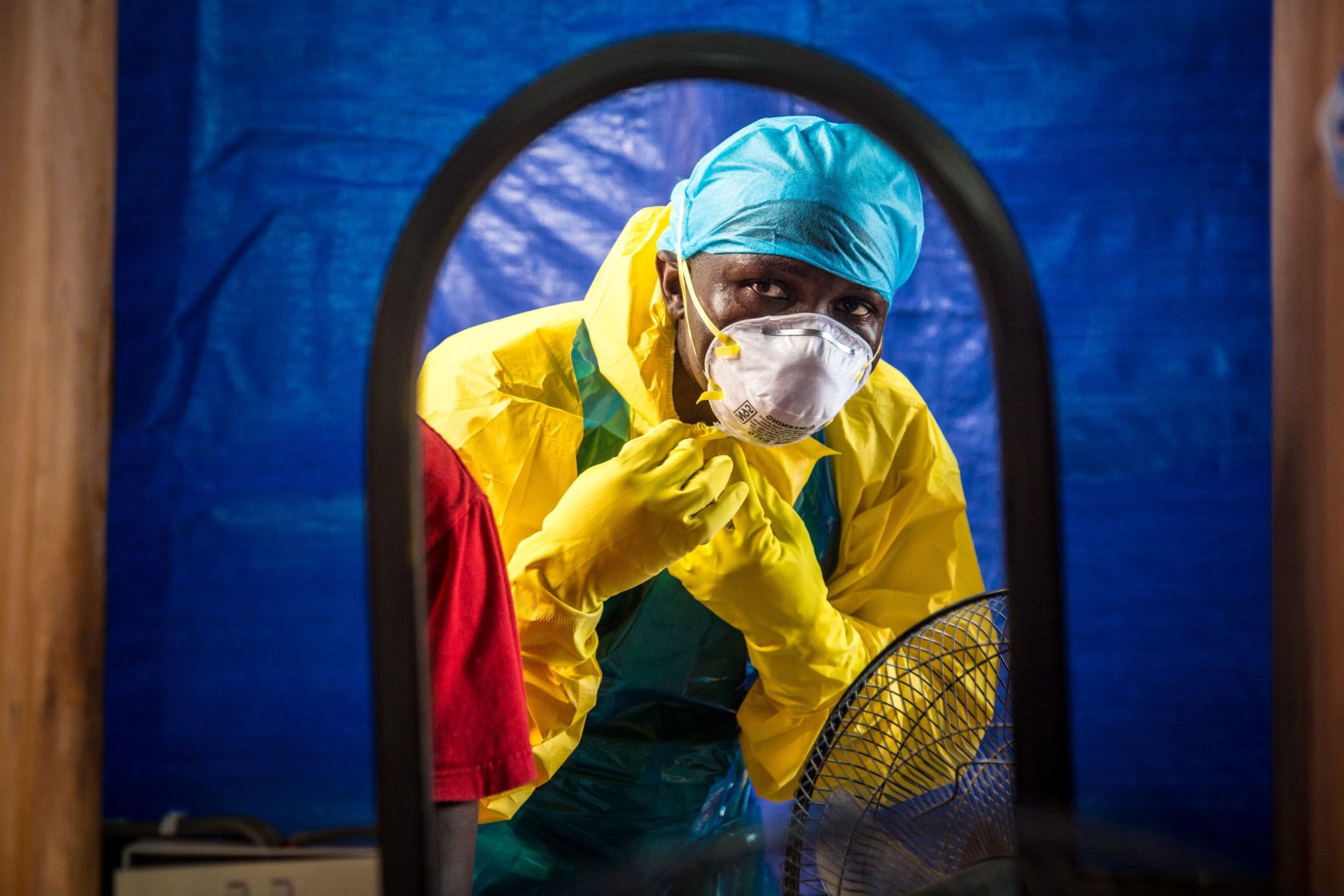
Cut to ground level: a checkpoint outside a treatment centre. The image is dominated by luminous protective suits — white, yellow and bright lime PPE that contrasts sharply with the browns and greens of the landscape. Figures move deliberately, their gestures slowed by layers of plastic, goggles and gloves. The camera lingers on process: disinfectant sprayed on boots; vigorous hand washing; thermometers held just short of skin.
The frame tightens. A temporary treatment tent comes into view — canvas walls, improvised partitions, and metal cots. Inside, medical staff lean over patients, but always at a slight remove, bodies shielded by protective layers. The distance is visualized as much as enforced.
The soundscape of the newscast is layered with ambient noise. Generators hum, radio chatter crackles, boots crunch through gravel, and always the soft hiss of disinfectant sprays and muffled voices of responders speaking through masks. A steady voiceover delivers rising case numbers and urgent updates, all of it creating tension between the routine rhythms of containment and the escalating narrative of crisis.
Ebola has once again captured global attention, not only as a virus, but as a story. As Priscilla Wald reminds us, the newsreel’s power stems from what it shows and also how it orders meaning, a narrative that is both epidemiological and cinematic. It’s a story of numbers and bodies, but also of visibility, uncertainty and urgency.
For Ebola is a narrative event as well as a public health crisis. And how this outbreak story is told is consequential, for those of us far removed from the site of hazard, and, more urgently, for those closer to ground zero.
Ebola then and now
Ebola ravaged Guinea, Liberia and Sierra Leone for nearly two years starting in 2014. As I wrote at the time, fears of contagion moved faster and further than the pathogen itself, amplified through media that spread anxiety far beyond the transmission zones. More than a decade later, as Ebola re-emerges in the Democratic Republic of Congo (DRC) and Uganda, this basic pattern persists. Although the virology has changed, the narrative that binds risk perception, state response and geopolitics has not. If anything, it has intensified.
The current outbreak began May 5, when Congolese authorities alerted the World Health Organization (WHO) to a high-mortality illness in Ituri Province. Ten days later, as the case count climbed to 250, lab results confirmed Bundibugyo virus disease. Then Ugandan officials reported a single case in Kampala involving a Congolese national, a potentially serious development given the capital’s dense population, major transport networks and international airport.
On May 31, health officials in Brazil and Italy disclosed potential cases linked to international travel. Though Ebola infection would later be ruled out, the possibility of transnational contagion had established its narrative bona fides. The outbreak had crossed a critical threshold; it became believable as a global risk.
That’s how a virus spreads. The reporting of that spread reflects how events are framed, named and circulated. “Ebola” operates as a circulating sign that carries with it an archive of associations: crisis; danger; mobility; vulnerability; dread. It is a diagnosis that serves as a narrative trigger that activates a global response.
Uncertainty and media visibility
The 2026 outbreak differs significantly from that of 2014, most notably in its viral strain. Unlike the Zaire ebolavirus species that was responsible for more than 28,000 cases and 11,300 deaths across Guinea, Liberia, and Sierra Leone, Bundibugyo is harder to detect and currently there are no approved vaccines, although there are several promising candidates in development. These biomedical details matter as much for how they are communicated as for how they are managed.
Despite more than 1,000 suspected infections and more than 225 deaths, the global epidemiological risk remains low. We should be far more alert to the threats of measles, influenza and SARS-like coronaviruses which are airborne, constantly circulating and capable of sudden large-scale outbreaks across borders. Ebola, by contrast, is not airborne. Transmission requires direct contact with the bodily fluids of a sick or recently deceased person or from contaminated surfaces and objects.
Yet this measured assessment co-exists with heightened global unease. The gap between expert risk assessment and public risk perception is not simply a failure of understanding. It is produced through powerful visual and narrative conventions, the product of what Sean Hier describes as a cultural politics of anxiety through which uncertainty is amplified, objectified and stabilized through media representation and institutional response.
Uncertainty around diagnosis, treatment and trajectory creates narrative openings. It makes the outbreak harder to stabilize both epidemiologically and cognitively, more resistant to reassurance and more susceptible to speculation and misinformation. In this sense, virology and communication are inseparable. Instability at the level of detection translates into instability at the level of meaning.
Ebola is uniquely “media-visible.” Hemorrhaging bodies, biohazard suits, isolation wards and containment zones align with familiar tropes of catastrophe. These images compress complex biomedical realities into emotionally resonant symbols. They travel easily— and they endure.
The politics of performing preparedness
Government responses both reflect and amplify this communicative environment. Canada’s recent decision to impose a 21-day quarantine on travellers from affected regions, alongside suspending immigration processing, illustrates how public health policy now operates performatively.
Officials emphasize that domestic risk is low. Yet the visibility of these measures suggests a different story.
In this way we see how contemporary biosecurity gets enacted through communication regimes that make preparedness visible. These measures are as much political as they are moral. They signal taking responsibility and demonstrate that authorities are treating the threat seriously, even though the objective risk may be limited.
In this context, policy is about demonstrating control.
The timing — the eve of the FIFA World Cup — underscores how public health actions are increasingly entangled with managing mobility, visibility and political accountability. The World Cup presents a global stage on which states must perform pandemic preparedness in real time.
Uneven communication, uneven risk
At the same time, the outbreak exposes fractures in the global health communication ecosystem.
While North American governments co-ordinate messaging and travel restrictions, conditions in Central Africa are shaped by conflict, resource scarcity and deep public mistrust in governments and health authorities. Attacks on treatment centres and resistance to public health interventions reflect failures of risk communication and institutional legitimacy.
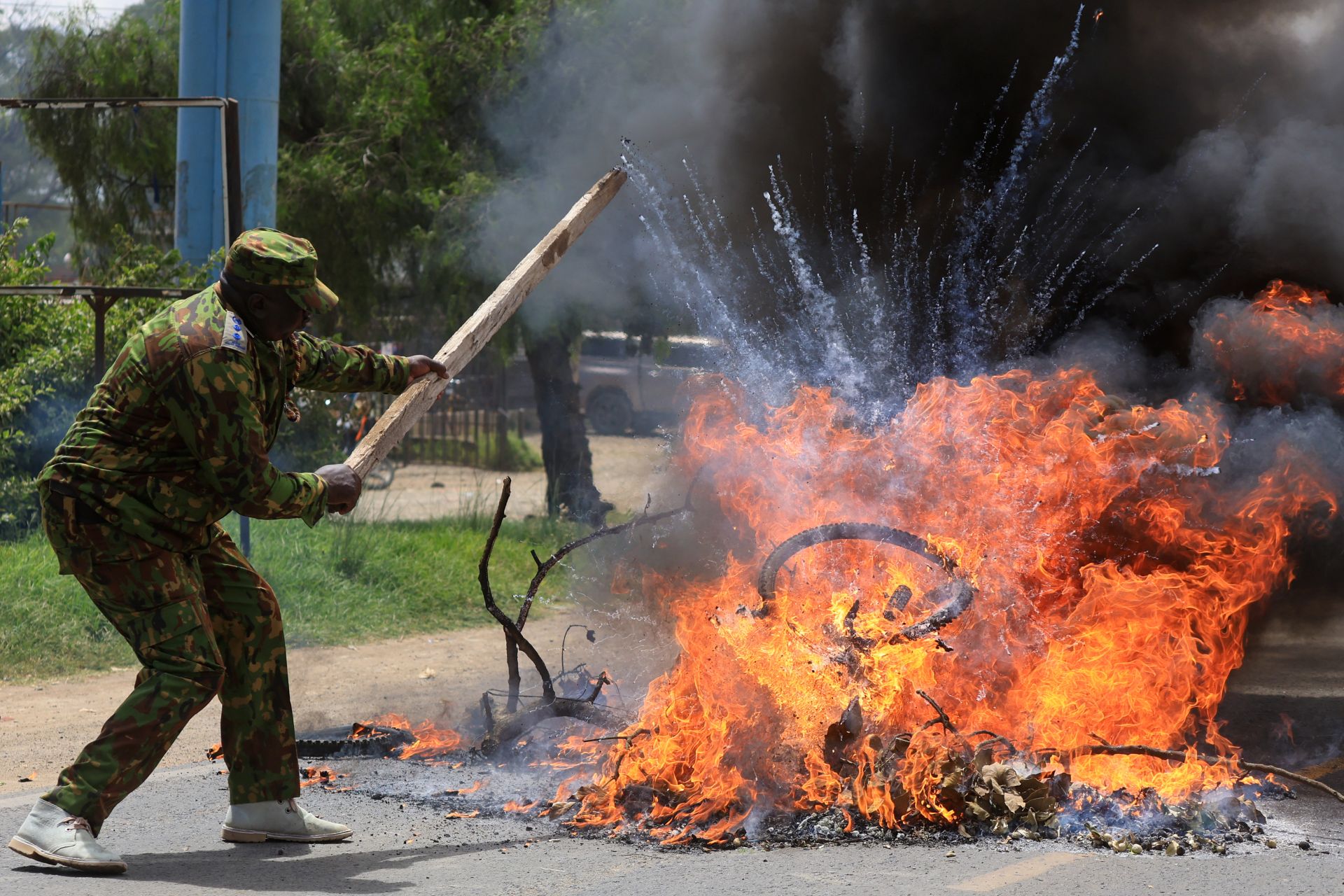
Information in these contexts does not flow smoothly. It is contested, negotiated and bound to local histories of marginalization and violence at the site of tension between cultural practices and beliefs and public health guidance.
These asymmetries matter. Risk is not distributed evenly, either biologically or symbolically.
In affected regions, the central challenge is building trust in environments where institutions often lack credibility. In countries like Canada, the challenge is almost the reverse: how to communicate low risk while justifying highly visible precautionary measures.
The result is a communicative bind. When governments say “the risk is low” but act as if it is high, credibility can erode, adding fuel to public skepticism and mistrust.
What to watch for next
Several dynamics will shape how this outbreak is narrated in the coming weeks.
First, the trajectory of the disease itself is important. The absence of vaccines and the difficulty of detection raise the possibility of prolonged transmission, conditions that sustain media attention and narrative volatility.
Second, the escalation of border policies. As case counts rise, mobility restrictions may expand, further entrenching the association between movement and risk. Such measures are moral and political responses to anxiety, dictating who can move and who cannot.
Third, the World Cup. As a global event compressing concerns about health, travel and security into a single spectacle, it will act as a live experiment in risk governance and communication.
Narrative inflection points also matter. Cases in major urban centres or new international detections could rapidly shift framing. Once an outbreak is narratively constructed as a global threat, its symbolic trajectory can outpace its epidemiological reality.
More than a virus
The coverage of Ebola reveals how diseases are made meaningful through communication, how states govern through visibility and how global inequalities are reproduced through uneven flows of information, trust and mobility. Outbreaks are structured as stories, circulated through infrastructures of power and regulate anxiety, assign responsibility and shape collective response.
The virus spreads through bodies. But fear, policy and politics spread through stories. And those stories continue to shape how the world sees, and responds to, Ebola.
In the end, Ebola does not simply expose a virus moving through populations. It reveals how power, perception and inequality travel faster still, carried in the stories that determine whose lives are seen, whose risks are believed and whose crises command the world’s attention.