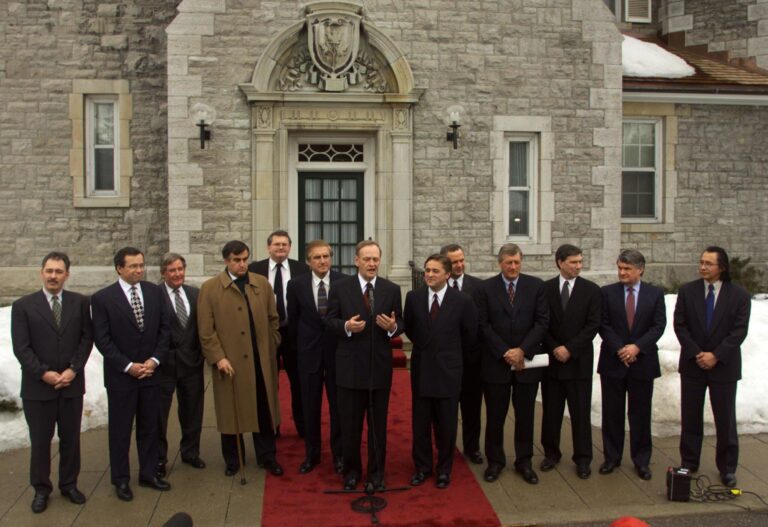
For more than a year, the machinery of executive federalism has been operating at full blast, trying to reconcile conflicting positions about the “fiscal imbalance” and, more specifically, the equalization formula.
Meetings of ministers and officials have skipped from one city to another, an advisory panel and an expert panel have reported, while experts and columnists, skeptics and advocates have sustained a stream of advice from the sidelines.
Recently, there was a new voice in the process. The Premiers’ Advisory Panel on Fiscal Imbalance commissioned Canadian Policy Research Networks to invite randomly selected citizens to reflect on “how we share public funds.” Never before, in the long and fractious history of fiscal federalism, has anyone considered asking citizens how they thought the system should operate. It was presumed that fiscal federalism was over the heads of ordinary citizens: only intergovernmental officials and professors were equipped to expound on these issues.
But this group of randomly selected citizens— pipe-fitters, teachers, retirees and students, etc.— quickly grasped the significance of the transfers for their own quality of life, learned the jargon and worked effectively with the concepts. To get up to speed, they absorbed background information, asked questions of the experts available at each session and weighed the pros and cons of different approaches. In Edmonton, where there were a lot of questions about how equalization works, one group actually drew a chart to show how the funds flow.
Once the participating citizens could see the way the transfers and formulas work, they concluded that there is a better way.
But first, it is essential to understand that their experience with federalism bears no relationship to the approach taken by governments. They see themselves as Canadian citizens, and they see programs like health care “as a provincial service but a national necessity,” to quote Tom Kent in Policy Options. It is this capacity to focus on the policy and citizenship dimensions and to balance both local and national needs which is missing in intergovernmental relations today.
The citizens’ main criticisms of the existing transfer programs are about the barriers to mobility they throw up, including the lack of portability of services, credentials and education credits across provincial borders; and about the uneven quality or absence) of service from one province to another. People are looking for a pan-Canadian community with a common standard of service for all. But governments are fixated on jurisdiction, competing for power and money.
Fundamentally, Canadians see fiscal transfers as an expression of our citizenship— how we define ourselves, what we want to be and how we ensure all Canadians can meet their basic needs with respect to health, education and economic opportunity. This view emerged in day-long dialogue sessions which took place in five cities across the country and culminated in a national session engaging a cross-section of the regional participants.
The dialogue participants believe that the design of fiscal transfers should flow from a four-step process. First, agree on a vision for the core national services. Second, establish common standards for service, giving provinces room to reach (or surpass) those standards. Third, figure out what it would cost to deliver services to that standard. And finally, determine how much money each province needs to make progress toward meeting the standards.
For citizens, then, sharing public funds is a form of straightforward budgeting exercise. The four-step process requires collaboration among governments, and it should be supported by input from leaders in civil society and citizens.
A second theme in the deliberations was the need for accountability, in a context where trust in governments is low. Because they don’t trust either federal or provincial governments, the participants did not favour unconditional transfers or the transfer of tax points. Instead, they expressed a preference for conditional transfers— at least that way the two orders of government could hold each other to account. They also saw a role for federal transfers directly to individuals and to institutions, but only on the basis that the recipients would be held accountable for appropriate use of the funds. They talked, for example, about holding post-secondary students to account by insisting that they pay back money received if they did not work in Canada for a minimum period.
The citizens’ preoccupation with accountability led to skepticism about the Equalization Program because the provinces are free to spend the money on anything. Nor did they see it as an adequate instrument to guarantee service equity among citizens. The more the participants discussed it, the more they came to see it as formula-driven instead of purpose-driven. They wanted to promote cooperation, not competition.
At the beginning of the dialogue, and again at the end, participants rated their level of support for tax points and unconditional, conditional and direct transfers. Figure 1 shows how support for conditional and direct transfers grew over the course of the dialogue, while support for tax points and unconditional transfers fell.
A third theme in the deliberations was a search for new ways to work together based on principles and values.
-
They want governments to focus on the meaning of Canadian citizenship in a country which has changed radically since the 1860s, when the powers were divided, or since the 1940s, when Rowell-Sirois completed its blueprint for sharing funds among governments. “When the Constitution was written, people lived their whole lives in the same village. Today we are mobile,” said one citizen.
-
They therefore focus on the barriers to mobility in Canada and the inefficiency of the federation, a theme that was highlighted in the federal discussion paper Restoring Fiscal Balance in Canada in 2006.
-
They insist that the well-being of all provinces has to be taken into account— both the “have-less” and the “have-more” provinces. None of them wanted an outcome that would disadvantage any province, including Alberta or Ontario (to do so would threaten unity and economic prosperity).
-
They recognize disparities within provinces as well as the fact that provincial economies fluctuate. The current distribution of wealth can change in the future as it has in the past. Transfer programs need to be flexible enough to address real needs of real people, rather than institutional jurisdictions.
-
They articulated six core values which should guide fiscal federalism negotiations going forward: fairness, access, transparency, accountability, sustainability and efficiency.
CPRN’s experience with this national citizen dialogue raises two questions about the future of executive federalism. First, how can executive federalism be adapted to make good use of the contributions of citizens and stakeholders? Governments have very little experience with participatory approaches to policy discussion. Is there scope here to democratize intergovernmental relations? And second, what are the implications for building trust through performance reporting, which is the current recipe for addressing the accountability deficit?
First, let’s look at the citizens’ role. Thinking back over the many federal-provincial-territorial meetings on health care over the past four years, at no time did the people or health care institutions affected by those negotiations on health transfers actually have a voice in the outcome. The experts and stakeholders (leaders of national and professional associations, for example) had many opportunities to comment to the media from their own perspective. But at no time were the stakeholders or citizens invited to consider alternative viewpoints, to work through the trade-offs or to attempt to reconcile the differences that were blocking progress.
Again, during the past 18 months of debate about fiscal federalism, there was no room for third parties, even though it was clearly a major turning point for federalism, a time when priorities had to be set and trade-offs made. The results of the citizen dialogue commissioned by the Advisory Panel show just how far executive federalism has strayed from meeting the priorities of citizens.
Michael Prince zeroes in on this weakness in intergovernmental relations in his recent article on Canada’s Cancer Control Strategy in Canadian Public Administration. He points out that “most of the intergovernmental and inter-sectoral organizations and processes that would be required for consulting, building consensus, planning, managing and implementing a pan-Canadian strategy are not in place.” The missing pieces are at the national level. For example, Canada has no:
-
national strategy for coordinating and alignment of resources to achieve the best outcomes for Canadians,
-
modern strategic planning and budget and accountability framework, or
-
national or delegated coordinating systems.
All of these functions are well beyond the capacity of executive federalism. The Cancer Control Strategy, Prince says, is built on the idea of “deliberative federalism.” The strategy was developed by 700 cancer experts, including cancer survivors. Together with Health Canada, they designated eight priority areas for coordinated cancer control action across Canada.
In 2002, the National Advisory Council was created to give strategic direction and report on progress. This is a governance model which fully engages the federal, provincial and territorial governments as well as the voluntary health sector, cancer care professionals and cancer survivors. The council includes representatives from each provincial cancer agency or health ministry as well as others selected through recommendations made by stakeholder groups. It therefore “harnesses the benefits of Canadian federalism and leverages knowledge spread across networks of cancer professionals in priority areas.” Thus, the front lines have a direct influence on the horse-trading about what gets funded. Governments are very much part of the deliberation, but jurisdiction is less likely to trump the policy priorities.
The second issue is the perennial problem of accountability and transparency. In all the citizen dialogues CPRN has convened since 2001 (nicely summarized by Julia Abelson and F.-P. Gauvin), accountability has been a sticking point. It was a major theme in the Citizens’ Dialogue on the Future of Health Care done for the Romanow Commission, where the citizen participants spelled out their needs as follows:
-
Where does the money go?
-
How do we compare with other jurisdictions?
-
Are we making progress?
To respond to these and other demands for more open government, governments have developed performance reporting as a tool for improving transparency and accountability. This is especially true in health care where federal-provincial-territorial governments have spent many years (and a lot of money in data development) building a common set of performance indicators. The work began in 2000, leading to a series of reports by individual governments in 2002 and 2004 with 2006 reports due soon.
While the reports provide a great deal of useful information in plain language on the health status of the population and on access to the system, including some key wait-time indicators, they do not provide information on where the money goes. Nor do they make, or even enable, interprovincial comparisons.
The Health Council of Canada’s latest annual report, released last month, takes first ministers to task for not meeting agreed commitments to report on comparable health indicators. The report notes that in order to “evaluate the promise of accountability that heralded the health care agreements, the public needs a more detailed and transparent account of how historic investments have helped strengthen the health of the system and the people it serves.” The Health Council calls on “governments, providers and policy makers to create mechanisms to facilitate the collection and reporting of high-quality, standardized data to strengthen accountability and guide decision-making to improve health and health outcomes,” and it gives notice that it will closely examine progress made toward greater accountability in its next annual report.
The same weakness shows up in the annual reports on the impact of the National Child Benefit, a combined federal-provincial initiative to support families with young children. These reports do show where the money goes, and more recently have provided estimates of the success in reducing poverty and encouraging greater labour market participation.
But once again, there is no information about how the provinces compare in meeting the needs of families with young children, or even whether the provinces are living up to their commitments to provide services and supports to families in order to complement the federal income transfer to families. No reports are given, for example, on how many children are wait-listed for child care, or how many families have access to parent resource centres or home visiting programs. This failure in transparency shows how jurisdiction is trumping good governance and appropriate accountability to citizens.
In their assessment of Canada’s track record on performance reporting, Kathleen Morris and Jennifer Zelmer provide only tepid support: “If included as part of a suite of accountability tools, public reporting of performance measures will be a useful mechanism for meeting these expectations [of stronger accountability].”
Is there a better way to do executive federalism? As Donald Smiley has acknowledged, executive federalism has achieved a lot for Canada by improving channels of communication, integrating tax structures among governments and reaching a modicum of national equality and equity in social domains.
Can it be strengthened by adding deliberative institutions like the Cancer Control Strategy and citizen dialogues on key issues? Yes.
For one thing, governments would be likely to gain greater legitimacy. Look at the BC Assembly on Electoral Reform. Its recommendation of the single transferable vote gained the support of 58 percent of BC voters in May 2005, a remarkable outcome for a system that was difficult to understand. When asked why they supported the STV, a high proportion expressed their support for a decision that came out of a deliberative process involving a representative group of citizens. Many eyes will be on the Ontario Citizens’ Assembly on Electoral Reform, due to report on May 15, 2007, to see if the Ontario electorate deem it to be as legitimate and credible.
The Cancer Control Strategy, which includes stakeholders as well as citizens, is being used to set priorities, allocate funds and integrate cancer services across the continuum of care. If it is successful, then cancer patients can expect services to be more responsive to their needs. Citizens in general can expect greater transparency in decision-making and results, more effective use of the limited resources available and a higher standard of accountability to the public.
In summary, citizens who had the opportunity to wrestle with how fiscal federalism should work have made one thing very clear: being a Canadian must mean something more than tinkering with formulas based on fiscal capacity or equal per capita transfers. There is a better way, in their view, and it means establishing commonly accepted goals for the quality of and access to public services. They also insist that decisionmaking should be more inclusive, transparent and accountable.
Their direction points to a new blending of executive federalism with deliberative federalism. By opening the door to citizens and stakeholders, critical resource allocation decisions will be guided by a strong sense of policy priorities. And those decisions will make more sense to the voters.
By giving citizens a voice, federal, provincial and territorial governments can improve the quality of public services and add a powerful new tool to their accountability tool-kit.