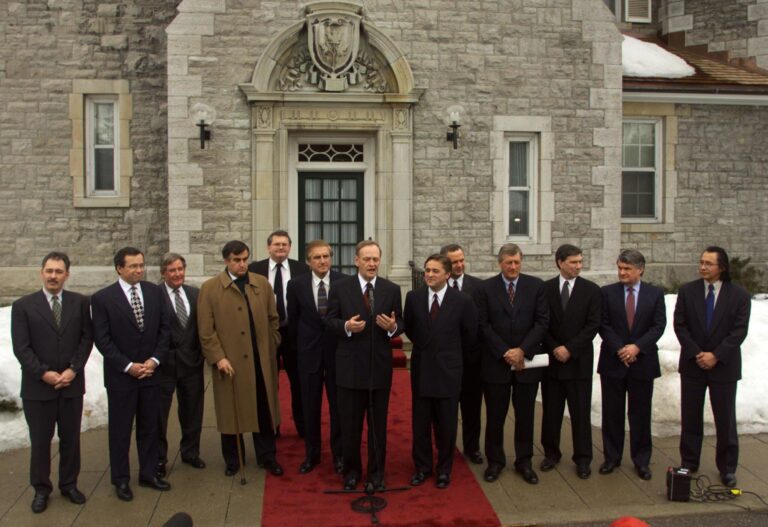
On December 19, 2005, Conservative leader Stephen Harper made a lunch-hour campaign stop in Quebec City to outline his vision for the future of Canadian federalism and Canada-Quebec relations. In the following 24 hours, the speech topped many of the Frenchlanguage newscasts and was the subject of a great deal of commentary in French newspapers. It would, however, take several more weeks before many in English-speaking Canada would hear about what has come to be known as the “Quebec City speech” or the “open federalism speech.”
Since then, many political commentators have gone back to the speech to explain the Conservatives’ surge in popularity in Quebec during the final weeks of the campaign. Noting Harper’s commitments to resolve the fiscal imbalance and give Quebec a voice on the international stage, they argue that the speech laid the groundwork for the Conservatives’ strong showing in la belle province on election night a short month later.
There is no question that this campaign stop just before half-time in the marathon election defined the man who would become Canada’s 22nd prime minister in the eyes of many Quebecers. But that focus on Quebec may well be short-changing the speech’s longer-term significance for the whole of federal-provincial relations in Canada. Often described in recent years by media commentators as a “Quebec grievance,” the fiscal imbalance is in fact a panCanadian phenomenon— felt by provincial governments right across the country. Any proposal to resolve the issue, therefore, will and should have resonance for all Canadians.
The 2006 Conservative election platform, Stand Up for Canada, is unambiguous when it comes to the fiscal imbalance: “In the last eight years, the federal government has amassed enormous surpluses. Meanwhile, many provinces have seen reduced revenues and have had to run deficits in order to pay for education, health, and other social programs…A Conservative government will [w]ork with the provinces in order to achieve a long-term agreement which would address the issue of fiscal imbalance in a permanent fashion.”
Of course, part of the challenge for any government is to define what is meant by the fiscal imbalance— let alone the degree to which it needs balancing. In basic political terms, and in contrast to the Martin government, the Harper Conservatives acknowledged two basic realities: first, as noted in the campaign platform, the federal government was taking in tax revenue in excess of what was required to discharge its jurisdictional responsibilities as defined by the Constitution, while the provinces were having increasing difficulties making ends meet; secondly, acknowledged more explicitly upon taking office,an adjustment was needed in the horizontal distribution of resources to ensure adequate capacity across provinces to deliver comparable levels of service.
In addition to acknowledging the very existence of the fiscal imbalance— something the Chrétien and Martin governments had steadfastly refused to do, and which Stéphane Dion still refuses to do— the specifics of the Conservative pledge signalled a change in direction at the federal level. Rejecting the recent penchant for short-term and even oneoff agreements (in vogue since at least the first ministers’ health agreement of September 2000), the Conservatives aimed at a comprehensive agreement to resolve the matter “in a permanent fashion.” After so many years of what Paul Boothe has called “smash and grab federalism” (Policy Options, September 2006), the Government of Canada would attempt to put an end to annual negotiations on specific issues and side deals in exchange for a comprehensive agreement to resolve the matter in full. The challenge, of course, would be to find a way to come to a principled restoration of fiscal “balance.”
Part of the answer to that challenge came shortly after the swearing-in of the Harper government in the form of a 2006 budget paper entitled Restoring Fiscal Balance in Canada: Focusing on Priorities. As many public policy analysts have observed since its publication nearly a year ago, the discussion paper provides a most interesting framework according to which the Harper government intends to bring the issue to a resolution. As explained in detail in the paper, any federal proposal would be guided by the following five principles:
-
Accountability through clarity of roles and responsibilities.
-
Fiscal responsibility and budget transparency.
-
Predictable long-term fiscal arrangements.
-
A competitive and efficient economic union.
-
Effective collaborative management of the federation.
Ten months later, after consultations with provincial and territorial governments, experts and citizens, the Harper government is preparing to table its final proposal, to be implemented through Budget 2007. Of course, from a political point of view, no one will know until Finance Minister Jim Flaherty rises to deliver the budget speech exactly what is being proposed, how much the federal government has put on the table and whether that amount will be enough for a permanent resolution. Nevertheless, the five principles outlined by the federal government allow us to speculate as to the potential long-term impacts of the soonto-be-announced proposal on updating Canadian federal arrangements.
There is no question that establishing predictable long-term fiscal arrangements will enhance provincial governments’ capacity to better plan beyond any single budgetary cycle. Since the 1995 budget, the provinces (and many federal political parties who were in opposition at the time) have been unanimous in their call for stable, predictable funding, particularly for health and social transfers.
Moreover, enhancing budget transparency— specifically with regard to anticipated surpluses— will also add to the certainty with which governments can plan, and the quality of the information upon which citizens make decisions on public priorities. Depending on how they find expression in the forthcoming implementation proposals, therefore, it is highly likely that these two principles will be welcomed by parliamentarians and provincial governments alike.
What the provinces might find less acceptable is the federal government’s linking the fiscal imbalance to the economic union. As stated priorities since the early 1990s, internal trade barriers, labour mobility issues, securities regulations and the recognition of foreign credentials are unquestionably issues in which the provinces are intricately involved and that impede the federal government’s ability to create a stronger economy. What is new is not the federal government’s interest in bringing these matters to some measure of resolution; it is that, rather than make federal transfers conditional on federal preferences regarding provincial issues, the Harper government has linked the permanent resolution of the fiscal imbalance to the permanent resolution of another “structural” problem in federal arrangements that is of great concern to Ottawa.
The decision by the federal government to move away from unilateral conditions defined by Ottawa raises another, equally interesting question. Even if the federal government no longer defines common standards unilaterally, Canadians will not want common standards and portability across the country any less. Who, then, will determine the benchmarks for provincial performance in service delivery, particularly for social programs? Given their current inability to agree on equalization, it seems far-fetched to imagine provincial governments negotiating and agreeing on these common standards. But in the absence of Ottawa deciding on them, we may be on the verge of seeing “pan-Canadian” standards that need not mean “federal.” Down the road, overseeing the negotiation of such standards may well even be the role of an enhanced Council of the Federation.
We’re certainly not there yet, but there are some hopeful signs. It’s gone almost unnoticed across the country that Alberta and British Columbia last year signed an extensive Trade, Investment and Mobility Agreement. It will streamline business registration and reporting requirements, recognize occupational certifications in both provinces and provide open access to government procurement between the two jurisdictions. The BC government believes that over time, this agreement has the potential to add $4.8 billion to real GDP and create 78,000 new jobs. These potential successes on a smaller scale may well provide the impetus to move to panCanadian agreements.
Increased and more predictable funding with fewer and shorter strings will therefore go a significant way toward enhancing provincial autonomy in provincial matters. More interesting still, however, is the Harper government’s stated commitment to more closely confine federal government activity to policy areas traditionally defined as federal jurisdiction. In this, the Conservatives are proposing to frame and limit federal action de jure as well as de facto.
Explicitly listing spending priorities in the areas of national defence, security, immigration, aboriginal policy and international affairs, the 2006 budget paper proposes to reverse more than a decade of successive federal governments using their spending power to create a role for themselves in areas of provincial jurisdiction. In doing so, the Harper government is resisting a powerful electoral urge to make itself more present and relevant in the eyes of the electorate by playing a more active role in those public services citizens access more frequently. And, depending on the size of the proposed monetary settlement included in the 2007 budget, this current government may in fact go a long way to bind future governments to that same discipline.
Of course, the assumption that follows the observation is usually that this clarity of roles and responsibilities and the commitment by Ottawa to focus on its own jurisdiction will disentangle our levels of government and more accurately reflect the intended division of labour in sections 91 and 92 of the Constitution. Commonly referred to as “classical federalism,” this view holds that the only likely relationship between the federal and provincial governments is one of interference of the former in the latter’s backyard. Disentanglement, therefore, is a desirable thing, and intergovernmental peace will ensue.
Trouble is, it is doubtful that such a disentanglement of both levels of government is either possible or desirable in 2007. Citizens today expect high quality public services, and do not much care to know what level of government is responsible for what portion of an array of connected services. In response, governments everywhere have worked hard to reorganize the delivery of public services around the needs of citizens, to align policies and programs and to deliver services jointly.
Interdependence is the norm in a world in which the vast majority of meaningful policy challenges defy neat compartmentalization into departmental silos, levels of government or sections of a constitution. That reality is what makes the inclusion of the final principle— collaboration— so revealing. Putting a twist on classical federalism, the Harper government has acknowledged the critical importance of collaboration in modern governance and recognized that true, accountable partnerships require clear roles and responsibilities as well as a certain degree of shared decision-making, risk and accountability. The value in the five principles as a whole is this acknowledgment that well-defined roles and responsibilities do not necessarily mean isolation. In negotiating the implementation of the federal proposal, the challenge will be to frame the circumstances that will govern the independence and the interdependence of governments.
The final question, of course, is whether the proposed resolution of the fiscal imbalance constitutes transformative change or business as usual for federalism in Canada. Depending, of course, on the monetary value of the proposal, the guiding principles outlined by the Harper government last year offer the possibility of both continuity and change.
On the one hand, a federal government that sticks to section 91 while allowing the provinces to be better financed to deal with section 92 (by addressing both the vertical and horizontal imbalances) will change the way in which many issues are addressed and commonality across the country ensured. On the other hand, the Harper proposal does not put an end to all interdependence, nor does it break with developments of the last decade toward collaborative governance. Indeed, Harper has been clear that he sees a continuing substantial federal role in three areas of provincial jurisdiction— health care, infrastructure and post-secondary education. In fact, in combining the need to delineate roles and responsibilities with creating new mechanisms for collaboration and coordination in areas of shared responsibility, this proposal may well allow for both levels of government to better understand how to design, manage and account for federal-provincial partnerships in many policy areas.
The only potential downside to resolving the fiscal imbalance is, What in the world will we policy analysts write about now?