Canada and the United States are approaching a milestone in their bilateral relations. By the end of the year, each country will have a new government. Both may have old-new governments; or new-new governments; or one of each on respective sides of the border. But regardless of who is governing our countries, it will be time for stocktaking, and we can anticipate that reassessment will be in process, if not completed, by the end of 2004.
In the United States, policy assessment is more likely to be ad hoc than by detailed design. It will be performed by mid-level diplomats and bureaucrats who are focused on management rather than innovation; evolution not revolution will be the guidelines. Particularly if President Bush is reelected, there will be no soul-searching policy papers; from our optic, Canada’s conduct of bilateral relations is far from perfect, but regarded as petulant rather than poisonous. Our bilateral policy will be more of the same concerning points such as missile defense, border security, refugee control, and economic differences (softwood lumber, demented bovines). The Bush administration has made its decisions on these issues: security trumps economics. In any event, virtually all of our economic relationship is “in the weeds” so far as senior level official attention is concerned. The differences over participation in the “coalition of the willing” in Iraq are sunk costs in terms of the basic relationship. We are willing to move on.
In that regard, Prime Minister Martin’s April 29-30 visit to Washington was politely inconsequential, the equivalent of a kitchen cup of coffee with the new next door neighbour on the block. Persistent problems remain: overhanging tree branches, pest control, a sagging fence line, and so on. The prospective plus of the new neighbour is the departure of the nasty dog that barked whenever you left your front door.
In contrast, regardless of whether the Liberals or Conservatives win the next election, for Canadians the reassessment is a more formal and hardly trivial exercise. Thus we can anticipate that official white papers on foreign and defense policy that presumably now are at least embryonic (pending the outcome of the Canadian election) will be completed and released. Both existing policy papers are circa 1994 and a decade old; they have been recognized as outof-date for several years. Once again, however, with the March budget release, they were kicked downstream. Doubtless it is bureaucratically neater to line up the electorate before embarking on policy revisions, but the postponement also had the added advantage of not having to make budget decisions based on foreign and defense policy choices that will be expensive and controversial.
As a point of departure, we should recall that the 1994 Liberal study of foreign policy accurately noted that Canada’s most important relationship was with the United States. However, it also emphasized that the objective of Canadian foreign policy was not to have “good relations” with the United States. Seeking just to have “good rela tions” might mean that Canada would sacrifice its self-interest to stay in the US good books. Rather, the objective of Canadian foreign policy was to manage the relationship to Canada’s (not mutual) benefit.
Good enough, and indeed, it is useful to the United States to recognize Ottawa’s self-interested national purpose. However, if managing the bilateral relationship to Canada’s benefit is the agreed objective of the next Canadian government, the past several years are a negative example.
Without tediously belabouring the point, the bilateral relationship seriously soured— at least in perceptions— since the 2000 election. It was rational for the Chrétien government to prefer “President Gore” for practical and political reasons. Al Gore was a known quality to Canadian observers; a denizen of Washington for his adult lifetime, and eight years as Veep made him personally known to senior Canadians; indeed, he even made an official visit to Ottawa. At the same time, his policies were unlikely to have differed markedly from the Clinton administration’s views (and he was not known for “Monica” type problems either). Thus, at an absolute minimum, Gore qualified for “devil you know” status.
George W. Bush was a decidedly different cat. The Chrétien government had never dealt with Republicans, and not since 1984 had Liberals dealt with Republicans of any stripe in our executive branch. The “getting to know you” game would be protracted, and policy disconnects with the Liberals would be anticipated (even waiting to know what a conservative Republican administration would do would be time consuming). Consequently, Liberal preference certainly would be for Gore (just as one can assume that in 1992 the Mulroney government preferred the reelection of George H.W. Bush.) Nevertheless, the preference for Gore as expressed by Ambassador Raymond Chrétien during the campaign and the reported reiteration of this preference by Jean Chrétien at Duke University while the election was still in doubt fell into that “worse than a crime, it was a mistake” category.
And the relationship stumbled steadily downhill from there. From a stiff initial encounter marked by discussion of A-Rod’s salary to a condescending lecture from Chrétien at the Quebec Summit of Americas to a rather huffy set of comments about the US pushing its own concerns at the July 2002 G8 Summit in Alberta, Chrétien and Bush never developed a relationship better than “polite.” After 9/11 and the US decisions on how to respond to terrorism and how to address the perception of danger from Iraq, we had a rare level of rhetorical insult from the Canadian government. You don’t get a prime minister’s press spokesman calling the president a “moron” without it reflecting PMO attitudes. If a tertiary backbencher trumpets her hatred for Americans and calls us “bastards” without being disciplined, it indicates that these emotions and characterizations are acceptable Liberal views.
So far as Iraq was concerned, we fully recognized that Canadians did not agree with our conclusions; we accepted the disagreement (as we did with Mexico). We did not accept Canada’s intimation that our decision making was illegitimate and should be subordinated to the United Nations approval. The most USG officials ever said was that we were “disappointed” by the Canadian position— a comment by Ambassador Cellucci that reportedly prompted two senior ministers to call for his ouster.
Nevertheless, Chrétien and his coterie are history, and it is time to move on.
At the one-year anniversary of the “willing” coalition’s military action, Iraq is important to Canada, but not for its intrinsic elements. Canada’s essential interests in Iraq are about the same level as Brazil’s: no geographic proximity; little ethnic representation; and virtually no economic interchange. Iraq is important to Canada because it is important to the US. It will remain overwhelmingly important to a re-elected Bush II government and almost equally to a Kerry I administration (if only to get out without looking defeated/disgraced à la Vietnam).
Consequently, it would be useful for Canadians to move past their personal distaste for George W. Bush and remember that he well could be president as long as Paul Martin is prime minister (one can be sure that the Canadian desire for a “President Kerry” will not be a big selling point for his campaign). It even might be worth admitting that regarding Iraq, the United States could have done the right thing for the wrong reason, that the elimination of a brutal dictatorship is a positive for global human rights, and the certainty that Saddam will never employ WMD is more than a trivial improvement in regional stability. The ancillary decision by Libya to eliminate its WMD programs should also be positively regarded— and a direct consequence of action in Iraq. Washington is not right all the time, but neither is it wrong all the time; sometimes, the USG can even re-do the “wrong” decision and make it “right.”
In this regard, Martin struck the appropriate tone in his April 29 speech to the Woodrow Wilson Center. He noted inter alia that Canada had not joined the US in Iraq and continued to endorse nonparticipation, but indicated current and future willingness for rebuilding and stabilizing the country. There was no intimation of apology for not being “willing” or even supportive, but neither was there implicit “told you so” gloating.
Sophisticated Canadians are aware that 9/11 changed the world for the United States. However, only a tiny minority of Canadians believes that it likewise changed the world for Canada.
Everyday Am ericans ant ic ipa te the next shoe will drop; that despite all of the commitment, money, intelligence collection, training, military action, and prayer, al-Qaeda operatives will devise a comparable effort to the blows that fell on New York and Washington now nearly three years ago. Canadians have no comparable concerns— and that point irritates Americans. Not that Washington wants Islamic terrorists targeting Toronto or Ottawa, but many believe that the Canadian antiterrorism effort is stronger on lip service than commitment. It smacks of humoring that half-demented uncle who believes in alien abduction but has a sizeable legacy that you don’t want to lose out on.
The carnage in the Madrid train bombing in March doubtless left many Canadians quietly saying, “There but for the grace of God…” and even further convinced them that the farther Ottawa stands from Washington, the less chance Madrid will be replicated in Toronto. It is not that Canadians were or are uncaring that Americans died in New York/Washington/ Pennsylvania or may die again; it is simply that they care more for Canadian lives than for American lives. This is not cynicism; it is realism, but the reverse of that coin is that Washington will do what it must to limit the potential that terrorists can use Canada as a base to strike against the United States. We will not change our clichéd “undefended border” language, but it most certainly cannot be an unprotected, insecure border.
Many Canadians believe that US attention in this regard is misplaced and unfair; they correctly note that none of the 9/11 terrorists came through Canada. Our riposte is that we doubt that Ahmed Ressam (the LA Airport “Millennium Bomber”), the ubiquitous Khadr family, Canada’s “first family of terror,” and their bin Laden/al-Qaeda connections, and the Mayer Arar-associated network of dubious figures are isolated weeds in a field of flowers. It is disconcerting that 36,000 individuals subject to deportation cannot be located, let alone expelled. It is even more disconcerting that the average Canadian could not care less about this failure. The Canadian response that the United States has millions of “undocumented aliens” is a fair point; however, Ressam was not based in Mexico City.
The continued failure of Canadian security efforts as documented in the recent analysis by Auditor-General Sheila Fraser prompts a sigh of despair. The level of insecurity still represented in Canadian airports and the weaknesses implicit in Canadian passports (plus the 25,000 lost annually) leave the impression that Canada remains reluctant to implement high intensity (and admittedly expensive) programs that can resolve identified problems. According to Stewart Bell, author of C old Te r ro r, more th an 5 0 ter ror ist organizations have a presence in Canada, ranging from al-Qaeda to Hezbollah to the Egyptian Islamic Jihad. Is the level of attention given them proportionate to they risk they embody? In Canada accountants are measuring risk and figuring that less is enough; in the United States, politicians are making the calculations and spending more.
Nor does the announcement of the new National Security Policy, adroitly released immediately prior to the Martin visit, impress. It smacks of hasty improvisation to respond to the auditor general’s damning critique. Nor, as the State Department report on terrorism released on the day of Martin’s visit noted, has there been a single prosecution under the 2001 Anti-Terrorism Act. Not one. Clearly our wavelengths are not in tune.
Anti-Americanism in Canada waxes and wanes but like a skin disease (or Quebec separatism) never really goes away. Indeed, Canadians have been described as the best and most relentless anti-Americans; to be antiAmerican is as defining to the Canadian image as loving the stars and stripes is American. Its deep historical roots were laid out a generation ago in the S. F. Wise and Robert Brown classic, Canada Views the United States. For an American, this Canadian attitude is a shouldershrugging oddity; after all, no other significant country seems to define itself as “not” another. Do Argentines need to say they are not Brazilians? French, that they are not Germans? Japanese, that they are not Chinese?
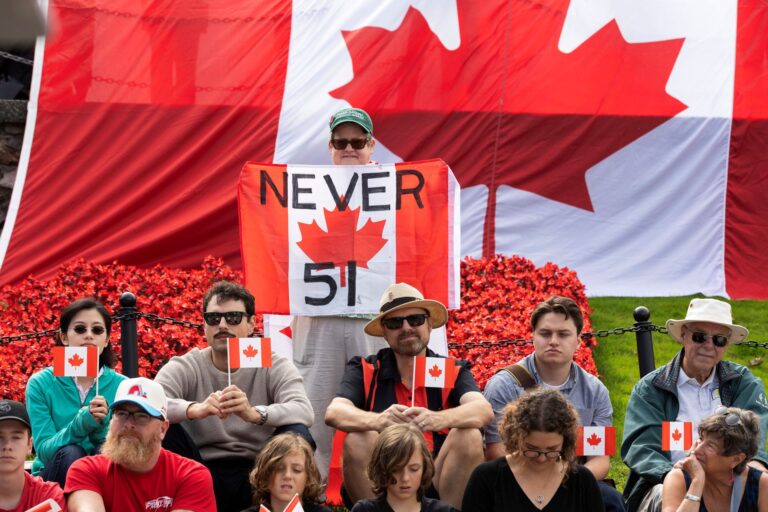
Nevertheless, for the past year, many Canadians have once again defined themselves as, at core, antiAmerican (or at least anti-Dubya). Most Americans haven’t noticed Canadian antipathy or believe that the problem passed with the end of intense combat in Iraq. Recent polls suggest blandly positive US attitudes toward Canada juxtaposed with teeth-gritted Canadian anger against Americans. But the same poll also showed that more than 10 percent of Americans hold a negative impression of Canada; that number may be regarded as trivial, but it is roughly numerically equal to the Canadian population.
This US judgment falls into the “cloud the size of a man’s hand” category, but Canadians should note its potential. When a student with an American flag is booed off the stage in tears by Montreal Anglos during a multicultural day in March 2004, it suggests that Canadians are tolerant of all peoples— except Americans. Both our countries have been fortunate that the disrespect during the past year has been limited to rhetorical taunts and insults; but neither has there been a videotape of events such as the recent Montreal booing or the repeated insults directed at the Brocton pee-wee hockey team in 2003. That the Brocton team was politely received in Fredericton in March 2004 is pleasant, but irrelevant; the 2003 insults never came from Fredericton.
The vast majority of Americans have a vaguely positive residual impression of Canadians as those quiet, polite, even humorous people up north who come to the United States for some winter vacation time in Florida, or Arizona. The average American is indeed ignorant of Canada and finding a US citizen who thinks seal hunting is a Saskatchewan sport or that igloos are low cost housing in Quebec is like shooting fish in a barrel. On the other hand, those with the most association with Canadians are not necessarily overwhelmed by the experience.
It is one of those frequently bruitedabout maxims that US Democrats “fit” better with Canadian Liberals, and Republicans match better with Canadian Conservatives. That judgment is a reflection of the political reality that Canadian politico-social policies are several steps to the left of their US analogues. Of course the maxim is a better generalization than a guide to specific conduct as there are many personality driven contrary examples. Thus Tory leader Diefenbaker got along badly with Kennedy. And the classic antagonism between Liberal PM Pearson and Democrat President Johnson that led to Pearson being literally throttled by LBJ was a function of tempestuous international relations differences rather than variants in political philosophies.
On the other hand, quite predictably, Nixon and Trudeau related to one another like Rotweiler and bobcat; one might say that personalities reinforced politics. And, almost as predictably, Mulroney had close political and personal relations with Presidents Reagan and the first George Bush. But also, equally unsurprisingly, the relations between Clinton bureaucrats and the waning Mulroney-Campbell government were essentially untroubled. The absence of dramatic economic or international political challenges made for a smooth relationship.
The calm relationship between Canada and the United States during the Clinton-Chrétien overlap years (1993-2000) was more apparent than real. Essentially, it was the equivalent of being adrift on calm seas. During the core of this period, Canada was gripped by the existential national unity question: would it remain a single country? The United States had then and has now no interest in sponsoring an independent Quebec; if during the same period, Washington campaigned vigorously for a united Yugoslavia, it would hardly have had sponsored a divided Canada. Consequently, our ritualistic mantra on Canadian unity complemented by high-level official statements by Secretary of State Warren Christopher and ultimately President Clinton in 1995 made it clear to anyone with a grade three education that the United States supported a united Canada. To the degree that Chrétien was capable of gratitude toward an American, he recognized that the United States had acted in Ottawa’s interests with its support. But even so, he was unable to resist the cheap shot open microphone comments at the NATO Summit in Madrid in 1997 suggesting to other senior officials that Clinton’s interest in expanding NATO to include Baltic states was driven by ethnic voter considerations.
Paul Martin begins with an enormous advantage in Canadian-US relations: he is not Jean Chrétien. And in his first several months in office, he did nothing to damage that advantage. Martin and Bush met on the margins of the Summit of the Americas in Monterey in January. It was a professional, businesslike session addressing for the most part bilateral issues of concern: BSE; softwood lumber; border security; treatment of arrested Canadians of the Mayer Arar ilk. Martin came away with a small plus through the public recognition that Canadians could bid on subcontracts in Iraq reconstruction. They did not duet The Yellow Rose of Texas à la MulroneyReagan, and Bush did not bestow a nickname on the prime minister, but the session turned the page.
They reinforced this new leaf with Martin’s April visit. To be sure, Martin needed this visit; it is hard to campaign on a platform including a plank to improve relations with the US when you won’t meet its national leader in Washington.
Martin’s visit was a strategic and tactical success. For Canadians of all political stripes, he “checked the box.” He enjoyed two lovely spring days in Washington, delivered a baseline foreign policy speech to a receptive audience, held what were characterized as productive meetings with President Bush and senior administration Cabinet officials on substantive issues of import to Canada, defined his differences with US policy, e.g., on Iraq, but emphasized Canadian concern for US defense and security priorities.
Moreover, he escaped without ostensible political damage. He evaded any public commitment to Canadian participation in North American missile defense, leaving it moldering in the “under study” limbo. He conveyed no impression of playing third fiddle in a US orchestra; the exchanges could be described as respectfully friendly and cordial.
But what did the visit really mean or accomplish?
So far as greater exposure to the US public was concerned, the trip was a zero. Martin’s April 29 foreign affairs speech will be parsed and praised by Canada experts, but it received not a word of coverage in the Washington Post. Unsurprisingly, US media was consumed by the unprecedented Bush-Cheney meeting with the 9/11 Commission earlier that day. There was almost as little note of the following day’s bilateral meeting as the Rose Garden press conference coverage focused on the President’s reaction to allegations that US soldiers mistreated Iraqi prisoners. The Post’s coverage (four paragraphs on A-4) was completely devoted to the mad cow issue and the president’s commitment to resolve it “as quickly as possible.” The US television network newscasts completely ignored the Martin visit.
But is that commitment a “deliverable” from the meeting? Canadians should not hold their breath. The words fall into the bureaucratic ASAP (as soon as possible) morass in which “soon” or “quickly” are firmly subordinated to the conditional modifier “as possible.” And “as quickly as possible” almost surely means not until after the November election, particularly since Senator Kerry and other key Democrats in fear of their electoral lives, such as Senate Minority Leader Tom Daschle, have attacked any quick resolution of the problem. Nor does softwood lumber appear any closer to resolution; even beyond the merits of the disputes, it is cheaper to dispatch battalions of lumber industry lobbyists to Washington than to invest in higher efficiency pulp and saw mills.
Nor was there much from the Canadian side to make American hearts beat faster. The border doubtless is “smarter,” but Canada’s persistent failure to locate its reported 36,000 illegal immigrants subject to deportation suggests a lack of serious purpose gainsaying the ostensible commitment to shared security.
Likewise, Martin’s statements such as “our security is indivisible” and “the defense of North America is also the defense of Canada” are a ringing affirmation of the obvious. The corollary commitment that “Canada will do more than its share” to protect continental borders is interesting rhetoric that would require expenditure substantially beyond what has been publicly announced to become a reality. And the subsequent statement that Canadians will “defend ourselves” and are not going to ask anyone else to do it is pure bombast. We will not publicly contradict sound bite politics, but the US eye roll could have been a drum roll upon hearing that bit of fancy.
Martin’s proposal for improved global institutions, featuring a G20 style gabfest with national leaders (including Canada), is amusingly selfserving. How a G20 will prove more likely to address effectively problems such as terrorism or world health when the 15-member UN Security Council (featuring many of the same states— but not Canada) cannot is an open question. Of course, given the opportunity to sit down with President Bush over a Crawford Ranch or Camp David weekend and actually practice such an exchange, Martin crawfished away. But no offense taken; we understand your pre-election need for discreete distance.
Nevertheless, this level of engagement suggests a solid, productive beginning to a realistic relationship. What it needs is a rescheduling of President Bush’s official visit to Ottawa— a visit that was postponed but not cancelled in April 2003. A Bush-toOttawa trip would be timely and appropriate. Already, it has been over 9 years since the last official presidential visit (Clinton on February 23, 1995), and the current gap is greater than any since the almost 11 years between the visits of Kennedy (May 1961) and Nixon (April 1972).
Traditionally, except for the Nixon visit, presidents have not visited in an election year. Nor, would we expect that Bush would visit Ottawa before Canada goes to the polls— that would mean visiting under the Chrétien election 2000 mandate, and one thinks that neither Bush nor Martin would want such a circumstance.
Fortunately planning need not begin from scratch. On the US side, personnel in Washington and Ottawa are essentially unchanged from 2003; on the Canadian side, bureaucratic professionals are the custodians of the security and protocol files.
Consequently, assuming a June election for Canada and a Liberal victory or even a minority government, there is a small but possible window for an official presidential visit quickly thereafter, perhaps following our mutual national days in early July, but before the US presidential election campaign becomes all-consuming. There is sufficient time to cover all the substantive and procedural bases and, perhaps, even devise solutions to some nettlesome bilateral complaints. It would provide a solid bilateral starting point for Martin’s personal electoral mandate and demonstrate for US audiences that relationships in North America are again on an even keel even if the sea is far from calm.