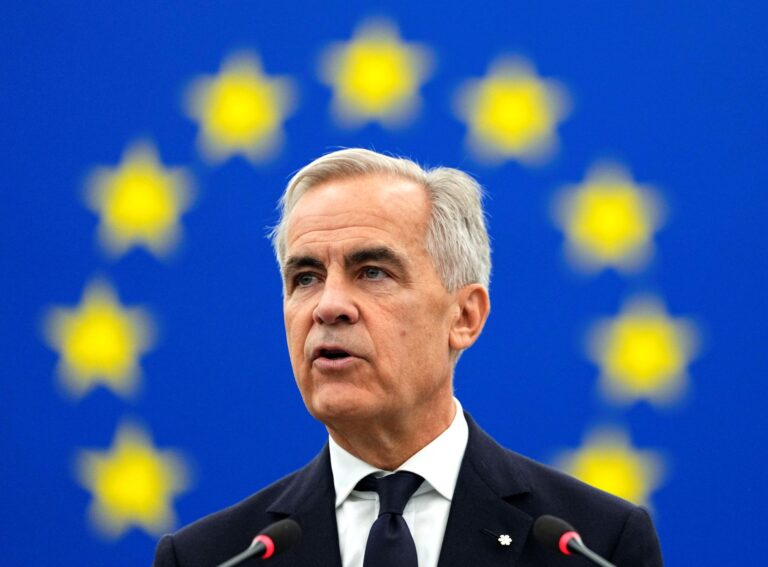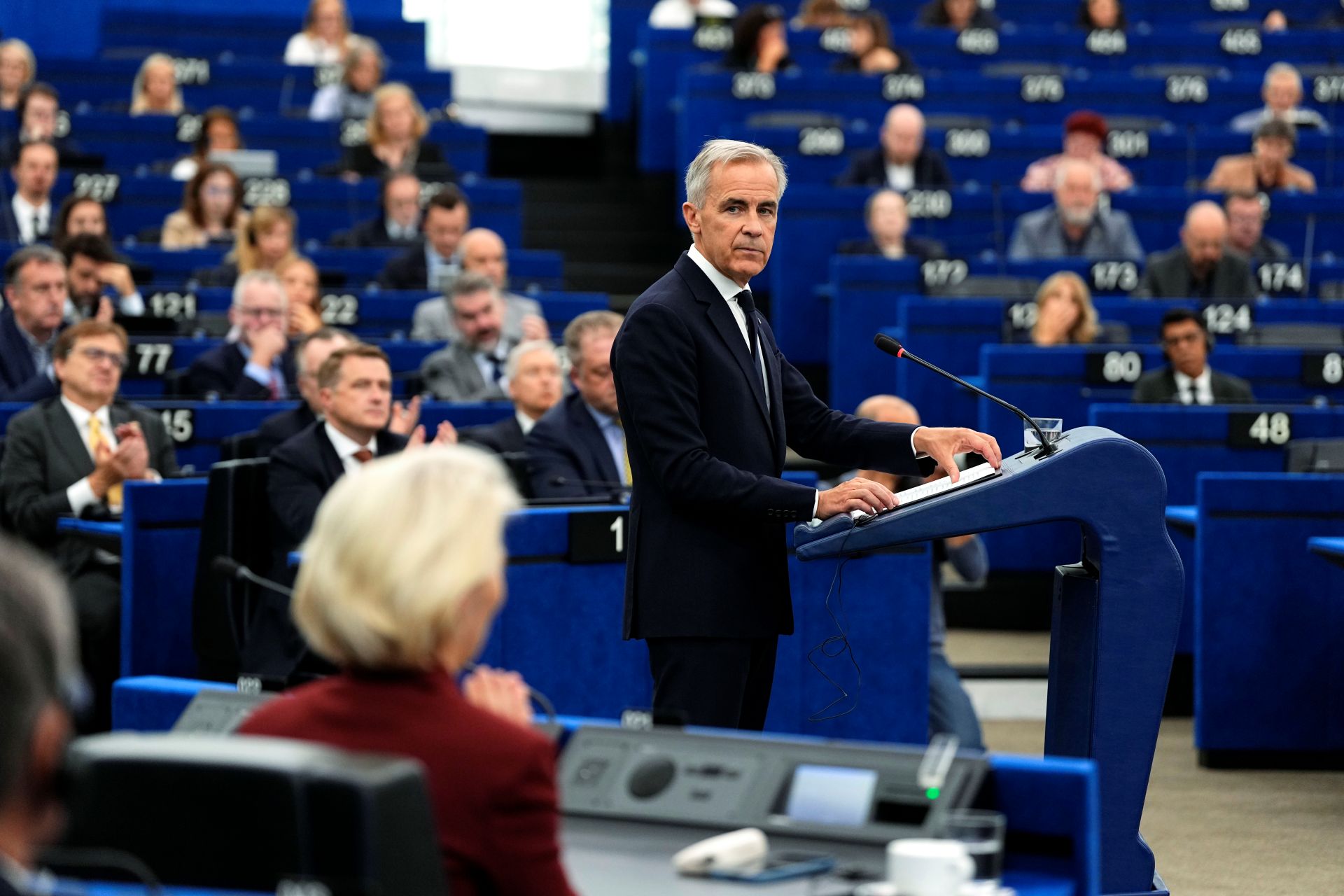
Prime Minister Mark Carney hosting European Union leaders at the Canada–EU summit in Montreal this week is just the latest step in a rapid diplomatic pivot toward Brussels that has already produced a security and defence partnership, negotiations on an “alliance for the future,” even if the exact arrangement is being debated in European capitals.
The timing is no coincidence. With the Trump administration weaponizing tariffs and industrial subsidies amid the high stakes CUSMA joint review, Ottawa has staked Canada’s economic security on doubling non-U.S. exports over the next decade. The European Union – the world’s second-largest single market and one of Canada’s closest democratic partners – could sit at the centre of that strategy.
Speaking to the European Parliament in Strasbourg last month, Carney argued that Canada and Europe must learn to “ally by function” – allowing Canada to gain increased access to European industrial, defence and technology programs.
Building on the landmark agreement in February making Canada the only non-European country inside the €150-billion SAFE defence procurement fund, draft plans for the Montreal summit would allow Canadian firms to:
- bid on EU sovereign artificial intelligence (AI) and cloud tenders;
- bring in the European Investment Bank to co-finance critical mineral projects;
- co-ordinate a proposed joint purchase of 50 De Havilland water bombers;
- advance negotiations for a Canada–EU digital trade agreement.
Why is such a hands-on push necessary when CETA, our free trade agreement with the EU, eliminated nearly 99 per cent of bilateral tariffs after it was enacted in 2017?
Nine years of free trade show that zero tariffs were just the starting line. With Europe at least, it seems free trade agreements are just one part of a broader strategy that must include strategic procurement partnerships and address other non-tariff barriers.
Nine Years of CETA
Figure 1 tracks Canadian exports before and after CETA’s provisional entry into force in September 2017, illustrating both real transatlantic progress and the ceiling that tariff cuts alone seemingly hit.
In merchandise trade, goods exports to the EU-27 (which excludes the U.K.) jumped in 2018 after CETA took effect, then rose and cooled alongside U.S. exports during the 2021–22 post-pandemic rebound and global commodity price spike.
Through 2024, cumulative growth to the EU (38 per cent) roughly tracked the increase in our exports to the U.S. and the rest of the world (excluding the U.S., the U.K. and the EU) before breaking away in 2025 to reach $42.8 billion as U.S. and Chinese tariffs pushed Canadian aluminum and canola seeds toward Europe (Table 1.4.2) alongside rising crude oil volumes.
Meanwhile, as figure 2 shows, exports to the EU in commercial services (digital, research and development and business services) jumped 75 per cent between 2017 and 2021, excluding Ireland where multinational headquarters and intellectual property hubs skew the data. However, these exports have hit a plateau at $10.7 billion since then, with growth falling behind both the U.S. and the rest of the world.
CETA seems to have helped where tariffs previously existed, increasing overall imports in goods from the EU by 61 per cent to $78.3 billion by 2025 (authors’ calculations from Statistics Canada), as well as lifting exports that previously faced high tariffs, such as specialty foods, and establishing bilateral regulatory and raw materials committees.
Still, tariff removal alone does not appear to explain Canada’s overall gains in Europe. Before CETA took effect, roughly three quarters (Page 531) of Canadian goods exported to Europe entered duty-free or at very low rates.
This includes our three fastest-growing exports – nuclear fuel, crude oil and complete aircraft – to six of the largest EU economies (Germany, Italy, France, Netherlands, Belgium, Spain) since 2017, as figure 3 shows.
Conversely, where CETA granted duty-free quotas for beef and pork, unresolved European food safety rules kept Canadian ranchers locked out. Canadian meat exports to Europe fell, while European meat imports into Canada more than tripled (authors’ calculations from Statistics Canada).
Three forces driving transatlantic trade
Figure 3 shows the change in exports across key industry groups from the period before CETA until recently for the core EU-6.
These groups were chosen because they are among our largest export categories – some where shipments to Europe grew considerably faster than our exports to the rest of the world and others where the opposite is true.
These comparisons cannot tell us whether this growth would have happened without the agreement, but they suggest tariff reductions were not the main driver. Instead, three non-tariff forces stand out: geopolitical supply security deals, direct foreign ownership and regulatory alignment.
Geopolitical supply security deals
Almost all the surge in nuclear fuel and uranium exports followed Russia’s 2022 invasion of Ukraine. Because Russia’s state-owned Rosatom controlled more than one-third of global uranium conversion supply at that time and because Canada had one of only three Western industrial facilities capable of replacing it, European utilities signed long-term Canadian contracts.
Likewise, once Europe banned Russian seaborne crude, Canadian crude oil exports to the EU nearly quadrupled, led by surging shipments to the Netherlands and Germany, which imported virtually no Canadian crude during CETA’s first four years.
Even 2025’s agricultural jump followed China’s anti-dumping probe into Canadian canola and a smaller European harvest.
Direct foreign ownership
In Europe, complete aircraft imports from Canada more than quadrupled largely because Airbus bought control of the spun-off C-Series program in 2018, making Mirabel, Que., the export hub for the Airbus A220.
Similarly, iron ore exports reached $3.03 billion (authors’ calculations from Statistics Canada) to Europe anchored by steelmaker ArcelorMittal’s longstanding investment in Quebec mines. On the other hand, B.C. copper ore exports to the EU fell despite an increase elsewhere, flowing mainly to Asian companies that co-financed those mines.
Regulatory alignment
Other areas of high-value manufacturing, such as scientific and measuring electronics, grew because they were built on specialized equipment supply chains, where CETA’s conformity-assessment protocol lets accredited Canadian labs test and certify equipment to European standards at home.
What the Montreal agenda gets right
While many details remain unknown, these patterns suggest the draft Montreal agenda is on the right track because it targets the exact procurement, investment and regulatory levers that tariff cuts alone could not move.
Public procurement is a core avenue for expanding bilateral trade in big swoops, which CETA sought to open in 2017. Yet across a 27-country bloc with large infrastructure multinationals and fragmented national tendering rules, it has proven easier for European firms to win municipal transit contracts in Canada than for Canadian firms to win tenders in Europe.
By contrast, the Montreal draft plan targets specific, restricted programs where Europe faces acute shortages and Canada has a clear edge.
These include the proposal to jointly buy 50 De Havilland water bombers, opening the €150-billion SAFE defence fund and sovereign AI tenders to restart stalled services growth, as well as bringing in the European Investment Bank to co-finance critical minerals, anchoring production in Canada without requiring foreign takeovers.
Beyond trade, these deals offer a middle-power insurance policy against superpower coercion while aligning standards on AI, climate and Arctic security.
Just as important, the political and tariff friction radiating from Washington is not only pushing European governments to de-risk their supply chains but is also changing how European consumers, travellers and businesses view the North American market.
As U.S. trade and border policies grow more unpredictable, Canada is well-positioned to present itself as the stable, welcoming North American alternative for European tourism, talent and regional headquarters. Early signs of that shift are already visible. While U.S. travel to Canada cooled in late 2025, overseas arrivals jumped 13.1 per cent, led by visitors from the U.K. and France.
Finally, whether Ottawa and Brussels simply modernize CETA or heed recent calls from Canadian trade experts for a broader middle-power charter, the past nine years show that the process of diversifying our exports toward the EU only begins with removing tariffs.
The next challenge is equipping Canada with the logistics and mutual regulatory recognition that allow global buyers to turn to us as they look for new suppliers.