Prime Minister Mark Carney has won deserved praise for standing firm against the Trump administration’s threats and imposition of tariffs. But political credit is only as good as the strategy that follows, and Canada now faces a genuine opportunity to do something more ambitious than weather the storm.
Carney’s approach has sparked a broader conversation among the world’s ‘middle powers’ – countries with significant economies like Japan, South Korea, Australia, and the U.K. that share a commitment to rules-based trade but sit outside the U.S.-China superpower axis. These are countries that are actively looking for a different economic path forward, one that doesn’t simply mirror the nationalism coming out of Washington and Beijing.
Canada’s recent trade missions and the signing of memorandums of understanding have been first steps in building that alternative. They make clear the government’s determination to refocus Canada’s trade relationships, alongside new investments designed to reduce Canada’s exposure to its southern neighbour. However, Canada is also focused on aligning the trans-Pacific trade pact and the EU into a ‘middle powers’ trade arrangement rather than leading the development of something new.
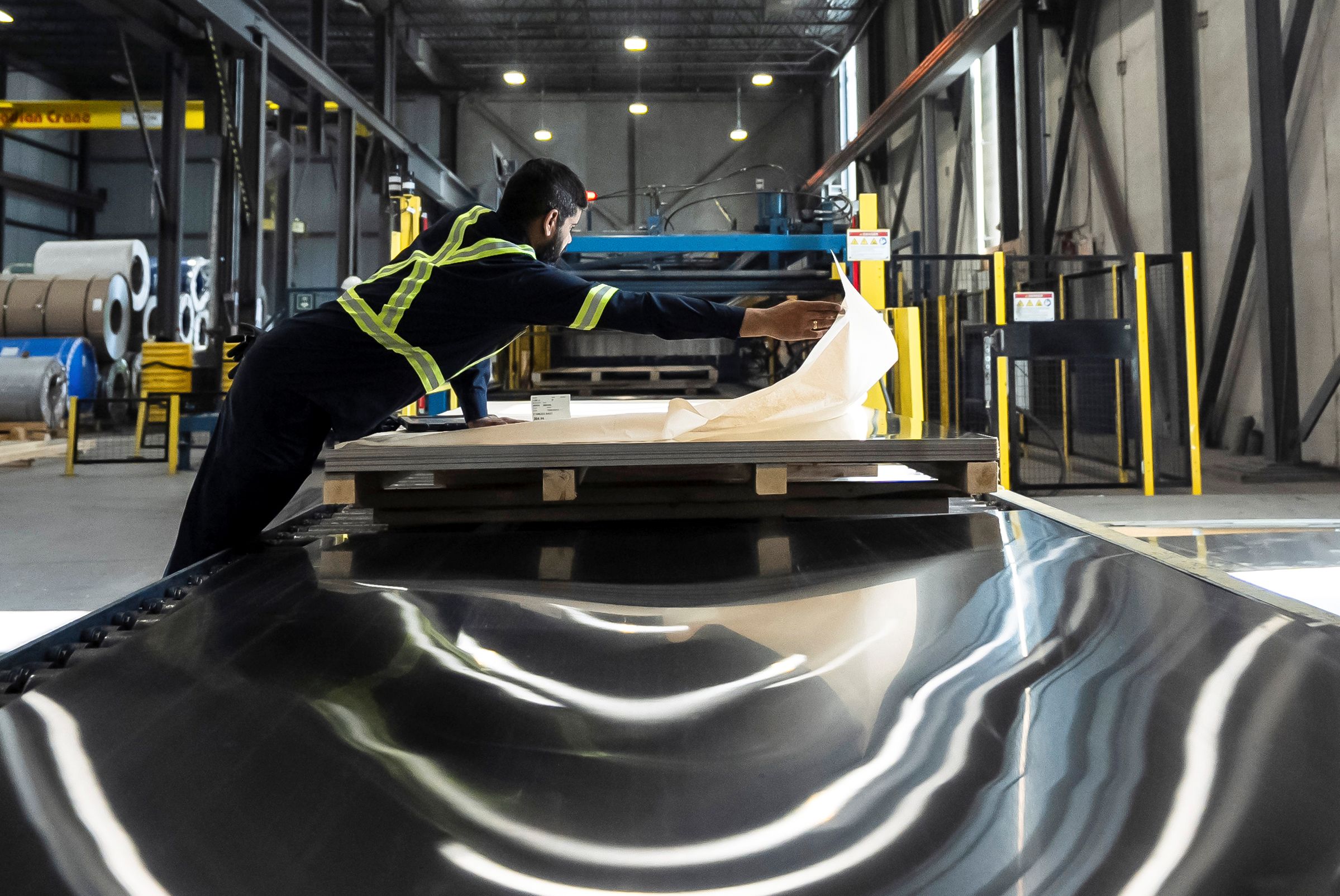
Canada’s push for middle powers to align economically must not simply defend or reinforce the old rules. Canada’s new path should be grounded in the future of the global economy, built on clean growth and electrification, and deliver sustainable careers and widely felt prosperity. The perfect place to start would be a new, open, plurilateral clean trade pact with like-minded partners, focused on trade-exposed commodities that factor into nearly all clean technology supply chains – namely, steel and aluminum.
A clean trade pact to secure key supply chains
The foundation of an open, plurilateral clean trade pact is already in place. Many of Canada’s recently signed MOUs prioritize key sectors of the global clean economy: EVs, batteries and broader electricity system technologies. The opportunity now is to begin securing clean supply chains for the steel and aluminum that feed into these industries through a plurilateral trading partnership that could also move Canada meaningfully towards its goal of being a clean energy superpower.
A new plurilateral pact could begin with these upstream industrial products and provide pathways to expand to a wider gamut of technologies that underpin the electrification of the global economy, from EVs to electricity system components.
Conventional trade agreements have value, but a new model is needed to move quickly enough to facilitate the energy transition and diversify critical supply chains outside of China. This model would involve business-to-business co-operation, state-level investment and joint ventures and include developing integrated supply chains where each partner contributes according to their comparative advantage alongside shared infrastructure investment.
Unlike more traditional free trade agreements, a plurilateral clean trade pact should include preconditions to join, including industrial decarbonization goals, fair pricing standards, strong workers’ rights, and safeguards against non-market imports. In return, members would benefit from a differentiated carbon-based tariff structure, eliminating import duties on low-carbon products imported from partners while maintaining tariffs on higher carbon imports.
By establishing clear carbon-based benchmarks that grow more stringent over time, a firm’s market access would be contingent on their continued decarbonization, both of their own production and their supply chains.
A secure opportunity for the coming decades
Creating a robust market for clean steel and aluminum would protect foundational supply chains and support the reshoring of clean manufacturing. Clean technologies represent one of the fastest-growing areas of industrial demand in the world. Global EV sales grew 29 per cent year-over-year in 2025, grid investment topped $470 billion for the first time, and clean energy sectors drove 10 per cent of global GDP growth in 2023, making clean energy supply chains the most secure global economic opportunity for the coming decades.
Expanding Canada’s electricity system between today and 2050 will require more than 12 million tonnes of steel alone, close to Canada’s entire annual output. Building out diverse, deep partnerships can also help protect middle powers from supply chain overexposure and price depression. China’s subsidization of its steel sector runs 10 times that of other OECD countries, flooding world markets with high-carbon exports.
Co-operation on upstream inputs of steel and aluminum has the potential to lower prices across supply chains at a time when affordability concerns around the world are being exacerbated by the Trump administration’s wanton use of tariffs and the wider geopolitical instability resulting from the war with Iran. In Canada, non-ferrous metal products (including aluminum and copper) are up 56 per cent year-on-year, making it harder for manufacturers that rely on these inputs to produce competitively and keep prices down for consumers.
Any pact should, moreover, include a co-ordinated strategy to maximize the climate and economic impact of each partner’s domestic industrial modernization investments, another novel addition to the traditional free trade agreement structure.
For example, Canada could leverage its low-cost clean electricity to attract energy-intensive manufacturing in key clean supply chains such as electrical steel. Partner countries could contribute intellectual property and technical expertise in exchange for a reliable, competitively priced and diversified supply.
Finally, decarbonizing heavy industry is an urgent climate imperative. Sectors like steel and aluminum alone account for roughly 11 per cent of global CO2 emissions. Given the longevity of industrial equipment, major new investments require confidence that market conditions will remain fair and viable, further supporting the need for strong, clear rules that guarantee a market for clean metals, clean ore, and clean products more broadly.
Good for Canada, good for the world
An agreement like this is how middle powers stamp their values on the future of global trade. It would create strong, consistent demand for clean steel and aluminum across various supply chains, giving clean producers the market certainty to invest at scale while reducing partners’ exposure to price shocks and coercive trade tactics.
But it isn’t just Canada that would benefit. The European Union is searching for a way to safeguard its steel and aluminum industry against Chinese dumping while maintaining its climate ambition. A clean trade pact with clear carbon benchmarks and co-ordinated anti-dumping provisions would offer the EU precisely this: a framework that protects its industrial base without abandoning its climate commitments.
Fortress North America is replacing free trade in Canada’s lexicon
Markets like Australia, Japan, South Korea, and Brazil would also benefit. And since the agreement would be open for others to join, provided they accept the ambitious preconditions required to do so, a future American administration or even China could join in the future.
Underpinning all of this must be a shared data and standards framework. A truly effective clean trade pact will need to ensure supply chain traceability requirements that account for where and how materials are extracted, processed, and transported. Without this, carbon benchmarks risk being gamed at the border.
An open plurilateral pact like this would not only demonstrate that collaborative climate action is possible, but that novel forms of high-standard co-operation are achievable in the face of great power coercion. Prime Minister Carney should embrace Canada’s full potential to be a clean energy superpower and pursue trade relationships more aligned to the realities of the 21st century.
An open, plurilateral clean trade pact could do just this, embodying the type of renewed international co-operation that the world needs now more than ever.