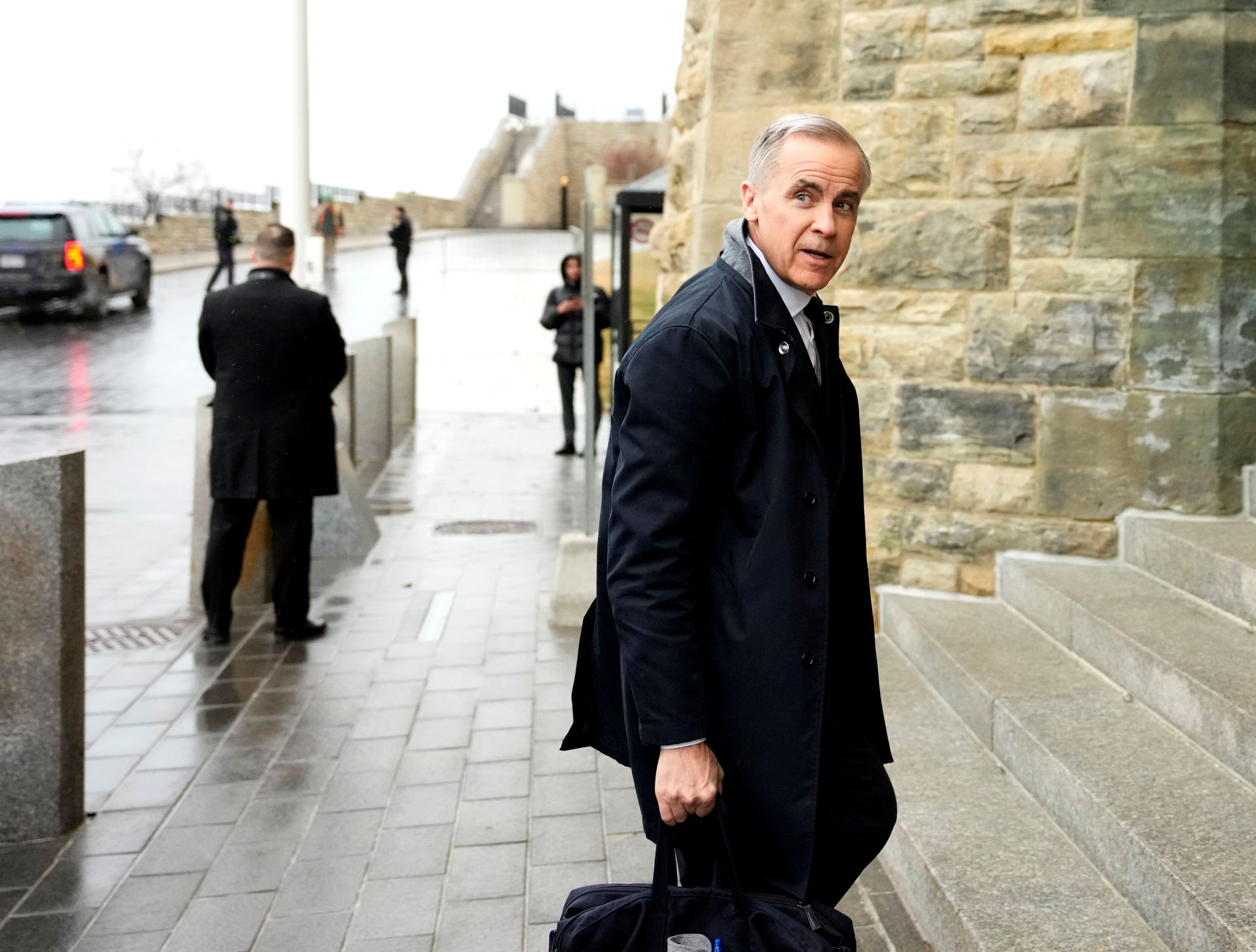
At the World Economic Forum in Davos, Prime Minister Mark Carney was the adult in the room. In his speech he told the world that the American-led, rules-based international order — the foundation for the prosperity and security of liberal democracies for 80 years — is over.
His remarks were, in some ways, a bookend to Winston Churchill’s famous 1946 “Iron Curtain speech” in Fulton, Missouri, which called on the West, led by the United States and Britain, to collectively confront the menace of Soviet communism. The global order that Carney pronounced dead in Davos was arguably born in Fulton.
For Canadians, the implicit message is that the bedrock assumption underpinning our public-policy architecture — that we willingly accept a very high degree of dependence on the United States for economic prosperity and national defence — has come to an end. The implication is a need for national resolve and tough choices.
Carney has declared that Canadians are “under no illusions” and must prepare for sacrifices. He has yet to say what those sacrifices will be.
Complacency is our greatest risk in the world the prime minister has described.
This complacency is evident among Canadian businesses. Export-oriented firms have been deeply embedded in the U.S. market for decades, cemented by successive trade agreements stretching back to the 1965 Auto Pact. That dependence was a deliberate policy choice. It is understandable, then, that Canada-U.S.-Mexico Agreement negotiations dominate business attention. But U.S. market access now carries a far higher risk premium than ever before. Does anyone seriously believe a Trump-signed agreement will be worth the paper it is printed on?
How Canada can put Carney’s Davos speech into action
Ottawa has talked about trade diversification for generations, to no avail, because business has never fully embraced the agenda. In the past, diversification was a nice-to-have. Today it is an imperative. But the federal government cannot do it alone. Business must co-lead this effort, just as an earlier generation of business leaders helped build support for the Canada-U.S. Free Trade Agreement in the late 1980s. To date, Canada’s business leadership has not taken up this mantle. It is time they did.
There is some complacency among the premiers as well. This time last year, the provinces appeared resolute about dismantling internal trade barriers — which a recent International Monetary Fund (IMF) report estimates are equivalent to a nine-per-cent tariff.
There has been progress, most notably a November agreement eliminating interprovincial trade barriers on goods except food and alcohol. But in services, significant protectionism persists.
Services account for four-fifths of the $210-billion potential increase to Canadian GDP the IMF estimates would result from fully eliminating internal trade barriers.
Internal trade barriers need to be eliminated. Reforms like mutual recognition of professional credentials in construction, health care, and education would liberalize services and drive long-term productivity gains. The federal government should offer financial adjustment support to provinces in exchange for removing all remaining barriers — as it did in the 1990s and early 2000s to persuade provinces to harmonize sales taxes with the GST in the name of economic efficiency.
Now is obviously not the time for disunity, yet separatist referenda are on the horizon in Alberta and perhaps in Quebec.
In Quebec’s 1995 independence referendum we came perilously close to losing the country, and that was long before the age of disinformation and foreign interference in Canadian politics. We can expect both of those forces to come into play this time, particularly in Alberta, with encouragement from the MAGA movement in the U.S.
Here too, the prime minister must lead and make the case in both Alberta and Quebec that this is not the moment for independence votes. Unity is essential to our national security.
Finally, Canadians need to be told the truth about public finances. Tax increases will be required. The government’s commitment to raise core defence spending to 3.5 per cent of GDP — a level last seen when John Diefenbaker was prime minister — cannot be financed under the current tax structure without running large, perhaps unsustainable, fiscal deficits indefinitely. Young Canadians — already the most pessimistic about the country’s future — should not be saddled with a massive debt overhang. Older Canadians need to lead by example and accept higher taxes to lessen our defence dependence on the United States and reduce the intergenerational equity burden.
Carney’s core message in Davos was that the rupture we face is permanent. There is no return to the status quo ante; that “pleasant fiction” is gone.
Our new harsh reality demands a difficult national conversation. It will require candour about taxes, the provincial versus the national interest, and acceptance that economic and security independence carries costs that everyone must bear. It may even require, as is occurring in parts of Europe today, a discussion about national service.
Prime Minister Carney had his Churchillian moment in Davos. Now it is time to invoke former president John F. Kennedy’s civic challenge: “Ask not what your country can do for you — ask what you can do for your country.”