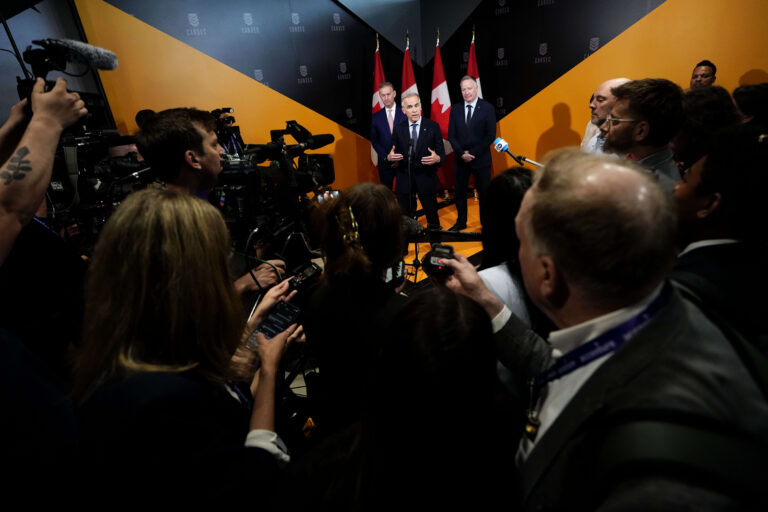
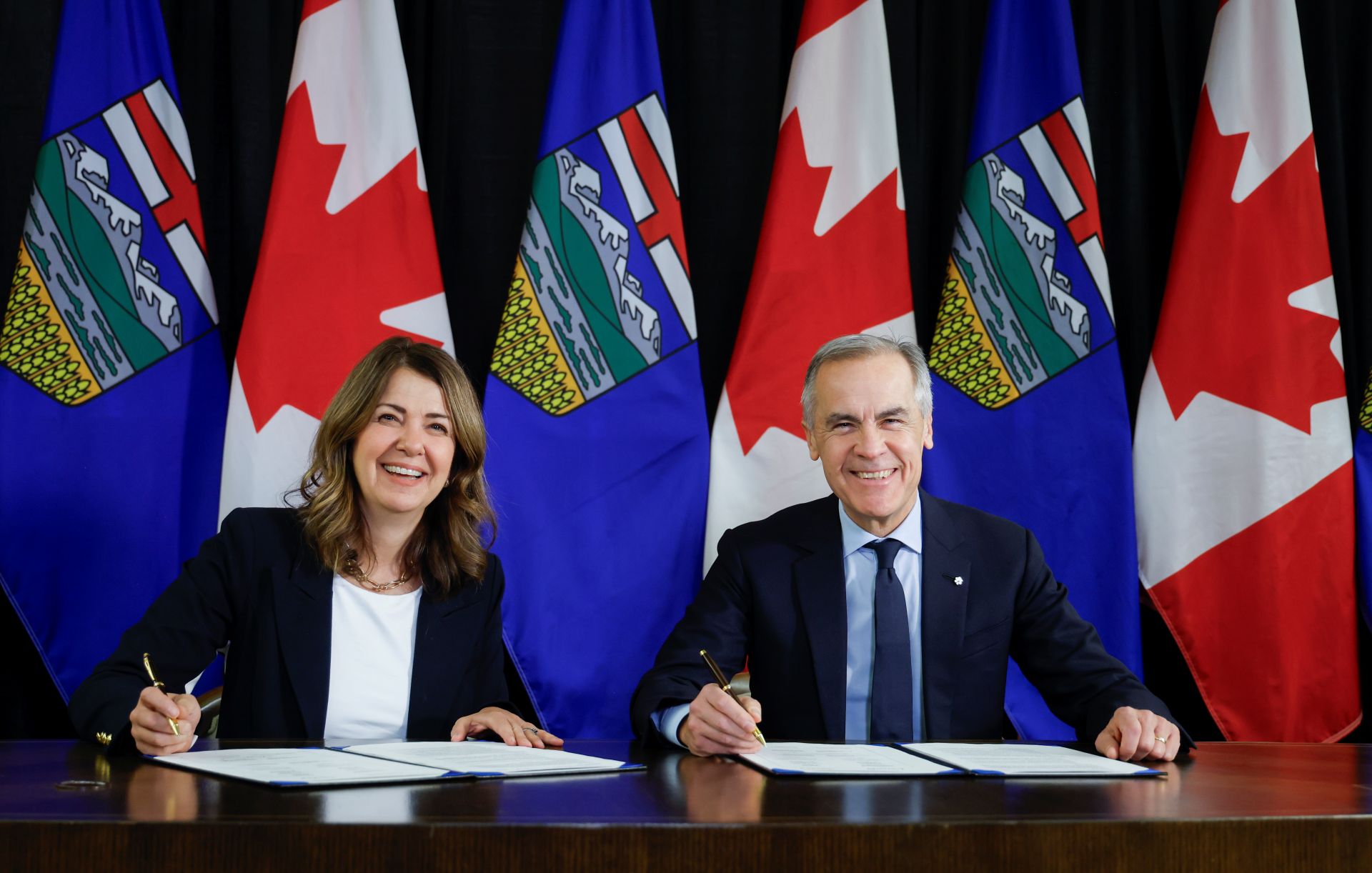
“I’m a firm believer and practitioner in co-operative federalism,” Prime Minister Mark Carney said in his year-end interview with Global News – a commitment he has repeatedly made since the signing of a controversial energy deal between Ottawa and Alberta in late November.
“This is Canada working,” Carney said at the time of the deal.
Only, it isn’t. What we have seen so far is an old pattern. It’s competitive federalism, the opposite of co-operative federalism.
Why else, for example, was British Columbia Premier David Eby so utterly upset about the energy deal which includes the possibility of another pipeline from the Alberta oilsands to the B.C. coast – a plan that he said “caught [him] off guard?”
Or what about Ontario Premier Doug Ford’s disappointment after he said he received only a few hours notice about Ottawa’s trade deal with China on electric vehicles and Canadian agricultural exports?
If we had co-operative federalism, Eby, Ford and all other premiers – not to mention representatives from Indigenous communities – would have been part of the advance negotiations on any such deals.
Lessons from the Trudeau era
The Carney government’s bold attempt to launch a new industrial strategy is not without historical precedent. It is reminiscent of Pierre Trudeau’s ambitious policy of national economic development to cope with multiple crises in the 1970s and early 1980s. Among many other similarities, Trudeau’s effort entailed a major projects task force.
The Royal Commission on the Economic Union and Development Prospects for Canada (1982-85) intensively examined different aspects of this largely failed experiment. One key lesson: Canada’s institutional mechanisms facilitating co-operation in economic policymaking are too weak to compensate for the country’s significant political, social and economic fragmentation.
It is remarkable that this past experience – and the wealth of knowledge resulting from decades of research – do not have a place in current debates.
Why institutions matter
Facing existential geopolitical and domestic threats, being “laser-focused” on resilience and results is not enough. What is needed is a broader dialogue about how Canada can, as Alasdair Roberts has argued, become an “adaptable country” again.
An institutional reform of federalism and of intergovernmental institutions specifically needs to be front and centre of Ottawa’s new approach to nation building.
Why? Because at the heart of co-operative federalism lies institutionalized multilateral collaboration among federal, provincial and territorial governments. There should also be a formal role for First Nations, Métis and Inuit. Arguably, for municipalities, too.
Institutions shape political behaviour. Institutional reform aimed at strengthening co-operative federalism would help define common interests and align action to achieve these goals. It would also help to cultivate shared norms and understandings – a key condition for strategic policymaking. Finally, it would make intergovernmental co-ordination less dependent on the political leadership of the day.
The limits of Team Canada
By contrast, in competitive federalism, each government prioritizes its self-interest over collective goals. Bilateral deals and unilateralism are the dominant approaches.
As a result, policymaking often lacks coherence and conflicts tend to be more prevalent. All of this has been on full display recently – not only in the energy or China deals.
Take, for example, the premiers’ humiliating trip to Washington last February, how Ford’s $75-million anti-tariff ad campaign in the U.S. backfired in October, or the latest political theatre around Ontario’s plan to ban Crown Royal from LCBO shelves.
Crown Royal is distilled in Gimli, Man., but U.K.-based Diageo, which owns the Crown Royal brand, announced last year it was closing the factory that bottles the whisky in Amherstburg, Ont., prompting Ford’s threat.
In response, Manitoba Premier Wab Kinew asked his Ontario counterpart to reconsider, saying: “Targeting jobs in other provinces is at odds with a Team Canada approach.”
The problem is that Team Canada is a chimera, an empty signifier. The term sounds good, but no one knows what it means. It’s Canada’s fragile default mode of intergovernmental co-ordination in times of crisis because co-operative federalism is weak or, to put it bluntly, barely exists.
While Team Canada may help muster a short-term response to address an acute threat, it is not a sufficient substitute for intergovernmental institutions that facilitate robust policymaking for the long-term.
A pattern of failed resets
Like Carney, other prime ministers promised to reset federal-provincial relations through co-operative federalism, usually after prolonged episodes of federal-provincial confrontation. Yet they all failed to understand the importance of the institutional reforms necessary to entrench it.
Brian Mulroney and Paul Martin came to power with the promise to end Pierre Trudeau’s and Jean Chrétien’s unilateralism. In the same fashion, Justin Trudeau pledged to re-engage the provinces and territories through a new collaborative approach after Stephen Harper had de facto abolished first ministers’ meetings.
Without tackling this structural deficit through institutional reforms, however, intergovernmental relations will always revert to a competitive mode.
Strong intergovernmental institutions are the foundation of co-operative federalism. Federal states such as Germany, Austria, Switzerland and even the European Union all have a formal and differentiated framework for regular, frequent in-person meetings, prepared by sufficient administrative support.
In its strongest form, co-operative federalism even provides constituent units with a role in federal decision-making. Think the German Bundesrat or the Council of the European Union.
The 27 heads of government in the countries that make up the European Union convene at least four, and often eight, times per year through the European Council. On the ministerial level, the Council of the European Union co-ordinates, negotiates and adopts policies in different configurations.
Consider also, for example, the General Affairs Council, which consists of the European affairs ministers of each country. Usually, it meets every month.
All these meetings are carefully prepared by well-staffed administrative expert committees, working groups and COREPER, the Committee of Permanent Representatives, in Brussels.
Canada’s parochial intergovernmental system
Against this backdrop, intergovernmental relations in Canada are parochial.
The only pan-Canadian top-level intergovernmental body, the Council of the Federation, was created by the provinces in 2003 for “strengthening interprovincial-territorial cooperation.” However, it has never become an institution encouraging substantive horizontal policy co-ordination.
What is worse is that first ministers’ meetings are not institutionalized. Since Carney took over as prime minister, there have been only three in-person meetings – in Saskatoon in June followed by one in Huntsville, Ont., in July, embedded into the Council of the Federation summer meeting. The third was in Ottawa in late January, six months later. All other meetings were virtual.
Without a new framework that formalizes such meetings and establishes guidelines for the roles and responsibilities among governments, these baby steps toward more co-operation will likely meet the same fate as earlier attempts.
For example, shortly after becoming prime minister, Justin Trudeau hosted three in-person first ministers’ meetings between November 2015 and December 2016, but then only one in 2017 and one in 2018. After that, there was no single in-person meeting until January 2025.
Competitive federalism prevailed.
There is certainly no lack of feasible reform proposals to strengthen co-operative federalism. Since the 1960s, scholars have produced an abundance of practically relevant research on how to address this problem.
The main issue is one of recognition. The prime minister often juggles lofty ideas from nation building to a new industrial strategy to co-operative federalism without substantiating what they mean.
The major project problem
This lack of clarity is not pragmatism. Rather, it is an impediment to developing sustainable policy and governance reforms of vital importance at this historical juncture.
A good example is the Major Project Office (MPO), which lies at the heart of Carney’s new industrial strategy. While symbolically headquartered in Calgary, the MPO is a purely federal agency that makes decisions on fast-tracking nation-building projects.
Research on Pierre Trudeau’s industrial policy has already demonstrated that this approach doesn’t fit well with Canadian federalism.
As Hugh Thorburn concluded in his 1984 study, a new institution such as the MPO must be truly intergovernmental or, in his words, “a co-operative institution answering to both levels, charged with the mission of building bridges of co-operation and integrated policy to maximize the effectiveness of Canada in the international economic contest.”
The prime minister and his inner circle should take seriously multiple calls for an encompassing mobilization of the deep expertise already available.
The federal government can’t navigate Canada’s historical challenges alone, top down from the prime minister’s office. We can’t rebuild our federal country ad hoc and through virtual meetings. Without taking the necessary steps to institutionally entrench co-operative federalism, Carney won’t be able to bring to life a new industrial strategy, let alone nation building.
The timing for reforming intergovernmental relations could not be any better because the relationship between the prime minister and his provincial counterparts is relatively cordial today.
Ottawa must seize this moment. As any observer of Canadian federalism knows, this can dissipate at any time.