Consequences of the recent annual meeting of Asia-Pacific Economic Cooperation (APEC) leaders in Gyeongju, South Korea, are already radiating outward — and Ottawa would be wise to take heed.
The headline out of Gyeongju was the conclusion of U.S.–South Korea tariff talks. But this was not a standard trade deal. It was a grand bargain. In exchange for a US$350-billion package of industrial investments, including money targeted specifically to shipbuilding, Seoul secured a cut in tariffs on automobile exports to the U.S. and more favourable treatment for its semiconductor sector.
The real breakthrough, however, was on the security side: U.S. President Donald Trump publicly supported South Korea’s plan to build and operate nuclear-powered submarines. Despite earlier reports that the submarines would be built at a shipyard in Philadelphia, South Korean officials say the subs are to be built locally with U.S. co-operation in gaining access to nuclear fuel.
This deal has implications for two of Canada’s most important and currently stalled files: the country’s tense trade relationship with the United States and the government’s submarine replacement project.
A masterclass in transactional diplomacy
Ottawa is rightly concerned about protecting our interests as the Canada-United States-Mexico (CUSMA) agreement heads toward review. Another worry is how to blunt Trump’s protectionist measures. But Canada’s talks with Washington have mostly been defined by a defensive crouch.
Seoul’s posture was the opposite. Facing a highly transactional White House, South Korea did not just defend what it already had. It bought what it needed next.
The government made clear what it was willing to put on the table: a huge job-creating investment package aimed squarely at a core U.S. political priority — reviving American industrial capacity, especially naval shipbuilding, through what Seoul pitched as the “Make American Shipbuilding Great Again” (MASGA) initiative.
In return, South Korea got what it strategically wanted. It locked in tariff relief on sectors vital to its economy and won explicit U.S. backing for a national security objective that had eluded Seoul until now — to build, fuel and operate nuclear-powered submarines. This ambition has been an open secret for years. It is seen as essential to deter North Korea, which is said to be working on its own nuclear-powered submarine with Russian assistance. Seoul also wants to shadow an increasingly capable Chinese navy across contested waters in the Indo-Pacific.
The core lesson? Give on industrial investment and infrastructure; get on trade and hard power. That challenge now faces Ottawa. But as Canada moves through its own talks with Washington, is it even playing on the same board?
Canada is still trying to limit damage from tariffs. South Korea turned concessions into leverage. What is our equivalent grand bargain? Which assets — from critical minerals to Arctic geography to undersea surveillance expertise — is the federal government prepared to bring forward to not only preserve the status quo, but gain something new and concrete? That could include guaranteed access to advanced defence technology, exemptions from retaliatory tariffs or a defined role in continental supply chains the U.S. wants to secure.
Canada should not walk into the next round of North American trade talks with nothing to offer except moral authority and polite frustration.
The submarine project has become more complicated
The APEC outcome also lands squarely on the desk of the Department of National Defence. The choice of Canada’s next submarine fleet is one of the most consequential defence purchases of this generation. It will shape how — and where — Canada can operate at sea in both the Arctic and the Indo-Pacific for the next half-century.
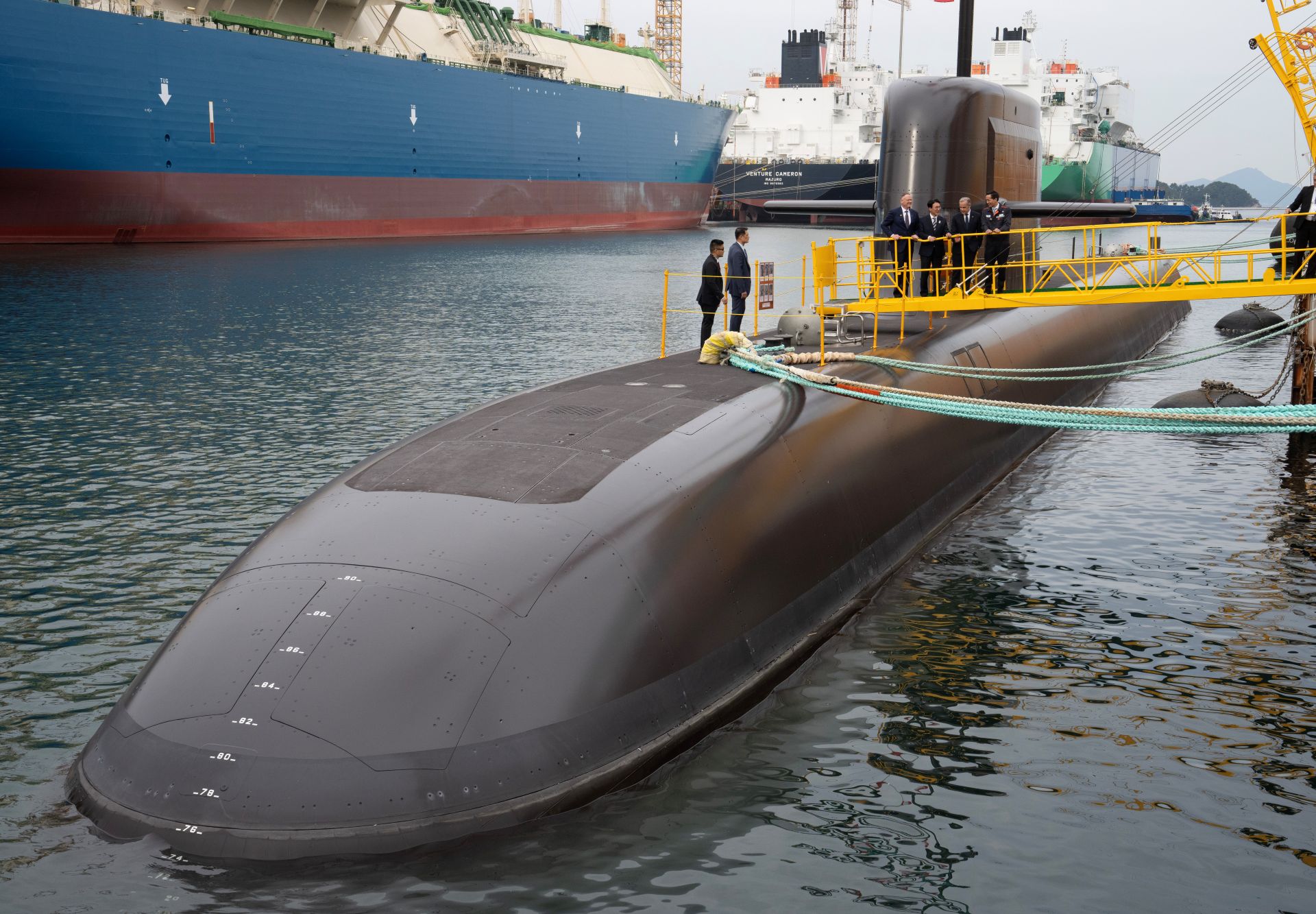
Before the summit, the field looked relatively clear. The shortlist was narrowed to two advanced conventional (diesel-electric) designs: Germany’s well-regarded TKMS offering and South Korea’s KSS-III design backed by a consortium that includes Hanwha Ocean. Prime Minister Mark Carney’s high-profile visit in October to Hanwha’s shipyard in Geoje, where he toured a new submarine, accentuated how serious that bid has become.
But South Korea is no longer just a builder of long-range conventional submarines. Overnight, it has become a nascent nuclear-submarine power with explicit U.S. blessing. That fundamentally changes its profile as a potential Canadian partner.
A strategic dilemma
This shift confronts Ottawa with a choice that goes far beyond specifications, timelines or price. It is not about finding the cheapest, quickest replacement. It demands a clear view of Canada’s long-term naval and strategic interests.
The German bid represents the “safe” option: NATO-compatible subs and a proven traditional Atlantic partner. Our security identity would remain anchored in Euro-Atlantic institutions. A Defence Report analysis days before Carney’s visit to South Korea argued Ottawa should favour Germany’s offer on the grounds that the Korean design might need to be significantly modified to meet Canadian operational needs.
The South Korean bid, the Indo-Pacific option, offers a long-term partnership with a capable middle power and world-class shipbuilder in the globe’s fastest-growing region and one which Ottawa sees as strategically vital to Canada over the next half-century. Bolstering the bid are a military secrets agreement and a bilateral security and defence partnership recently signed between the two countries.
The secret to a successful defence industrial strategy is procurement reform
South Korean President Lee Jae Myung has gone so far as to describe Canada as a key ally. Choosing South Korea as a supplier would strengthen a strategic defence relationship with a country that is tightly woven into the U.S. naval-industrial base and is on track to operate advanced conventional submarines and nuclear-powered boats.
This raises the important question of whether Canada should prioritize its familiar relationship with NATO or turn to an Indo-Pacific ally increasingly central to U.S. strategy in that region?
Canada needs its own grand bargain
Any choice of submarines — be they from Germany, South Korea, or some form of industrial collaboration — is no longer just about buying hulls. It will determine whether Canada secures a role in undersea warfare, can maintain a ready and effective fleet and support technological development, one it currently cannot hold with its outdated boats. The decision will shape how, and where, Canada will operate underwater from the Arctic to the Indo-Pacific.
The South Korea–U.S. bargain, which deliberately merged trade and security, has made Canada’s submarine decision more complex and more consequential. This is not a stopgap purchase. It is a generational decision about our country’s role in the world. Trade, national security and industrial policy no longer come in separate department folders. They are one file. South Korea treated them that way — and gained.
Canada should do the same. We need to shift away from protecting existing advantages to negotiating concrete strategic returns. A more proactive and transactional approach may be the only way to safeguard our economic interests and strengthen our security.