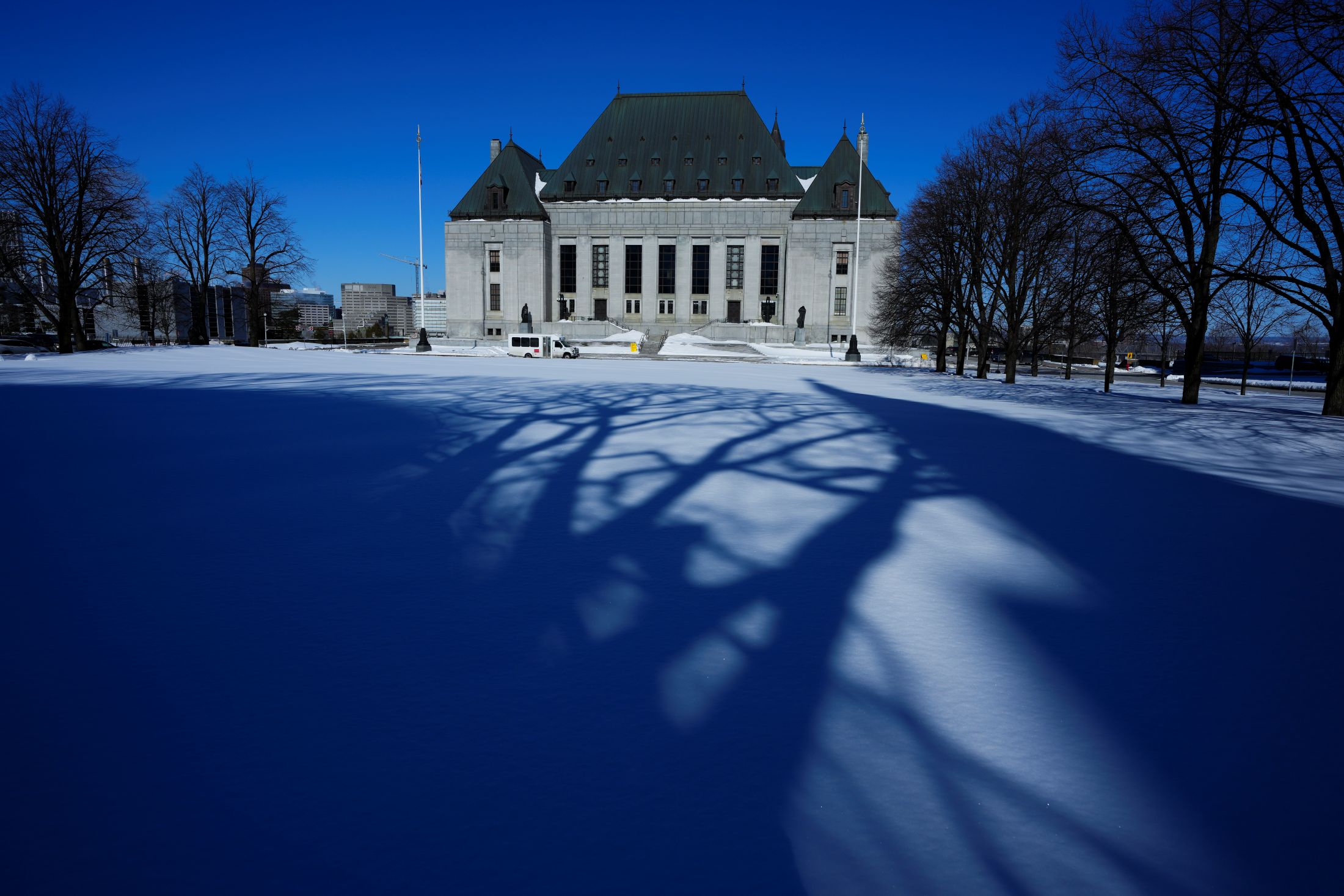
This year may prove to be the Supreme Court of Canada’s most consequential since its 1998 Reference re Secession of Quebec because it will soon hear an appeal of Quebec’s secularism law, Bill 21, which bars most public servants from wearing religious symbols at work.
While supporters of the law say it ensures religious neutrality, critics believe it flagrantly violates religious freedom, freedom of expression and other areas of the Canadian Charter of Rights and Freedoms. The Quebec government invoked the Charter’s notwithstanding clause in a bid to shield the law from judicial review.
Despite that, Bill 21 has faced several legal challenges. These range from the English Montreal School Board’s claim that it supersedes the province’s legislative authority over minority language education rights to the federal attorney general’s argument that the notwithstanding clause is subject to judicial review and cannot irreparably impair rights.
The resurgence of the notwithstanding clause
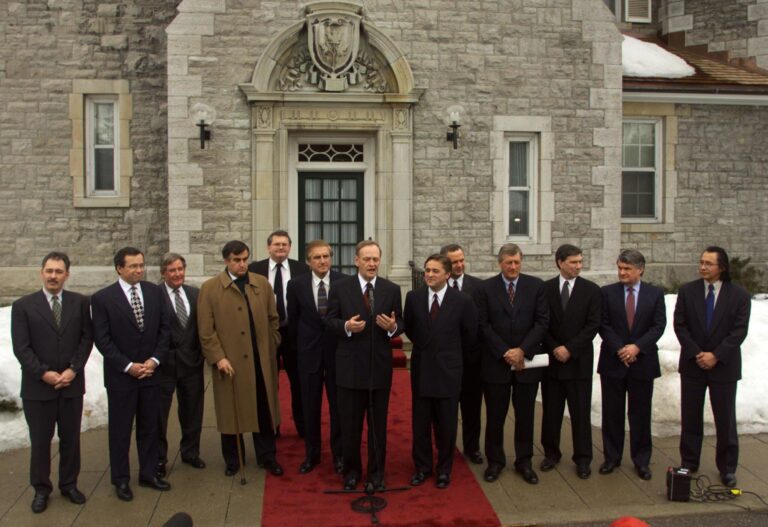
During patriation of the Constitution in 1982, the notwithstanding clause was added as a compromise between those who desired a fully entrenched Charter and those who wanted to ensure ultimate legislative power and were skeptical of the potential judicialization of rights. Their leaders were provincial premiers such as Alberta’s Peter Lougheed, Saskatchewan’s Allan Blakeney and Manitoba’s Sterling Lyon.
For the next 35 years, the notwithstanding clause was rarely used outside Quebec. Since 2018, however, it has been invoked 12 times – increasingly by other provinces. Ontario, Saskatchewan and Alberta have used it to cut the size of Toronto city council, protect provincial back-to-work legislation and restrict transgender youth policies on sports, gender-affirming care and pronoun use.
The significance of the Bill 21 case is not lost on the interveners at the Supreme Court hearing. Almost all of the 61 non-governmental interveners are urging it to impose new limits on the notwithstanding clause’s use.
An erroneous and dangerous suggestion
However, many of their arguments are based on the dubious legal grounds that Canada’s “unwritten constitutional principles” require the court to act in this way.
In the 1998 Secession Reference, the court invoked the unwritten principles of federalism, the rule of law, protection of minorities and democracy to guide Quebec’s hypothetical separation. That case dealt with a genuine constitutional gap – how secession by a province could occur.
But in the case of Bill 21, no such gap exists. The notwithstanding clause’s text clearly permits governments to override judicial decisions or prevent the courts from ruling on legislation. Invocation must be renewed every five years but can be done indefinitely. There is little reason to rely on unwritten principles when the plain text does the job.
Even if there are textual silences, this does not imply that it is the Supreme Court’s job to fill them. Our Constitution is full of gaps, abeyances and ambiguities. One is Quebec’s continued refusal to sign on to the 1982 Constitution Act – an issue that has been managed politically rather than judicially for more than four decades.
While many lawyers see these unresolved matters as cracks in the foundations of an all-encompassing Constitution, irresolution has served Canadians well by allowing us to avoid intractable political conflict through flexibility.
As University of Toronto political scientist Nelson Wiseman puts it: “The genius in the Canadian path of constitutional evolution has been to adapt, improvise, and muddle through.”
It is inconsistent with our constitutional traditions to see every uncertainty as being in need of legal resolution.
What about other rights?
Nevertheless, interveners have thrown a heap of unwritten principles at the wall, hoping a few will stick.
The Ontario Human Rights Commission contends that Section 27 of the Charter, which affirms multiculturalism, should limit the notwithstanding clause through the unwritten principle of minority protection.
Likewise, Egale, an LGBTQ rights organization, justifies substantive review of the legality of the clause and potential invalidation of its use in the Bill 21 case on the centrality to Canada’s constitutional framework of protecting minority rights.
Other groups, such as the Community Legal Assistance Society, the Constitutional Rights Centre and the British Columbia Humanist Association, go a step further by asking the court to invent novel unwritten constitutional principles such as “non-discrimination” or “equality” or the state’s “duty of religious neutrality.”
These arguments are perplexing because these principles – equality and freedom of religion – are in sections 15 and 2(a) of the Charter, yet are expressly subject to the notwithstanding clause.
Allowing unwritten principles to invalidate what the notwithstanding clause explicitly allows would render it meaningless – a point the majority of the court made a few years ago in Toronto (City) v. Ontario (Attorney General).
This is not the only problem with these arguments. These principles are nebulous, judicially created and unpredictable. The Supreme Court has not established a legal basis for identifying or applying these principles, nor has it ruled out the existence of other undefined principles. The only constraint in this exercise seems to be the bounds of judicial creativity.
These factums also ignore that unwritten principles cut both ways. Federalism and democracy are just as fundamental as minority protection and the rule of law. Bill 21 is about religious minorities, but it is also a question of the ability of provinces to pursue different models of secularism.
The notwithstanding clause needs more nuanced debate
If unwritten principles are to be taken seriously, provincial legislatures having the ability to disagree with nationally mandated judicial Charternorms in the interests of the voters who elected them falls squarely within the unwritten principles of federalism and democracy. But reading the factums of these opponents of the notwithstanding clause makes it seem as if these principles are of no consequence.
Finally, and ironically, relying on unwritten principles to hollow out the notwithstanding clause promises to do more damage to the rule of law than its use ever could.
Were the Supreme Court to impose limits on the notwithstanding clause nowhere implied by its text through unwritten principles, this would effectively amend the meaning of the Constitution through judicial fiat, injecting unpredictability into the law by allowing a grab bag of unwritten principles to change the meaning of fixed text.
Those opposed to the notwithstanding clause are welcome to convince their fellow citizens. But a change to its text requires a general amendment under Part V of the Constitution Act, 1982. To do through judicial fiat what should and can only be done democratically is not the rule of law. It is judicial supremacy.
The clause is essential
As in 1998, national unity in 2026 is being tested. Unlike in the 1990s however, it is not just the threat of Quebec separatism. Alberta separatism is also on the rise while U.S. President Donald Trump is constantly promoting the annexation of Canada as the 51st U.S. state.
The notwithstanding clause is key to keeping Quebec, Alberta and all Canadian provinces within the federation by allowing them to develop their own provincial rights interpretations separate from the interpretation of the Constitution by a federally appointed judiciary.
Without the notwithstanding clause, Quebec would have no way of defending its unique model of secularism and interculturalism. This risks triggering a national unity crisis that would play right into the hands of separatists in both Quebec and Alberta. The justices should resist the temptation to neuter the notwithstanding clause. For the sake of parliamentary democracy, federalism, national unity and the integrity of the constitutional order, they must leave it where it belongs – in the text of the Constitution, not erased or limited by unwritten contrivances.