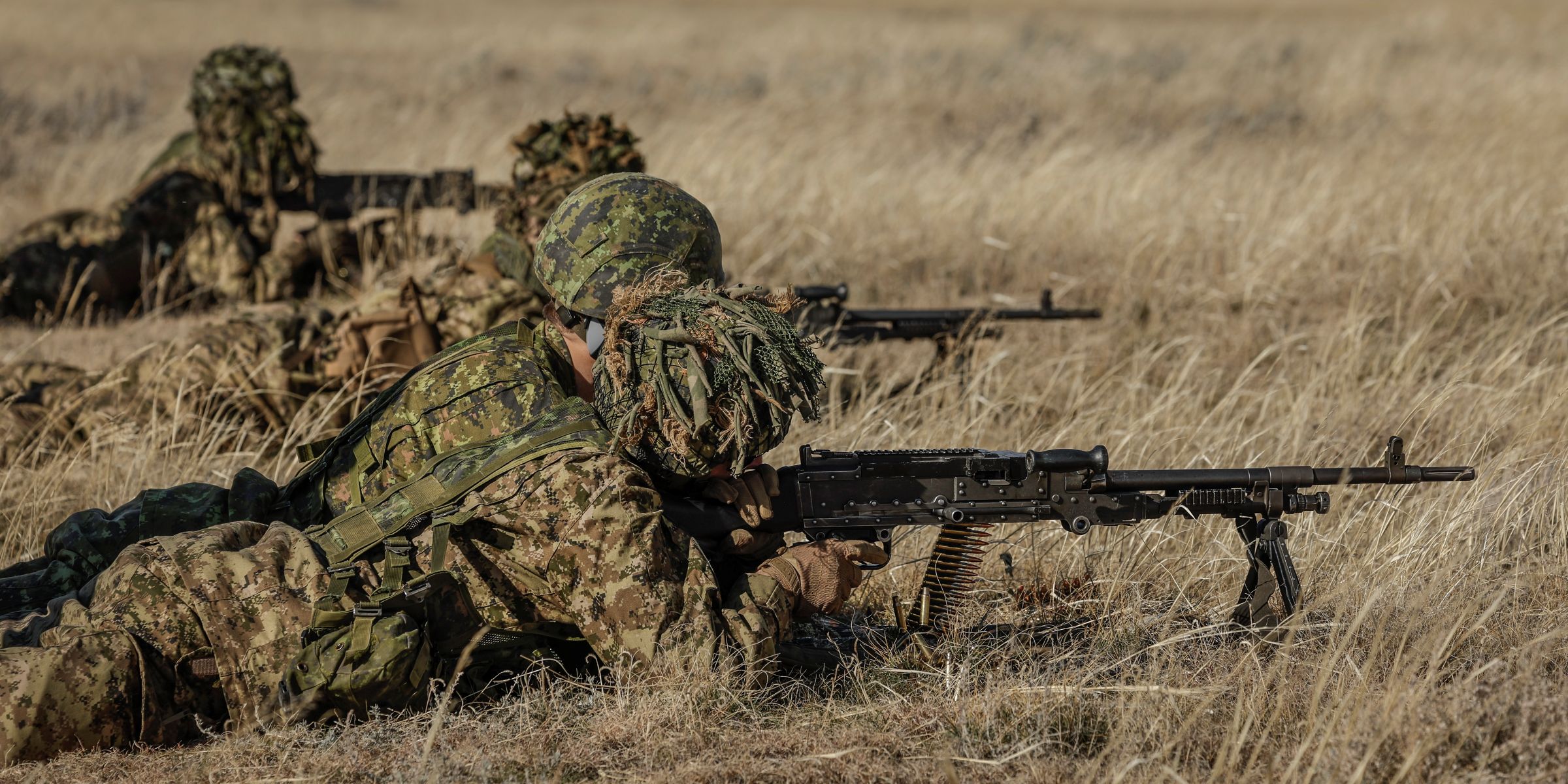
Recent CBC reporting that the Canadian Armed Forces (CAF) are examining large-scale mobilization scenarios has drawn understandable attention. The prospect of dramatically expanding Canada’s reserve force in a national emergency appears, at first glance, to reflect a more dangerous international environment. That focus, however, misses the more consequential point.
What the mobilization planning described by CBC actually tests is not political intent or public willingness, but force-generation capacity: whether Canada could convert civilian availability into trained, sustained military capability on a timeline that would still be strategically advantageous. What it exposes is a limitation that receives far less public attention than recruiting campaigns or equipment procurement – the system’s capacity for turning recruits into trained, deployable personnel.
The figures being modelled help explain why this matters. Canada’s primary reserve currently numbers roughly 29,000 members. The CBC report shows that internal planning scenarios explore expansion toward 100,000, alongside a much larger supplementary reserve, under extreme conditions. While not formal policy, these figures are serious planning assumptions designed to reveal where existing systems would saturate under sustained pressure. They are intended to expose constraints before those constraints become operationally decisive.
Civilian enabling systems are key
Mobilization is often framed as a personnel problem. In practice, it is a logistics and systems problem. Force generation depends on moving large cohorts through a sequence of enabling functions – medical screening, security clearance, enrolment administration, basic preparation, training capacity, accommodation, and sustainment – without degrading standards or overwhelming the institutions responsible for delivery. When any one of these functions saturates, the entire force-generation process slows, regardless of recruitment success. This is why mobilization planning cannot be treated as a challenge for the CAF to solve alone.
Universities and force generation
No modern military is designed to scale rapidly without relying on civilian enabling systems. In a surge scenario, many of the binding constraints are not tactical or operational, but enabling: administrative capacity, instructional throughput, housing, and regional co-ordination. If these functions are not reinforced in advance, force generation stalls long before questions of combat capability arise. Canada already possesses a significant component of this enabling capacity, but it resides outside the defence establishment.
Canada’s universities are provincially governed institutions, but, taken together, they form nationally distributed civilian infrastructure that already performs many of the functions large-scale force generation would require. Each year, they manage high-volume intake, deliver standardized instruction, operate residential and food-service systems, maintain secure administrative processes, and co-ordinate complex operations across regions.
The argument here is not that universities should assume military roles. They should not. This is not a proposal to militarize campuses, outsource soldiering, or place universities within the chain of command. Nor is this to suggest that the federal government should intrude on provincial jurisdiction. Rather, the point here is that force generation depends on enabling functions that already exist within provincially governed systems. Universities in particular are uniquely well-positioned because they already concentrate large numbers of people within structured, administratively coherent environments that can be scaled.
Canada must be ready for Iran’s democratic turning point
How Mark Carney is turning military spending into a force for economic renewal
Ottawa does have a legitimate role in contracting and aligning this civilian capacity when national defence objectives are at stake. This enabling approach is well-precedented. Ottawa routinely funds provincially delivered systems – including health care, training, and infrastructure – when national priorities require co-ordinated capacity. Force generation is no different.
Critically, this approach can strengthen national readiness while also improving the utilization of existing university infrastructure, particularly during off-peak periods when capacity is available.
A contract-based, seasonal surge arrangement with clear boundaries
Universities would not be required to suspend core academic functions or absorb unfunded workload. Instead, it could be structured as a time-limited, contract-based surge arrangement, delivered largely in seasonal windows such as the summer months, with any incremental staffing and support funded explicitly through federal–provincial agreements.
In that form, Ottawa would be purchasing additional throughput, while universities would secure a revenue-positive use for summer capacity, when fixed costs persist even as demand and revenue soften.
Clear boundaries would be essential. Military training authority must remain exclusively with the CAF. No weapons training would occur on campus. Participation by institutions and individuals would be voluntary, governed through transparent agreements, and subject to civilian oversight. The objective is not to blur civil–military boundaries, but to reinforce the enabling layer on which force generation depends.
Three supporting roles for universities
Here are three areas where universities could play a concrete, bounded role in support of CAF readiness:
Pre-enrolment readiness and administrative throughput
Before formal military training begins, potential reservists must meet fitness thresholds, complete first-aid or emergency response certification, and navigate medical and security clearance documentation. These are enabling functions, not combat training. Universities already deliver fitness programming, first-aid certification, and large-scale intake administration. Supporting these functions through advanced federal-provincial agreements would reduce early attrition and administrative backlog without altering CAF standards, selection authority, or training control.
Defence-adjacent instruction that accelerates force integration
Contemporary operations rely heavily on logistics, supply-chain management, communications, cyber hygiene, language capability, and emergency administration. These are core sustainment and support functions. Universities already teach them at scale through applied programs. Aligning specific modules with CAF requirements would shorten time-to-usefulness for reservists and free military training establishments to focus on warfighting tasks that only they can perform.
Surge and sustainment infrastructure
Rapid force expansion would immediately stress accommodation, classroom space, simulation facilities, and regional co-ordination nodes. Universities already operate distributed residential and instructional infrastructure that functions, in practice, as surge capacity. Time-limited access agreements would allow Canada to draw on this infrastructure during periods of expansion rather than attempting emergency construction or ad hoc leasing under pressure.
If universities are not deliberately integrated, this enabling capacity must be created elsewhere. That would require building new facilities, expanding bases, hiring instructors, and scaling administrative systems during a crisis – a slow, expensive, and operationally risky approach. Contracting capacity that already exists is faster, cheaper, and more reliable.
The mobilization planning reported by CBC should therefore be understood as a signal about force-generation fragility, not force numbers. Canada cannot improvise enabling capacity at scale. It must be organized in advance.
Force generation is not only about how many people are willing to serve. It is about whether the systems that prepare, train, house, and sustain them can keep pace. On that front, Canada already owns part of the solution. The remaining question is whether it chooses to use that capacity deliberately.