Canada is feeling the increasing instability of the world in a number of ways – not least because we currently have secessionist movements in both Quebec and Alberta, as well as ongoing threats from U.S. President Donald Trump.
We are all accustomed to Quebec separatism by now and there is little surprise about Parti Québécois Leader Paul St-Pierre Plamondon’s threat to hold another referendum if his party wins this year’s provincial election. There is also little indication yet that it would succeed.
Alberta may also be headed for a referendum, via a vocal independence movement whipped up by a small(ish) but determined group who have sought U.S. help for their efforts – an “act of treason,” as B.C. Premier David Eby says – and who are being facilitated (if not encouraged) by Premier Danielle Smith.
Polls show support in Alberta for secession sits at about 20 per cent, which might suggest that it’s not a serious danger. Certainly, one might say, Canada has bigger fish to fry, not the least being our fraught relationship with our increasingly unstable and unpredictable neighbour to the south.
Separatism amid growing foreign pressure
However, we now know that the Trump administration is watching (even encouraging) the Alberta separatists because it would love to divide Canada and get access to Alberta oil, as UBC professor Maxwell Cameron recently wrote. If a referendum is held, there could be destabilizing intervention by the U.S.
After Venezuela, it is too easy to imagine the American administration drumming up false allegations about vote-tampering or other irregularities as a means of continuing to chip away at Canadian sovereignty. If Canada won’t become the 51st state, maybe Alberta would, some in the Trump administration may be thinking.
Senior American government officials are already publicly supporting the idea of Alberta separation, despite that being a breach of the principle of non-intervention in the domestic affairs of other states, which is a fundamental precept of international law.
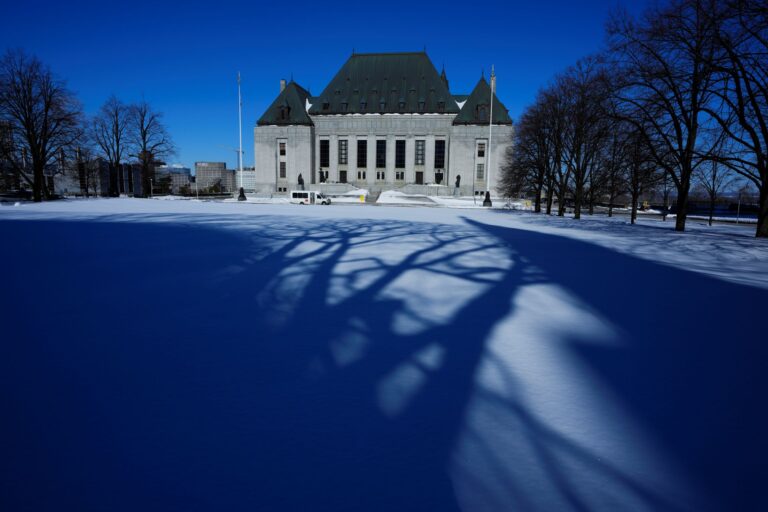
However, there is one major point that all the talk about a referendum has obscured: Alberta cannot lawfully unilaterally separate from Canada. We know this because the Supreme Court of Canada more than 25 years ago outlined the conditions for any such attempt; the Parliament of Canada has enacted these in law; and Alberta does not meet the criteria. In addition, it would be a violation of international law.
What Canadian constitutional law allows
The Supreme Court’s decision in the 1998 Reference re Secession of Quebec examines the situation where a “clear majority” of a province answers in the affirmative a “clear question” about separating. If that happens, the federal government would be required to negotiate with the provincial government in good faith about whether and how secession can happen.
Some would argue that decision clearly anticipates that there could be such a thing as the lawful secession of Alberta or any province from Canada.
To that argument, there are three responses.
First, as political scientist Emmett Macfarlane has recently written, as a matter of Canadian constitutional law, the Secession Reference is dated.
In particular, it did not take into account a constitutional principle that looms large in 2026: the honour of the Crown in its dealings with our Indigenous Peoples. The Crown, in both its federal and provincial guises, has a duty to support Indigenous interests. This would have to include claims to Aboriginal title and the pre-existing sovereignty of Indigenous communities in Alberta.
The result is that “Indigenous peoples must be a part of any negotiations, and…secession is simply impermissible where they do not consent,” at least with its existing borders intact, Macfarlane concludes.
Second, to implement the Secession Reference, the federal government passed the Clarity Act, which clearly states that the House of Commons is the decision-maker here.
Section 2 of the act says the House must consider negotiating only if “there has been a clear expression of a will by a clear majority of the population of that province that the province cease to be part of Canada” (i.e., not just a majority of those who vote in a referendum).
Actual separation would require an amendment to Canada’s Constitution, which means that all of the provinces and the federal government would get a say. The act also underscores that Indigenous “rights, interests and territorial claims” and “the protection of minority rights” must be factored in. This is a high threshold.
International law and Alberta independence
Third, in the Secession Reference, the Supreme Court conducted a separate analysis of whether separation of a Canadian province would be lawful under international law. The short answer is a flat “no.”
The analysis went like this: secession is a possible way to implement the “right to self-determination” – a well-established rule of international law that entitles a “people” to establish their own country (or to enter independently into another political arrangement, such as joining another existing country).
Secession is the nuclear option for a “people,” however, because the international legal order favours countries not being broken up and instead prefers maintaining territorial integrity.
Secession can legally be exercised only in certain circumstances under international law:
- where the “people” are governed by a colonial empire (think the various African, South American and Asian countries that became independent between 1950 and 1980);
- where the “people” are “subject to alien subjugation, domination or exploitation” (think the Palestinians or the Uyghurs);
- possibly (the court correctly noted that international law is uncertain on this point) where the “people” are “denied any meaningful exercise of its right to self-determination within the state of which it forms a part.”
Applying the test to Alberta produces an obvious answer.
First, Albertans (like Canadians in other provinces) certainly feel a sense of community, but they do not qualify as a “people” for this purpose. The definition is slightly unsettled but it requires objective markers such as a shared language, culture, religion and/or other trappings of ethnicity.
In light of modern developments concerning Indigenous Peoples, such as the United Nations Declaration on the Rights of Indigenous Peoples, there is actually a solid argument that Alberta’s Indigenous communities might qualify, but not Albertans generally.
In any event, at no time were Albertans “colonized” nor are they “subjugated, dominated or exploited.” On that latter point, transfer payments and (modest) oil royalties do not count as exploitation.
How the UCP is reframing Alberta’s separatist gambit
What public opinion tells us about the political outlook for 2026
In the Secession Reference the Supreme Court held that there is no credible argument that Quebecers are denied meaningful exercise of self-determination in Canada.
There is similarly no credible argument for Albertans. Not when each Albertan can vote in municipal, provincial and federal elections, when the province has produced prime ministers, cabinet ministers and Supreme Court justices, when Albertans thrive economically and when the rights of Albertans are protected by the law, the government and the courts.
Why a referendum would change little
It’s important that we say this out loud and counter some of the fever dreams of the Alberta separatists: a successful independence referendum would trigger certain Canadian legal processes, but by itself it has no other legal effect. In basic international law terms, a “yes” vote means almost nothing. It certainly does not mean Alberta is suddenly independent.
To be sure, things might happen. The Trump administration – unconstrained by international law or basic rationality – might immediately recognize an independent Alberta as a means of trying to absorb it as, for example, Russia did with Crimea. It might strong-arm a few other vassal countries to do the same.
Russia and China, which have already been interfering in Canadian politics, might follow suit to continue their campaign of destabilizing the democratic West.
So, at a time when the rule of law itself is in peril, we must assert it. While Canadian sovereignty is under attack by malign forces, we must clearly and loudly fight for it, as former prime ministers Jean Chrétien and Stephen Harper argued recently. At a time when we need national unity more than ever, it is time to speak boldly to fifth columnists who seek to break up our country.
This is no time for timidity. So, let’s say it: Alberta cannot separate from Canada on the basis of a referendum result. Maybe all of that separatist energy could be put to better use.