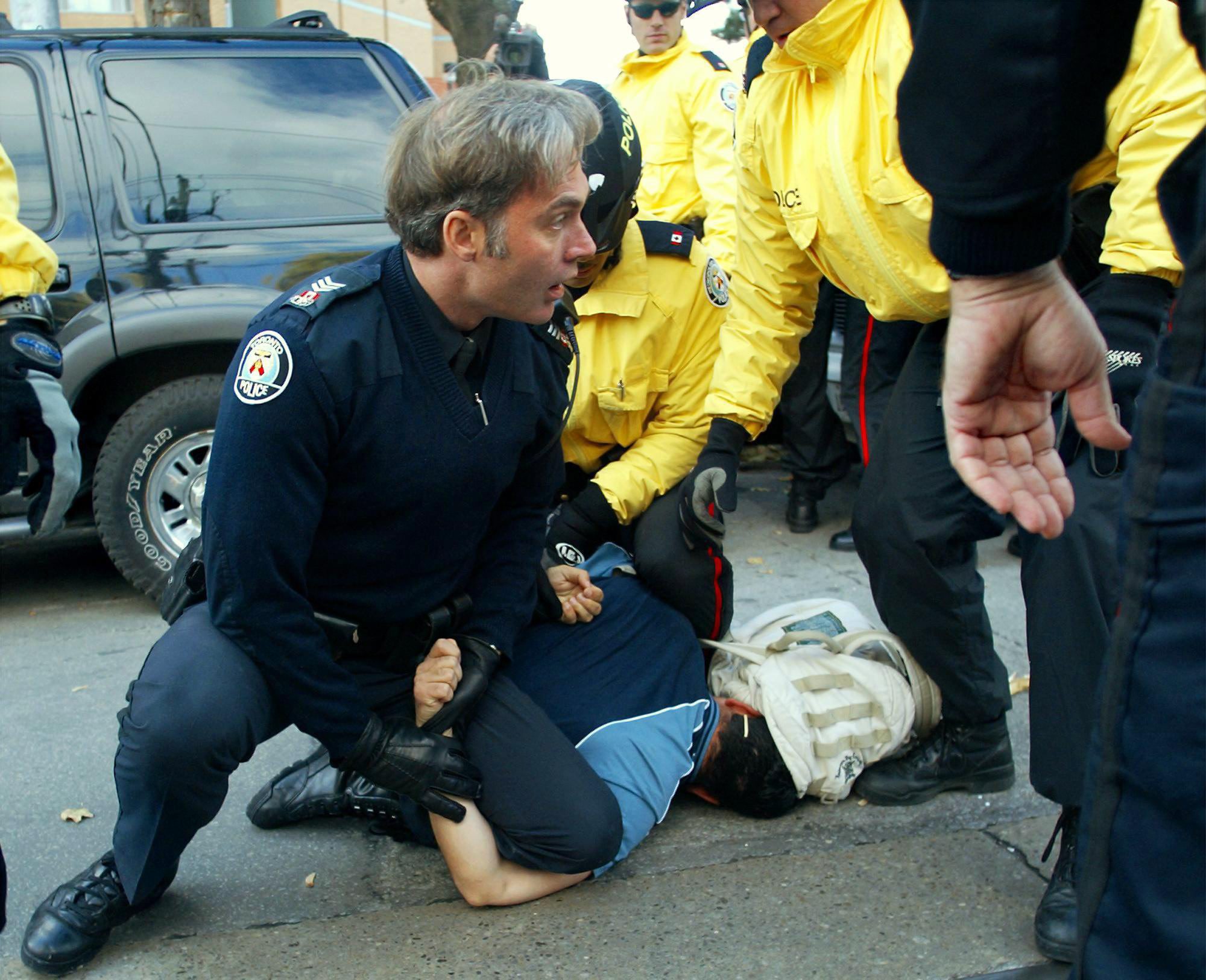
There is a serious imbalance between “protest, freedom and order” or between “dissent and democracy” in Canada today. Historically, the Canadian state has always managed to skew the balance between protest and freedom to maintain its own authority and to serve the interests of big business. But the new omnibus anti-terrorism legislation has dramatically tipped the scales.
I’m sure that most of us agree that the “right to dissent” is an essential ingredient of democracy. Yet, today in Canada, this fundamental right is being criminalized. In the light of the new legislation, dissent is in danger of being treated not only as a criminal act, but also as an act of terrorism. While this trend has been established for some time now, it has rapidly escalated since the events of September 11.
Speaking has a member of a social movement that has been building against corporate globalization, or the current stage of global capitalism, I will base my contention on five propositions, as follows:
-
The process of criminalizing dissent was already well underway before the tragic events of September 11 in New York City and Washington. During the Seattle protests at the meetings of the World Trade Organization in December 1999, the Pentagon’s top-secret Delta Force had set up its own command post in a downtown hotel. Five months later, at the IMF/World Bank meetings in Washington, undercover police were deployed everywhere throughout the demonstrations, while phone taps were reportedly set up to monitor the communication networks of 73 civil society organizations. In September 2000, following the IMF/World Bank meetings in Prague, the European Union put in place a new framework for anti-terrorist legislation that included a broad sweeping definition of “terrorism” designed to catch anti-corporate globalization protestors. Then, during the G8 demonstrations in Genoa in July 2001, the 250,000 protestors who hit the streets were infiltrated by undercover police officers who, it became known later, were engaged in provoking violence.
-
The post-September 11 anti-terrorist legislation in Canada””bills C-35, C-36 and C-42””go a long way toward entrenching the criminalization of dissent. Although there is not enough space here to detail the multiple dangers and threats posed by this new omnibus legislation, here are a few points. C-35 expands the definition of “internationally protected persons” to include government and business personnel participating in international conferences, cross-referenced with the definition of “terrorist activities” found in C-36. What is implied here, of course, is that any interference with these internationally protected persons can be seen as terrorist activity. C-36 contains a broad definition of “terrorist activity” covering protest and dissent. New terrorist offences involve “participating, facilitating, instructing, harbouring” such activity. This law, in tandem with changes in the Privacy Act and the Access to Information Act, also gives police new investigative powers for search and seizure. Add to this C-42, which, even in its amended form, allows the government to declare and create a “military security zone” or an armed encampment on Canadian soil.
-
The USA PATRIOT Act gives sweeping new powers to police and military forces in the United States which, in turn, will have an impact on freedom, justice and order here in Canada. Under the new “sneak and peek” provisions, U.S. federal authorities in the U.S. are now able to search a home or workplace and seize the property of a suspect without ever informing the person. The FBI’s own definition of domestic terrorism includes the criticism of capitalism and promotion of socialism by left-wing groups. These measures are reinforced by President George W. Bush’s own executive order granting the authority to submit non-citizens to military tribunals. Furthermore, the Bush Administration’s call for a continental security zone surrounding North America will, undoubtedly, have untold effects on the movement of immigrants and refugees, as well as on the civil liberties of Canadians.
-
The new definition of terrorism as “ideologically motivated” empowers law enforcement officers to target the ideology that lies behind people’s actions. In normal cases of criminal offense, the prosecution is expected to prove an act to harm or an intent to harm; the ideology of the person behind the act or intent is not a factor in adjudicating the case. According to Dr. Michael Clinchy of the University of Western Ontario, however, the new anti-terrorist legislation actually instructs police to contemplate a citizen’s active participation in the political life of his or her country as evidence of criminal offense. In other words, a person’s political ideology can be cited as evidence of his or her engaging in criminal activity. As a result, an increasing number of activists who are opposed to this model of corporate globalization or global capitalism are being investigated, arrested and detained primarily on grounds of their ideological disposition.
-
A prime target of the new wave of anti-terrorist legislation is, therefore, the movement against corporate globalization itself. Since Seattle, this protest movement has been effective in challenging the legitimacy of the main institutions of corporate globalization, namely the WTO, the IMF and the World Bank. Simply put, people who are actively engaged in this protest movement do not pass the ideological litmus test of our times, which is mainly meant to uphold and protect the ideals and values of the “new world order.” Let us be clear: new measures may well be needed to detect and stop real acts of terrorism. But the new laws have been crafted to cast the dragnet so wide as to catch the dissenters of the new world order and to criminalize the act of dissent. In effect, we now face the prospect that the current rallying cry of anti-terrorism is being used as a smokescreen for a much larger political agenda.
In short, these five propositions describe the growing threat to democracy that looms in the wake of the events of September 11. Following the April 2001 Summit of the Americas in Quebec City, we invited activists to share their stories and experiences on our website at the Polaris Institute. Dozens of first-hand accounts of police brutality and assaults on civil liberties were recorded. At the same time, hundreds of activists reeling from their shocking experiences at the “tear-gas summit” in Quebec City testified in community forums throughout the country. Yet this was before September 11 and its aftermath of anti-terrorist legislation. At this point, one can only imagine what police and security forces might do in Kananaskis and Calgary at the G8 Summit, June 26-27, 2002. Armed with unprecedented powers, the crackdown could swift and brutal.
As Ursula Franklin””longtime feminist, environmentalist, peace activist and professor emeritus at the University of Toronto””reminded us a few years ago: the end of the Cold War did not mean the end of militarism. On the contrary, militarism has become much more integrated into the workings of the global economy through international finance, trade and investment regimes. What we have now, in this era of globalization, she said, is an “economic war” in which “the enemy is the people.” The new armies of occupation are the transnational corporations. Under these new conditions of economic warfare, says Franklin, peoples’ fundamental democratic rights are threatened.
Indeed, the threat to democracy runs deep. At the core of the crisis of democracy is the emergence of what some of us call the “corporate security state.” In an increasingly globalized economy, the primary role of the state is to provide a secure climate for profitable transnational investment and competition. The “rights” of transnational corporations supersede the rights of citizens. Under the corporate security state, priority is given to providing security for investors, not citizens. If anything, it is the economic, social and environmental security of people that is being jeopardized by this new world order.
Finding the right balance will require nothing less than fundamental changes to the role of the state and the nature of capitalism itself.