Canadian cities are vital to Canada’s future prosperity. What happens in our cities fundamentally affects GDP, the way we understand ourselves, and how we interact with the natural environment. This is not a surprise given that almost 80 percent of Canadians live in cities, with about 64 percent living in the 27 largest metropolitan areas in Canada. So you would think the federal Liberals would have given serious thought to, and developed a detailed plan about, reflecting cities’ centrality to emerging social, environmental and economic public policy.
Sadly, this has not happened. Rather, municipalities are facing a $60 billion infrastructure deficit (which is growing annually by $2 billion). This funding crisis threatens the ability of our cities— large and small— to effectively act as the economic and cultural engines of Canada. And it undermines the ability of cities to act as places in which we can deploy innovative solutions to the many environmental challenges facing us. Explanations for this lack of engagement by Ottawa are numerous: Canada has a complex constitution devised in the 19th century that does not reflect the current urban reality in Canada and that makes it difficult for the federal government to act; the federal deficit had to be tackled to make sure our economy was on a sound footing and that meant no new investments; the new era of globalization has thrown a number of new challenges at Canadian cities and we still haven’t figured out how best to deal with them. While there are some grains of truth in these explanations, I want to suggest the real reason our cities are in such a desperate state has to do with one major cause: Paul Martin. As finance minister— and now prime minister— Martin consistently made policy decisions that have undermined cities. In fact, he has ignored the advice of a wide range of Canadians from all political perspectives who agree Canada must join with the bulk of the industrialized world and have a national government prepared to act to help our cities.
Fortunately, Martin’s well-worn path of inaction is not the only option. Led by their municipal leaders, Canadians from all walks of life have made it clear the time for investing in our cities is now. And the NDP is the only national party that has laid out a roadmap for reinvesting in our cities: our real deal for cities, big and small.
We all know this but it is worth repeating: cities are where most of Canada’s GDP is created. Just the seven largest metropolitan areas generate 45 percent of the country’s GDP. Regionally, the City of Winnipeg’s gross domestic product accounts for two-thirds of Manitoba’s economy; Calgary’s and Edmonton’s GDP is 64 percent of Alberta’s; Vancouver’s GDP is 53 percent of British Columbia’s; Montreal’s is just under half of Quebec’s; and Toronto is responsible for 44 percent of Ontario’s GDP. The ability of our cities large and small to continue creating economic wealth is significantly affected by the state of our cities’ physical and social infrastructures. When a city’s transportation system runs smoothly, when residents have access to affordable child care, and when the quality of life is good, chances are high the city and its residents are economically prosperous.
But cities do much more than create economic value. They are cultural engines as well. Cities are the spaces where we learn to understand ourselves and our place in the world, through the arts and, delightfully, now Canadian television shows such as DaVinci’s Inquest, modelled on the real life of Vancouver’s new mayor, Larry Campbell.
Equally, if we want to understand the environmental problems we face as a nation and how to solve them, cities are again the key. Because most of us live and work in cities, most of the nation’s energy consumption happens in cities. The energy efficiency of our buildings and the equipment inside them directly affect the rate of greenhouse gas production. Most of the air pollution is caused by activities that take place in cities; activities related to transportation use and energy consumption. Most of the destruction of agricultural and ecologically sensitive land happens because of pressure for urban expansion. The quality of our drinking water— even in distant farming communities— is affected by cities. For example, had the City of Toronto succeeded in shipping its garbage to an abandoned mine in Kirkland Lake, Ontario (a plan that was fortunately stopped), Toronto garbage would have contaminated the water table that thousands of farmers rely on. So if we want to figure out how to reduce smog, meet our Kyoto commitments, stop urban sprawl and end the contamination of our land, the place to start is with cities.
Policy-makers have long understood that what we do in cities and how we do it has a fundamental impact on Canada as a whole. So one would expect the federal government would equip cities— large and smal— with the tools required to ensure they remain healthy economic and cultural engines and become places where solutions to environmental problems are found. Unfortunately, the exact opposite has happened.
In spite of the huge budget surpluses experienced by the federal government in the past few years (since fiscal year 1997 there has been a cumulative budget surplus of $52.3 billion, most of it going toward debt repayment), cities are exhibiting disturbing and potentially fatal symptoms of decline. In November 2003, the Federation of Canadian Municipalities reported that “[the] gap between those with the most income and those with the least continue to grow in Canada’s cities.” Not surprisingly, poverty rates are worse today in Canada’s urban centres than they were in the first half of the 1990s. But not just the people are worse off. Municipal governments, which have become increasingly responsible for maintaining vital public infrastructure (thanks to federal and provincial downloading), are also hurting financially. For too many years now, they have been unable to keep up with the repairs required to maintain the physical infrastructure of a healthy city. In 2003, the municipal infrastructure gap continued growing, now reaching $60 billion. The list of infrastructure needs is by now well known.
-
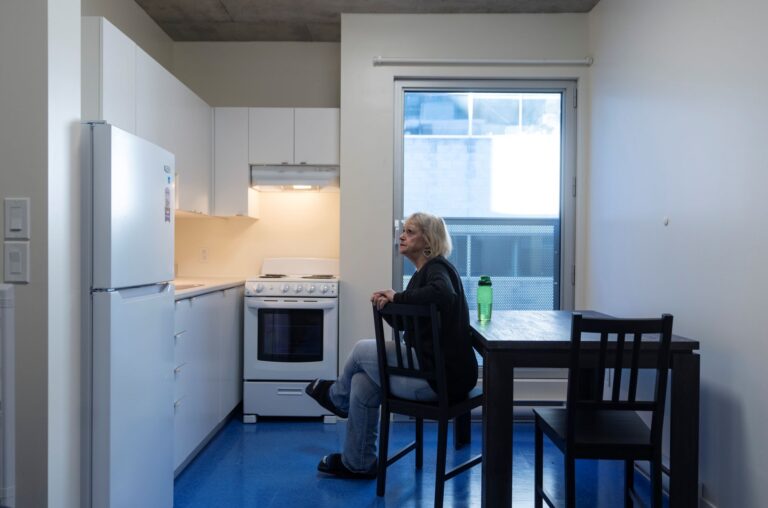
As I’ve written elsewhere in great detail, cities face a crisis in homelessness and a crisis in affordable housing stock. We need to repair existing affordable housing stock and build new affordable units.
-
Water and sewage systems need repair and upgrading
-
Transportations systems— in particular public transit systems— require repairs and upgrades.
-
Recreational programs, library services and cultural activities are being cut to try to keep property tax hikes from skyrocketing.
To be sure, the root causes of these multiple problems are, on one level, complex. The world has changed significantly in the past 30 years. We are now firmly in an era of globalization where the agglomeration of economic command-and-control functions have created a small number of large global cities that drive an increasingly information-based, service-oriented global economy. Thanks to incredible advances in information technology, capital now flows at the speed of light, making local economies and the global economy susceptible to instantaneous change. And as globalization increasingly concentrates the new wealth in global cities— the centres of the new economy— resource-based economies and smaller urban centres suffer.
The end of the Keynesian era and the new emphasis on “governance” have transformed how governments of all orders intervene in the economy. Add to this world migration patterns where poor people come to so-called developed countries looking for work. And, of course, the aftermath of the devastating attack on September 11, 2001, and the new security focus of the United States.
All of these factors have, to a degree, affected the ability of the federal government to act in defence of our cities. Yet, these forces have also acted on other cities across the planet, and from Barcelona to Baltimore, countries are helping their cities flourish as Canada lags embarrassingly behind.
So why is it that Canadian cities are in such bad shape? Is it because of our antiquated Constitution? As any student of urban politics in Canada knows, municipalities have been considered “creatures” of the provinces. The role, function, and structure of municipal governments in Canada derive from the Baldwin Act of 1849. Then, less than 15 percent of Canadians lived in urban areas, and local governments were concerned with running cattle in public places, noise-making disturbances, public drunkenness, profanity, and itinerant salesmen. The Constitution gives the provinces control over municipal institutions in their province. In fact, constitutional recognition of municipalities as a form of government doesn’t exist. Cities are the poor cousin of the Canadian political family, the neglected relatives. As my predecessor as president of the FCM, Joanne Monahan, used to say: “Somewhere between asylums and saloons, that’s where you find municipal government in the Canadian Constitution.”
There is no doubt a more up-todate Constitution, one that recognizes the central role played by municipal governments in managing cities, would improve the ability of all orders of government to solve the problems facing cities. But constitutional change is not a necessary precondition, and given the litany of urgent challenges, is not a priority for citizens or political parties. Rather, the federal government needs to stop starving our municipal governments of cash. Consider the following. In Winnipeg in 2001, over 50 percent of the taxes paid by residents went to the federal government, 43 percent went to the provincial government, and less than 7 percent went to the city government. In the Greater Toronto Area, residents’ taxes resulted in a net contribution (that is, their tax revenue minus payments back to the city) of $17 billion to Ottawa and $3 billion to the province.
Typically, across Canada, about one-half of all municipalities’ revenue comes from property tax. (In the US, it averages about one-fifth.) So, let’s look again at Winnipeg, whose revenues and expenses are fairly typical. In 2001, 54 percent of Winnipeg’s municipal revenue came from property tax. User fees, licenses, fines, utility bills, and other miscellaneous local revenue amounted to 30 percent of the city’s income. Grants from the federal and provincial governments provided only 16 percent of Winnipeg’s revenue. And Winnipeg’s lucky! Manitoba’s NDP government has been transferring fixed percentage points of income taxes collected to municipalities on a per capita basis, essentially sharing a little income tax revenue directly with the city.
Yet, over the last decade in particular, as they sought to balance their budgets and reduce their deficits, federal and provincial governments have been steadily downloading costs and services to municipalities— the level of government whose hands are most tied when it comes to collecting revenue from the economic activity that they spawn. Because cities are “creatures” of the provinces, the provinces have traditionally limited the ways that municipalities can fund themselves. By law, with very rare exceptions, cities don’t have the authority to collect income taxes, fuel taxes, sales taxes, or most other kinds of tax except property tax. So, when the federal government wants to wrestle the deficit to the ground, it does so by passing on costs to provinces, which pass some of them on to municipalities, the level of government with the least capacity (by far) to pass them on to anyone else— or to raise money to backfill the fiscal excavations. The results? A deterioration in the ability of cities to maintain vital infrastructure services and higher property taxes that bear no resemblance whatsoever to a citizen’s ability to pay.
And this is where Paul Martin enters the equation, since he had control of Ottawa’s purse strings for almost a decade. There is no point rearguing the manner in which Mr. Martin solved the deficit, but it’s incontrovertible that by 1997, he began running a yearly surplus that— after deliberately misstating the fiscal health of Canada to the tune of $80 billion— resulted in almost $50 billion being applied to our national debt. Add to this a multi-year tax-cut expenditure of $100 billion, and we begin to get an idea of the amount of money available that could have been used to help cities. Effectively, Martin reduced progressive forms of taxation such as income tax, downloaded responsibility for many key services onto the provinces, which in turn hurt municipalities, and as a result, Canada now funds many central programs on a regressive property tax system instead.
It was a conscious choice to spend on tax cuts instead of transit, affordable housing and environmental infrastructure. And instead of investing in necessary infrastructure repairs, he continued paying down the debt, even though Canada was on track to having one of the lowest debt-to-GDP ratios of the OECD countries. Last year, for example, $7 billion was allocated to debt repayment without any public debate, and I rather doubt this was the first priority of citizens.
Nobody forced Martin to choose to spend money on tax cuts, abolish the housing program, refuse to ramp up infrastructure funding to help deliver clean water, and to maintain Canada’s ignominious status as the only G-8 country not to fund public transit. Indeed, Canadians’ consistent priority during that period was investment, a priority reflected on paper at least in the Liberal Party’s election platforms, most notably the 1993 Red Book, a product of Martin’s last ideas exercise.
As I write this, Paul Martin has been prime minister for just over one month.
Before assuming office, much of 2003 was spent talking about his much-hyped new deal for cities. But the deal becomes less and less ambitious the longer he’s in office. In his first month on the job, Prime Minister Martin’s priorities were more corporate tax cuts, Star Wars missile defence talks, and a freeze on public spending. Indeed, he has flatly refused to follow Ontario Premier Dalton McGuinty’s lead and cancel corporate tax cuts he can’t afford. He proceeded with further corporate tax reductions. At exactly the same time, he has entered talks on joining a dangerous Star Wars missile defence program that could cost Canada $10 billion if we were told to contribute only 1 percent of the cost. (Based on a complete cost of $1 trillion, according to the Center for Arms Control and Non-Proliferation.)
These are significant choices with large impacts upon government finances and our ability to help cities. It speaks volumes that these choices could be made in a month, but the most basic first step toward helping cities— sharing the gas tax— has gone from an inviolable commitment to something that may not occur at all, if we’re to accept the flow of ministerial musings.
Instead, we’re told municipalities may get a bigger GST refund. This is good, but not great. It’s actually just a promise not to collect as much money from cities as the federal government has done since the GST was imposed.
While returning the GST to cities would be a start, it would not even begin to stem the infrastructure crisis, let alone get rid of the infrastructure deficit. For example, the City of Toronto alone has paid $500 million in GST since Martin became finance minister. A full refund would provide about $49 million a year to Toronto, which will leave the city’s transit authority under funded and do little to alleviate the housing crisis. Each Canadian city can tell its own tale of GST woe as its property taxes marched dutifully into Paul Martin’s pockets. Celebrating a GST refund is akin to thanking a robber for no longer taking your cash, after years of stealing from you, and staying quiet about giving back any of what he took in the first place.
If a GST rebate is all Martin gives to cities, our country is in deep trouble. A full GST rebate will put about $525 million back into municipal budgets. This will mean that the infrastructure deficit continues climbing by $1.5 billion a year instead of $2 billion. If this is the central plank in Martin’s urban agenda, it more resembles a central twig.
After spending years in municipal government, at the Federation of Canadian Municipalities and now as leader of the New Democratic Party I know we can do better. I call it a Real Deal for Canadian Cities.
First, municipalities should stop paying any GST for all the reasons mentioned above. Second, the federal government should share half the federal gas tax as a dedicated transfer for sustainable transport such as public transit, cycling and pedestrian infrastructure, and rural roads. Sustainable transport is key to our economic health, and central to fighting smog and climate change.
Let’s dismiss the nonsense we’ve been hearing from the federal government that sharing the gas tax is somehow “complicated.” It’s not. Nothing prevents gas tax revenue from being transferred immediately. Funds could be forwarded for the first year with a simple letter of transmittal:
To the Premiers: As promised, this portion of the gas tax is being returned to your provinces and territories for distribution to municipal governments for sustainable transportation improvements. Please forward the funds to the cities and towns, asap. Next year’s installment will be forwarded after we have worked out a plan together that accomplishes national objectives concerning climate change and transportation while assuring maximum local flexibility.
Yours sincerely,
Government of Canada.
Immediately after this announcement, the federal government could then put together a high level negotiating team to finalize a permanent arrangement with the provinces over the subsequent year. If Martin believes in cities, he must have faith in our mayors’ ability to ensure provincial governments extend the funding. I firmly believe that the way to a healthy federalism is to start with a little good faith and flow the gas tax now.
It’s not naïve to believe Edmonton Mayor Bill Smith or Montreal’s Gérald Tremblay would make their premiers pay a heavy political price if the received federal gas tax money was not passed on to municipalities. But it is naïve to require provinces to match federal funds, since most provinces (unlike the federal government) are facing deficits. In fact, it would be unfair and bad public policy for the federal government to insist on this in these times. Demanding that cash-strapped provinces share the bill for cities is a delaying tactic that lets Martin take credit for trying while being able to blame the provinces for failing. It’s also hypocritical, given that Mr. Martin refused long-term investment plans when he was fighting deficits federally in the mid-1990s.
Third, a national affordable housing plan is needed in Canada. We know this is a good idea and works in Canada, because we’ve done it before. Some 2.2 million people live in houses built by the housing program that NDP leader David Lewis began with Pierre Trudeau in the 1970s during a rare period of federal minority government. Mr. Martin abolished it in the 1990s and has repeatedly refused to announce a significant new program, despite housing crises in our biggest cities and smallest First Nations communities.
Affordable housing is key to fighting child poverty, increasing disposable income, creating jobs and creating markets for our beleaguered softwood lumber industry. I propose that Canada launch a national project to reduce homelessness by building 200,000 new affordable homes and 100,000 renovated houses at affordable rents over the next 10 years. This would cut in half the affordable housing deficit.
I have heard from countless Canadians that they want an end to homelessness and that we have a responsibility to provide decent, affordable housing to all our neighbours. It’s time to allow Canadians to mobilize behind the construction of housing. The details of the plan have already been developed by the Federation of Canadian Municipalities. I know this because I was there, in charge of that project.
Fourth, municipalities need a permanent infrastructure program (instead of starving municipalities and forcing them to privatize public services such as water, noting that Mr. Martin is a proponent of deeply flawed P3s, which actually cost taxpayers more and are profoundly unaccountable). This program would help Canadians repair and upgrade their water and sewage systems, invest in green energy solutions as well as improve their building infrastructure through energy conservation measures. And, the program would create jobs, lots of jobs.
This plan costs money. But corporate tax cuts and weaponizing space cost money as well. I believe cities that work are more important to our economy than helping the banks make even more money; and that we should be building affordable homes to cover our heads before building missile shields to cover our skies. So far, Martin has made it clear he doesn’t agree. But after a decade of his choices, Canadians are ready to start disagreeing back. We’re fed up with the smog, the traffic and the housing crisis. We want a government prepared to make wiser choices that improve our cities, our economy, the natural environment and quality of life.
Though federal money is urgently required, imagination is required, too, and it is important to note that despite restrictive municipal budgets, cities are often home to some of Canada’s most innovative public policy. I would like to end on this note, since I am proud of my role implementing solutions in municipal government, and bemoan the absence of imagination we’ve seen at the federal level of late, despite enjoying massive surpluses.
One of my proudest accomplishments is the Better Buildings Partnership (BBP) in Toronto, which created jobs through retrofitting buildings for energy efficiency, paid for through energy savings. To date, the BBP has retrofitted three million square meters of buildings, created 3,800 person years of work, cut 132,000 tons of greenhouse gas emissions and reduced energy costs by some $19 million— all without any cost to taxpayers.
By creating a revolving loan fund, we could pay for the retrofits through the fund without charging the building owner for the work. The building owner then kept paying energy bills as if the work had not been completed, the difference returning to the revolving loan fund until such time as the renovation costs and a small return were paid. Thereafter, the building owner would enjoy permanently reduced energy costs.
There is no reason such a program could not be implemented across Canada, helping create safe rates of returns for pension funds, creating jobs and reducing our unsustainable use of fossil and nuclear fuel. Yet, such ideas are found predominantly at the local level, which is why Canada must recognize the centrality of cities to innovative public policy— and export this innovation to the federal level in order to again show Canadians that wise government choices can improve our quality of life, economy and environment.