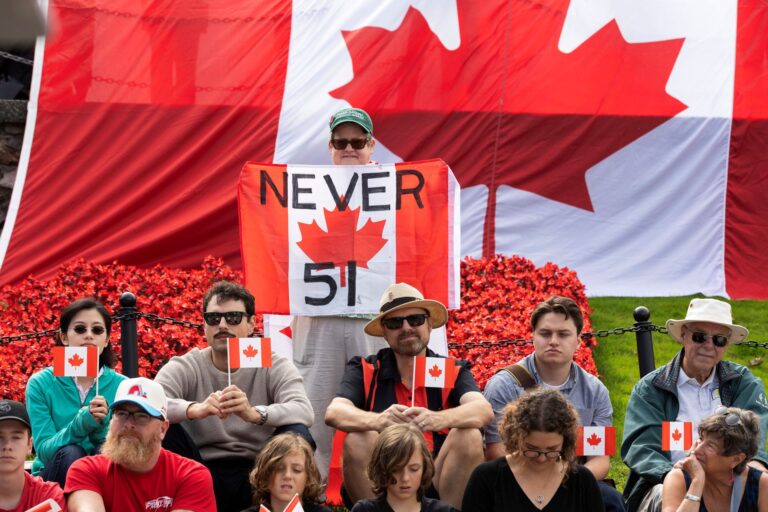
It has not been a good year for Canadian foreign policy, a year highlighted by further deterioration in relations with the United States and punctuated by a series of humiliating cases of Canadians imprisoned, tortured, and even murdered abroad. The government is facing a rising chorus of criticism for looking feeble, vacillating, and bereft of purpose. Bad foreign policy years sometimes occur for factors beyond a government’s control. Not this time. This bad year was the product of ten years of Potemkin-village foreign policy, featuring brightly painted false fronts masking a grim reality of naiveté and confusion.
Over the past decade, Canadian foreign policy has been stuck in a nostalgic time warp harking back to Canada’s status as a middle power within the small club of Western, democratic, market-economy states. Canadian foreign policy during that period moved with confidence in the conception of its national interests and the deployment of political, financial, and human resources to pursue them, well exemplified by the vast expansion of Canada’s diplomatic presence during and after the Second World War. No longer. The emergence of a unipolar world dominated by the United States, an integrated North American economy, and the decline of multilateral rules and institutions as prime instruments of global governance, have left Canadian foreign policy searching for new purpose and direction. It sometimes seems the single most important determinant of contemporary Canadian policy is a corrosive and self-defeating anti-Americanism, reflecting, in John Holmes memorable phrase “a lingering colonial mentality.” Canada’s friends and allies have become weary of the whining and fretting of Canadian diplomats looking for a place in world councils warranted by neither interests nor power nor contribution.
The time has come to bring Canadian foreign policy into the 21st century by grounding it in a conception of a national interest that accepts the primacy of the United States in securing both our national security and our prosperity. There is an need to recognize that the bilateral Canada-US relationship has outgrown the tools and institutions to manage it and to define the parameters of a new accommodation. This will not be an easy task. The attention of Canadians to foreign policy is modest and intermittent and the susceptibility to anti-American notions remains strong. The risk of capture by narrow visions and confused ideologies will be strong, as will the temptation to substitute sentiment for interest. The most effective antidote will be to establish a hierarchy of interests focusing on the bilateral relationship as the touchstone of successful foreign policy.
This essay analyses the Potemkin village of contemporary Canadian foreign policy and sets out a framework for restoring maturity and perspective to the definition and pursuit of Canadian interests.
In 18th century Russia, Prince Potemkin, favourite of Catherine the Great, used to line the royal route with painted canvasses thrown over wooden frames to give the impression of prosperous villages in a land of milk and honey and mask the reality of shabby poverty and misery. Canada’s modern-day foreign policy Potemkin village has three principal features that seek to shroud embarrassing reality. First, it thrusts forward domestic values as the foundation of foreign policy; second, it assigns merit to establishing difference and distinction from the United States; and, third, it invents principles of convenience to substitute for the definition of interests. All three fail to survive close scrutiny as the basis for a serious foreign policy.
Ministerial declarations on the centrality of values in Canadian foreign policy have become as common as the autumn leaves. In launching his “Dialogue on Foreign Policy,” current Foreign Minister Bill Graham asserted that Canadian foreign policy has a wealth of assets, notably, the Canadian image in the world as a “democratic, bilingual, multicultural, free and open society that respects and celebrates its diversity.” His most recent predecessors, John Manley and Lloyd Axworthy, proved equally forthright in proclaiming values to lie at the heart of Canadian foreign policy. Both the outgoing prime minister and his successor have felt the call to trumpet Canadian values. Even Trade Minister Pierre Pettigrew contends that when Canada exports, “we are exporting our values.” As political scientist Denis Stairs observes in this spring’s International Journal, Canadians have been actively encouraged by their leaders to believe that Canada is unique among the nations of the world in its moral superiority and distinctiveness. While eager to jump into moral crusades, Canadian attitudes to value-based crusades conceived and directed by the United States have often been marked by reluctance, even hostility. Contrast, for example, Canada’s indignant rejection of US extraterritorial measures on Canadian trade and investment with Cuba with Canada’s pressure on the United States and Britain for sanctions on South Africa in the 1970s and 1980s. As Stairs observes, “if there is anything worse than the value-based imperialism of the strong, it is the value imperialism of the weak.”
The problem arises from the inappropriate use of values to define interests. The values espoused by recent Canadian foreign ministers are virtually universal; foreign policy interests, on the other hand, derive from the combination of geography, demography, and history peculiar to each country. The United States, for example, is no less an open, tolerant, democratic, multicultural society than Canada, yet its foreign-policy interests are those of a great power with both the resources and the responsibilities to pursue global interests. None of Canada’s principal European partners— for example, France or Germany— can make the claim of multiculturalism and bilingualism, yet their interests in global security and prosperity are not significantly different from those of Canada. Before the wave of market-based democracy swept over most of Latin America, few if any would have been eligible to join Canada’s value club, yet their interests in managing relationships with the United States as the regional hegemon, were not observably different from those of Canada.
Historically, the defining moments of Canadian foreign policy have had little to do with values as proclaimed by recent foreign ministers. They have derived their legitimacy and importance from quite different factors. For example, Canada’s participation in the First World War was entirely a product of its devoted membership in the British Empire. The government’s pursuit of a distinct voice in military strategy, a seat at the peace conference, and a place in the post-war arrangements, flowed not from values but from an understanding that Canada’s interests could not be served by subsuming them within broader imperial policy. During and after the Second World War, Canada’s active engagement in global governance derived from a realization that failure to do so would risk incurring serious damage to Canadian security and prosperity. No longer was it true, in the words a decade earlier of O.D. Skelton, the architect of modern Canadian foreign policy, that “Canadians were immensely more interested in Alberta than Abyssinia.” Canadian membership in the North Atlantic Treaty Organization, the General Agreement on Tariffs and Trade, the International Monetary Fund, and the World Bank originated in perceptions of how Canada’s security and economic objectives could be best served. There is no evidence that Canadian engagement was based on statements of Canadian values.
Values play an important role in sustaining national self-esteem. No Canadian government can profess indifference to international events or situations that arouse Canadians’ sense of justice and compassion. However, the readiness of Canadians to pay the cost of making Canadian values operational is weak. They would prefer more healthcare. As Deputy Prime Minister John Manley aptly commented during his brief sojourn as foreign minister, Canadians have the habit of taking strong stances on any number of international issues, but when it comes time to take action, Canadians take a washroom break.
Foreign Minister Bill Graham doubtless speaks for many Canadians in asserting, “a better world might look like a better Canada.” It is the elevation of this sentiment into a guide for policy, however, that seems to have inspired the architect’s sketch for the Potemkin village of contemporary foreign policy.
In his memoirs reflecting on a long diplomatic career, The Rise and Fall of a Middle Power, the late Arthur Andrew recalled that a principal objective of Canadian foreign policy had always been to establish a difference between Canadian and US positions on major issues. Writing during the Mulroney years, he sadly noted that ensuring that such a difference existed was no longer an objective of Canadian foreign policy. Mackenzie King would have found such an attitude bizarre. As he indicated during the 1923 Imperial Conference, “there [was] no greater contribution that Canada can make to the fair and peaceful settlement of international affairs…as by so handling our relations with the United States as to build up an enduring fund of goodwill.” This did not mean sacrificing Canadian interests to achieve good will, nor did it mean the “policy of pinpricks.” His foreign minister and successor, Louis St. Laurent, defined relations with the United States in his principled Gray lecture in 1947 as those of negotiation and compromise combined with “our readiness to accept our responsibility as a North American nation.”
The current search for difference is largely informed by anti-Americanism among politicians, academics, and much of the media, to the extent, as historian Jack Granatstein observes in the 2003 C.D. Howe Institute Benefactors Lecture, that “it seems to have become a core value for many politicians and commentators.” Moreover, like many other varieties of anti feelings directed at a group or a country, it is ignorant, small-minded, and often driven by fear and envy. The gratuitous anti-Americanism on public view in the Liberal Caucus and the Cabinet in the weeks preceding the Iraq war reflected the view that a deep relationship with the United States, which geography, economics, and interests make inevitable, is a weakness, not a strength. The response is to look for, even, on occasion, manufacture, opportunities, as if declaring difference constitutes independence. Proclaiming difference is one of those harmless myths needed to nourish national vanity. It is not, however, policy, nor a basis for policy in a challenging global environment. There is no virtue in maintaining a difference when the resulting foreign policy departs from a hard-nosed appreciation of national interests and the commitment of resources in pursuit of those interests.
Following the prime minister’s announcement that Canada would not support the United States and other coalition members in the Iraq war, US Ambassador to Canada Paul Celucci issued a sharp rebuke of Canadian foreign policy. In a time of need, he said, Canada’s closest friend, ally, and neighbour had a right to expect more. As David Jones, a former US diplomat, and others have reported, some members of Cabinet and Parliament evidently wanted the ambassador expelled for such comments. The Ambassador had had the effrontery to look behind the gaily-coloured canvasses and report what he observed.
The pursuit of principle in foreign policy is costly when it conflicts with interests, but if the principle is constant and well-grounded in interest, the cost may be acceptable, for example, maintaining strict controls on trade in weapons at the cost of commercial opportunity. When principle is shaped to fit circumstance and conflicts with interest, it becomes parody, for example, the invocation by the government of the need for UN approval as a precondition for Canadian support of the Iraq war.
Protestations that the United Nations is the supreme arbiter of global peace and security wither before the mildest scrutiny. Canada has consistently shunted the UN to a minor role in pursuing Canadian foreign policy interests. Regional and bilateral military alliances in the form of NATO and NORAD, not the UN, were the instruments of choice for assuring peace and Canadian security through the long, bitter years of the Cold War. Canada sought its prosperity as a country deeply dependent upon international trade in the GATT, the IMF, and the World Bank. While these organizations maintain a tenuous and largely formal relationship with the UN, they have wholly separate governance arrangements and have succeeded in insulating themselves from the principal preoccupations of the United Nations. When opportunity presented itself, Canada abandoned even these multilateral arrangements and embraced first the Canada-US Free Trade Agreement and then the North American Free Trade Agreement as the best ways to preserve and promote Canadian prosperity.
Even under the Chrétien government, Canada has embraced pragmatism, not UN principles, when interest demanded. In 1994, Canada seized a Spanish fishing trawler in international waters and deployed the navy to discourage Spanish intervention, in clear violation of international law. Taking the complaint to the UN, claiming that Spanish flagged fishing vessels were devastating stocks, would have encountered a solid wall of resistance, at a minimum from Spain’s European Union partners. In 1997, Canada led a successful campaign to ban the production, trade, and use of landmines entirely outside the UN, again to avoid the certain failure of such an initiative in the UN. In 1999, Canada set aside its attachment to UN principle and played a leading role in a NATO military campaign to drive the Serbian government out of the Serbian province of Kosovo, forcing regime change at the provincial level. Applying the government’s newly discovered devotion to the UN to Kosovo would have had Canada arguing that, whatever the depredations of the Serbian government upon the population of Kosovo, nothing could be done without the United Nations. As former Ambassador to Washington, Alan Gotlieb, comments, “one has to wonder whether a country adopting such a policy is hiding isolationist tendencies behind a fake internationalism.” Our colleague John Noble adds “the idea…that the UN must henceforth endorse any military action against known tyrants is the height of folly and is unlikely to last beyond the mandate of Prime Minister Chrétien.”
Joined at the hip with support for the United Nations is the abiding public faith in multilateralism, not only as a tool but even as a goal of foreign policy. During the 1980s free-trade debate, many opponents, including voices within the federal government, argued that a bilateral agreement with the United States would destroy Canada’s multilateral heritage. In fact, the practice of Canadian foreign policy has long been to treat multilateral, regional, bilateral, and even unilateral (as the Spanish fish war demonstrated) approaches to problem-solving as the contents of a toolbox from which the government is free to choose to suit the circumstances.
There are encouraging signs that the UN-multilateral approach to determining the direction of Canadian foreign policy may be withering. During the Liberal leadership campaign, attacks by contenders Sheila Copps and John Manley on Paul Martin to the effect that he was prepared to abandon the UN and become a US toady failed to resonate. The new prime minister will no doubt manoeuvre carefully, but his statements suggest that he will lead foreign policy away from an outdated and dysfunctional preoccupation with form over substance and embrace an approach based on the national interest. Hopefully, we can then send Canada’s Potemkin village to the museum of historical oddities.
As he prepared to take on his role as leader of the Liberal Party and prime minister, Paul Martin indicated that refurbishing relations with the United States is high on his agenda. He has also suggested that he will chair a cabinet committee on Canada-US relations. Both are constructive signals of necessary changes to come. Even more important, however, is getting a handle on the object, purpose, and content of refurbished relations. A top priority in this respect is to begin by restoring maturity and perspective to Canadian foreign policy in all its ramifications and placing Canada-US relations squarely at the center. It should start with an analysis of Canadian security and economic interests, an examination of the options available to pursue those interests, and deployment of the steps necessary to pursue them.
Reduced to its fundamentals, Canada is an integral part of the US security and economic perimeter. In security terms, the perimeter has been in place at least since the late 1930s. At that time, US President Roosevelt made clear to Prime Minister Mackenzie King that the United States viewed with grave disquiet the utter inadequacy of the Canadian military. In the event of war, the United States was not prepared to tolerate the use of Canada as a launch pad for attacks upon it. The choice for Canada was clear, as King recognized: Canada could defend itself or the United States would do the job itself and serve its own interest. The creation of the Canada-US Permanent Joint Board of Defense in 1940 institutionalized the KingRoosevelt vision of a joint approach to North American security. Ever since, Canada has been an explicit part of a North American security strategy defined, determined, and almost entirely implemented by the United States.
Canada is equally part of the North American economic perimeter, in this case arising from a resource endowment that encouraged the development of a highly tradedependent economy. Across a broad spectrum of goods and, increasingly, service production in Canada, access to exports and imports is indispensable. Some 75 percent of this trade is conducted with the United States. In many sectors, a rising proportion of North American trade consists of intraindustry trade in intermediate goods. There is every reason to expect the continuing integration of the Canadian economy into the North American economy and no reason to believe that Canadians would exchange the prosperity flowing from North American integration for a strategy, if one were available, to reduce the proportion of trade with the United States in favour of expanded trade with other countries. It is, therefore, no more than idle chatter to contend that Canada has a choice of living either inside the perimeter or outside of it. That choice was determined by geography and reinforced by more than three generations of policy.
The process of North American integration arises both from the push of public policy and the pull of private behaviour. The push is the response of governments to the realities of integration. If Canada is to have a voice in protecting its territory, cooperation with the United States is necessary. To assure the prosperity of the trade-dependent Canadian economy, Canada has been an enthusiastic participant in global economic governance, with the purpose essentially of assuring access to the vast US economy. In the 1980s and 1990s, through the FTA and NAFTA, Canada obtained a special arrangement with the United States that carried economic integration further and faster than the global system could provide. The pull of private behaviour derives from Canadians’ comfort with integration. Canadians understand that the bedrock of their national security is the relationship with the United States. In their choices of what to buy, what films to watch, or what vacation spots to frequent, when they are not buying Canadian, they are choosing American. As a measure of that choice, on average 15 million Canadians, half the population, travel annually to the United States for visits of more than one day. Whatever discomfort these choices may cause politicians, they show no appetite for interfering with them, fearful, no doubt correctly, of the backlash that would result.
Former US Secretary of State Henry Kissinger once observed that Canada has narrow room for maneuver and has proved over time adept at defending its interests within that space. The room for maneuver for any country is defined by the immutable realities of its history, its geography, its resource endowment, and the characteristics and preferences of its people. A well-conceived and skillfully executed foreign policy will maneuver to maximum advantage within this narrow space.
The policy options open to Canada are defined by some hard realities. First among these is that no other relationship is so important to the country than the relationship with the United States. While the imperatives of geography have always made that relationship vital, the emergence of the United States as a hyperpower with no serious military or economic rivals on the near or far horizon makes the search for effective counterweights to that relationship a pointless diversion. Indeed, it is only with the United States that Canada has a comprehensive bilateral relationship. With every other country, Canadian relationships are for the most part brokered through multilateral institutions. Further, Canada’s enviable international image is of little value when the bilateral relationship with the United States is in poor repair. Other countries rightly wonder about the value of partnership, multilateral or otherwise, with a Canada that cannot manage the relationship with the United States.
Second, multilateral institutions and rule-making as a tool to influence US behaviour are assets of declining value. Multilateralism is at a low point in US foreign policy and the readiness of the United States to restore it to a place of prominence will not return during the Bush administration and likely beyond. Canada’s insistence on the primacy of multilateral rules and institutions in circumstances in which the United States judges its vital interests to be at stake, places the relationship at serious risk for no gain. This is what happened over Iraq. Canada effectively joined with France, Germany, and others in arguing that the United States had no right to act without UN approval, however vital the issue to US interests. The result for Canada was a pyrrhic victory: Canada upheld its commitment to the UN and the bilateral relationship with the United States fell to its lowest state in more than a generation. The lesson is clear. Mounting gratuitous opposition to US policy on grounds that the United States explicitly rejects is a sure recipe for removing Canada from the list of countries whose opinions and interests US officials respect. Sneering that Canada was too clever to be conned by the United States into joining the war may be emotionally satisfying for some, but it is hardly the product of mature foreign policy thinking.
Third, soft power is no substitute for hard power, even more when the exercise of soft power consists largely of prattling about Canadian values as if those values were an exclusive possession. Values are essentially domestic foreign policy in that they reflect back to Canadians the image they wish to project internationally. They are of little use in pursuing foreign policy interests unless they are backed by hard power. As Jack Granatstein, Denis Stairs and others have argued, an increasingly enfeebled military, an underfunded and widely dispersed development assistance effort, and a diplomatic presence staffed more and more by foreign nationals leaves Canada without the tools to pursue Canadian interests. Major reinvestments in these tools should go hand in hand with making the pursuit of Canadian interests the foremost objective of Canadian foreign policy.
In these circumstances, the first and only option for Canadian foreign policy is to reach a new accommodation with the US by taking deliberate steps to bring the architecture of the relationship into line with the challenge and fact of deepening integration. Historically, Canada and the United States have managed their complex relationship on an item-by-item basis. Great care has typically been taken by both countries to prevent the treatment of individual issues in the relationship from affecting the handling of others. This pragmatic management scheme may have served both countries well in the past, but is now out of date. The United States now regards relationships with other counties, including its closest allies, through the lens of national security. Prior to September 11, 2001, bold initiatives to construct a new trade and economic relationship could be considered on their merits. Now it is evident that no initiative has any chance of acquiring traction in the United States unless it addresses US preoccupations about security. The new relationship that Canada needs with the United States will have to embrace security, immigration, and military collaboration, as well as trade and investment issues.
This should not be an impossible task. Canadian policy objectives in these areas, and the manner in which they are pursued, may differ in detail but not in broad approach. While nationalist elites remain in denial, there exists a remarkable degree of convergence in regulatory and other areas of law and policy between the two societies. Officials on both sides of the border have also developed elaborate networks of cooperation, flowing from the imperative of managing the common North American space to our mutual advantage.
Some Canadians will inevitably assert that any further steps to facilitate deepening integration will entail unacceptable sacrifices of Canadian sovereignty. To this charge, there is no better response than that offered by IRPP President Hugh Segal at an Ottawa policy workshop a year ago: “Sovereignty is a vital national instrument. It is not a goal. …Sovereignty is not hoarded, it is not locked away, it is there to be used to advance the legitimate social and economic interests of Canadians on a host of fronts.” All international agreements, whether aimed at economic, environmental, human rights, military, or other objectives seek to curb the full expression of autonomous national decisionmaking. As the history of Canadian foreign policy has demonstrated, states make the reasonable calculation that their interests are better served if other states are required to behave in a predictable and stable manner, subject to commonly agreed rules and procedures to enforce them.
A variant on the sovereignty concern is the worry about policy autonomy. Again, policy autonomy is not an end in itself, but a vital tool of governance. Whether governments achieve their goals and objectives autonomously or cooperatively is less important than their ability to serve the needs and aspirations of their citizens.
Canadian and American officials have developed extensive, mutually beneficial networks of cooperation and work increasingly within the confines of internationally agreed rules and procedures. The reason is simple. Such cooperative joint strategies are an efficient way to meet Canadian goals and to ensure that others behave in ways that protect and reflect Canadian interests.
A frequently voiced criticism of deepening integration is that it fosters a “race to the bottom.” There is little evidence to support this charge. Indeed, there is a preponderance of evidence pointing in exactly the opposite direction. As societies become more prosperous— one of the most important impacts of globalization and deepening integration— the demand for regulations to enhance the quality of life increases. The explosion of government regulatory activity to address environmental, human rights, security, and other issues provides compelling evidence of the gap between rhetoric and reality. In the other direction, the impact of regulatory convergence and regulatory cooperation has been repeatedly to raise the bar by establishing international benchmarks of minimal performance and best international practice.
Inevitably, there will be Canadians concerned about Canada putting all its eggs in the US basket and failing to pay attention to Canada’s many interests around the world. They miss the point. Canada should continue to pursue its interests around the world, from trade and investment in Europe and Japan, to aid and development in Africa and Asia, but should pursue such matters through the clear lens of Canadian interests and on the foundation of a new accommodation with our most important partner, our neighbour, and the world’s only hyperpower. Our geography, demography and history provide scope for a privileged position in Washington, a privileged position if deployed shrewdly that will greatly enhance our ability to make a difference elsewhere. More productive relations with the rest of the world require productive relations with the United States.
The end of the Cold War dissolved the comfortable certainties that guided Canadian foreign policy with considerable success for almost fifty years. Over much of that period, Canada came out of its colonial shell and played a mature and responsible role in global governance consistent with its power and its national interests. During the last decade, Canadian foreign policy, with few exceptions, has been living off accumulated capital by substituting sentiment over interest and ignoring the radical changes that have roiled the global security and economic environment. Canadian foreign policy has to chart a course in a unipolar world dominated by the United States in which security threats arise from the unpredictable behaviour of non-state actors and rogue states. It needs to structure a new relationship with the United States that captures the dynamics of silent integration. It will need to pay respect to Canadian notions of values but dispense with “value imperialism,” which finds the definition of interest un-Canadian and claims that principles are more important than power to Canadians. The events of September 11, 2001 and the Iraq war exposed the extent to which the assumptions underpinning the practice of Canadian diplomacy diverge from reality. It is now abundantly clear that the post-war world has largely vanished. It has been eight years since the last foreign policy review. It is time for a new one to replace the Potemkin village whose false fronts are increasingly showing their age and irrelevance.